
Flexible work, healthier minds, happier employees: Evidence from Malaysia’s banking sector
Article Sidebar
Main Article Content
Abstract
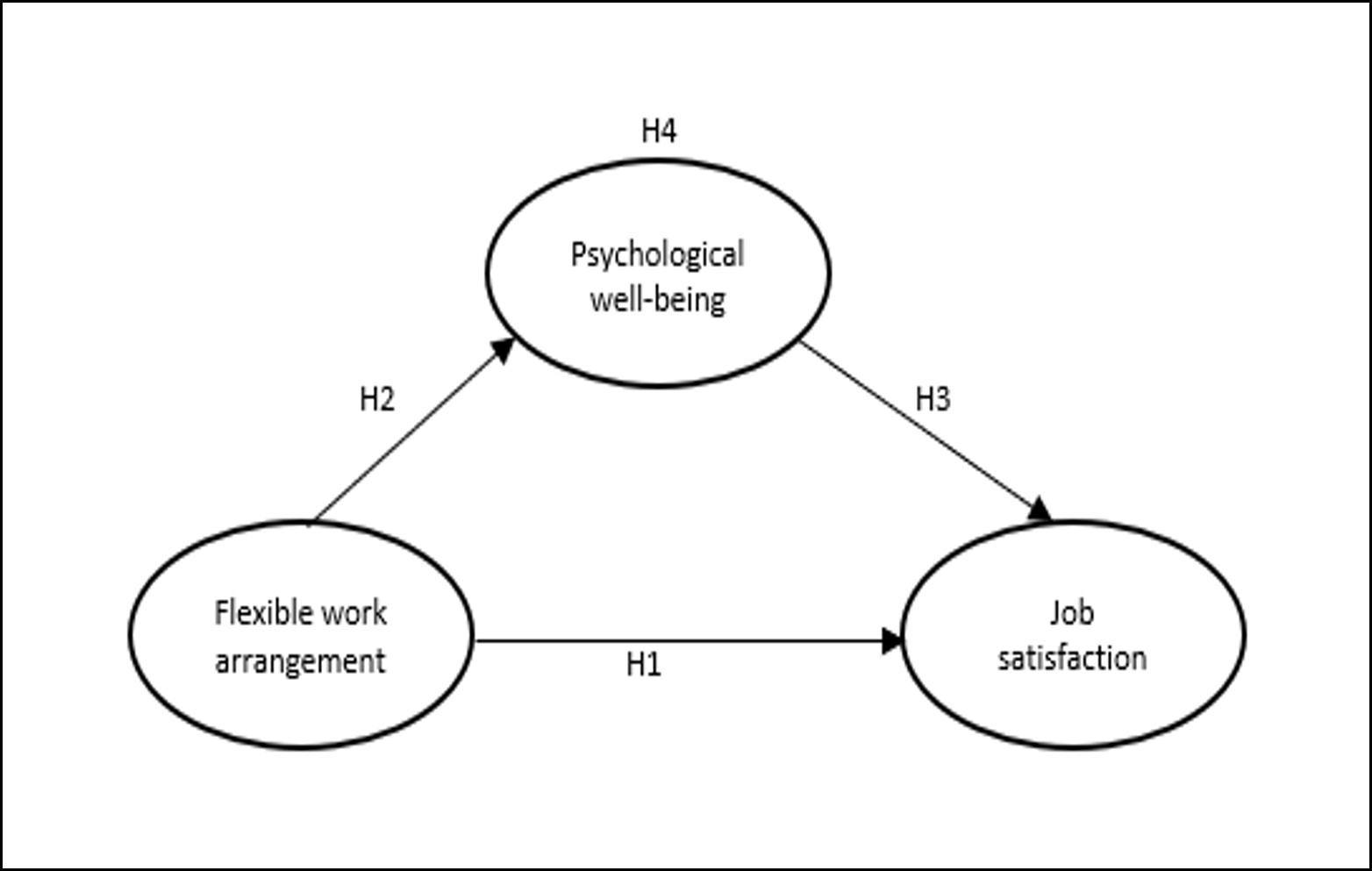
The increasing demands of professional roles and the difficulty of achieving work-life balance pose significant challenges to banking employees. These circumstances highlight the urgent need for flexible work arrangements in the banking sector. The Social Exchange Theory explains social interactions and relationships through the lens of cost-benefit exchanges. As such, this study investigates the role of flexible work arrangements in enhancing job satisfaction among banking employees, with psychological well-being serving as a linking mechanism. A total of 385 complete and usable datasets were collected in the banking institutions in Selangor and W.P. Kuala Lumpur, Malaysia. Partial Least Squares Structural Equation Modelling and bootstrapping were used to test the structural hypothesis. The results indicated that flexible work arrangements have a positive influence on psychological well-being and job satisfaction. Similarly, psychological well-being has a positive influence on job satisfaction and serves as a mediator of the relationship between flexible work arrangements and job satisfaction. The study enhances the existing literature by emphasising psychological well-being as a vital consideration for policymakers, particularly in the service industry, including banking institutions. Psychological well-being can lead to more satisfied and productive employees, thereby contributing to a healthier organisational culture.
Article Details

This work is licensed under a Creative Commons Attribution-NonCommercial-NoDerivatives 4.0 International License.
References
Ahdianita, F., & Setyaningrum, R. (2024). The effect of work flexibility, work-life balance, and job satisfaction of millennial employees. Action Research Literate, 8(2), 249–261. https://doi.org/10.46799/arl.v8i2.237
Aziz-Ur-Rehman, M., & Siddiqui, D. (2019). Relationship between flexible working arrangements and job satisfaction mediated by work-life balance: Evidence from public sector universities employees of Pakistan. Available at SSRN. https://ssrn.com/abstract=3510918
Beckel, J. L. O., & Fisher, G. G. (2022). Telework and worker health and well-being: A review and recommendations for research and practice. International Journal of Environmental Research and Public Health, 19(7), Article 3879. https://doi.org/10.3390/ijerph19073879
Blau, P. M. (1964). Exchange and power in social life. John Wiley & Sons.
Chong, Y., Frey, E., Chien, W., Cheng, H., & Gloster, A. (2023). The role of psychological flexibility in the relationships between burnout, job satisfaction, and mental health among nurses in combatting COVID-19: A two-region survey. Journal of Nursing Scholarship. https://doi.org/10.1111/jnu.12874
Chin, W. W. (2010). How to write up and report PLS analyses. In V. Esposito Vinzi, W. W. Chin, J. Henseler, & H. Wang (Eds.), Handbook of partial least squares: Concepts, methods and applications (pp. 655–690). Springer. https://doi.org/10.1007/978-3-540-32827-8_29
Dhanabhakyam, M., & Sarath, K. (2023). A study on psychological well-being and its impact on job satisfaction among IT employees in India. Journal of Positive Psychology and Wellbeing, 7(2), 456–466.
Diener, E., Wirtz, D., Biswas-Diener, R., Tov, W., Kim-Prieto, C., Choi, D., & Oishi, S. (2009). New measures of well-being. In E. Diener (Ed.), Assessing well-being: The collected works of Ed Diener (pp. 247–266). Springer. https://doi.org/10.1007/978-90-481-2354-4_12
Fauzi, M. A. (2022). Partial least square structural equation modelling (PLS-SEM) in knowledge management studies: Knowledge sharing in virtual communities. Knowledge Management & E-Learning, 14(1), 103–124. https://doi.org/10.34105/j.kmel.2022.14.007
Fornell, C., & Larcker, D. F. (1981). Evaluating structural equation models with unobservable variables and measurement error. Journal of Marketing Research, 18(1), 39–50.
George, J., & Poluru, N. (2024). Exploring the impact of flexible work arrangements on turnover intention: The mediating role of job satisfaction and the moderating effect of perceived supervisory support. Journal of Accounting, Business and Management (JABM), 32(1), 100–123. https://doi.org/10.31966/jabminternational.v32i1.1467
Gefen, D., Straub, D., & Boudreau, M. C. (2000). Structural equation modeling and regression: Guidelines for research practice. Communications of the Association for Information Systems, 4(1), Article 7.
Han, W. (2022). Chinese English as a foreign language teachers' job satisfaction, resilience, and their psychological well-being. Frontiers in Psychology, 12, Article 800417. https://doi.org/10.3389/fpsyg.2021.800417
Henke, R. M., Benevent, R., Schulte, P., Rinehart, C., & Coberley, C. R. (2016). The relationship between flexible work arrangements and employee health behaviors and well-being. Journal of Occupational and Environmental Medicine, 58(5), 503–509.
Henseler, J., Ringle, C. M., & Sarstedt, M. (2015). A new criterion for assessing discriminant validity in variance-based structural equation modeling. Journal of the Academy of Marketing Science, 43, 115–135.
Homans, G. C. (1958). Social behavior as exchange. American Journal of Sociology, 63(6), 597–606.
Hair, J. F., Ringle, C. M., & Sarstedt, M. (2011). PLS-SEM: Indeed a silver bullet. Journal of Marketing Theory and Practice, 19(2), 139–152.
Hair, J. F., Matthews, L. M., Matthews, R. L., & Sarstedt, M. (2017). PLS-SEM or CB-SEM: Updated guidelines on which method to use. International Journal of Multivariate Data Analysis, 1(2), 107–123.
Indradewa, R., & Prasetio, A. (2023). The influence of flexible working arrangements and work-life balance on job satisfaction: A double-layered moderated mediation model. Jurnal Ekonomi dan Bisnis, 26(2), 449–476. https://doi.org/10.24914/jeb.v26i2.9551
Jose, G., & Mampilly, S. (2015). Relationships among perceived supervisor support, psychological empowerment and employee engagement in Indian workplaces. Journal of Workplace Behavioral Health, 30(3), 231–250. https://doi.org/10.1080/15555240.2015.1047498
Jacob, G., & Kiranbabu, N. C. (2021). Psychological well-being and job satisfaction among teachers. International Journal of Indian Psychology, 9(4), 159–165.
Kesawa, A. H., Fatmawati, I. K., Puspitasari, D. P., Prastyo, B., & Fazlurrahman, H. (2019). The effect of psychological well-being and psychological empowerment on job satisfaction in Institution X. International Journal of Advances in Management and Economics, 8(6), 11–15.
Kitsios, F., Kamariotou, M., & Kamiri, N. (2021). Digital transformation and strategy in the banking sector: Evaluating the impact on job satisfaction. Journal of Business Research, 124, 557–567.
Krejcie, R. V., & Morgan, D. W. (1970). Determining sample size for research activities. Educational and Psychological Measurement, 30, 607–610.
Legesse Bekele, A., & Mohammed, A. (2020). Effects of flexible working arrangement on job satisfaction. Business, Management and Economics Research, 6(10), 135–145.
Lin, Q., Beh, L., & Kamil, N. (2024). Perceived organizational justice and support facilitate employee innovation: A moderated mediation model of work engagement and empowerment. Social Behavior and Personality: An International Journal, 52(3), 1–14. https://doi.org/10.2224/sbp.12961
Meira, J., & Hancer, M. (2021). Using social exchange theory to explore the employee-organization relationship in the hospitality industry. International Journal of Contemporary Hospitality Management, 33(2), 670–692. https://doi.org/10.1108/IJCHM-06-2020-0538
Mandal, S., & Goswami, M. (2022). Psychological well-being, motivation and job performance: A study among service sector employees. Indian Journal of Positive Psychology, 13(1), 31–37.
Mwaniki, D. (2022). Flexible working arrangements and employee psychological well-being in the Kenyan financial sector. International Journal of Social Sciences and Management Research, 8(1), 22–32.
Nair, S. (2021). The service sector and employment trends in Malaysia: A decade of transformation. Malaysian Journal of Economic Studies, 58(1), 45–61.
Nurhidayah, A. H., & Nurjanah, S. (2022). The relationship between flexible working arrangement and job satisfaction mediated by work-life balance in PT. Tiara Impresa Gugus Artha. Jurnal Pendidikan Ekonomi, Perkantoran, dan Akuntansi, 3(1), 3–15. https://doi.org/10.21009/jpepa.0301.01
Nikmah, U., & Martdianty, F. (2021). Job insecurity, work engagement and job performance of employees in flexible working arrangement: Exploring the mediating role of psychological well-being. Proceedings of the Sixth Padang International Conference on Economics Education, Economics, Business and Management, Accounting and Entrepreneurship (PICEEBA 2020) (pp. 458–463). Atlantis Press. https://doi.org/10.2991/aebmr.k.210616.071
Omoregbe, O., Yusuf, A., & Abdulwahab, L. (2022). Work stress and performance in the banking industry: Evidence from Malaysia. Asian Journal of Business and Accounting, 15(2), 175–193.
Putri, S., Suherman, E., & Anggela, F. (2025). Pengaruh flexible working arrangement, work life balance, terhadap job satisfaction yang dimediasi oleh work engagement pada karyawan milenial PT Nagahama Mesin Balancing. Al-Kharaj: Jurnal Ekonomi, Keuangan & Bisnis Syariah, 7(1), 666–681. https://doi.org/10.47467/alkharaj.v7i1.5374
Rajaram, H., & Jha, A. (2024). The impact of flexible work arrangements on job satisfaction. International Journal for Research in Applied Science and Engineering Technology, 12(III), 1996–2000. https://doi.org/10.22214/ijraset.2024.59265
Ringle, C. M., da Silva, D., & Bido, D. S. (2015). Structural equation modeling with SmartPLS. Brazilian Journal of Marketing, 13(2), 56–73.
Spector, P. E. (1997). Job satisfaction: Application, assessment, causes, and consequences (Vol. 3). Sage Publications.
The Association of Banks in Malaysia. (2024). Commercial banks and branches distribution by state as at 30 June 2024. https://www.abm.org.my/resources/commercial-banks-branch-tally/
Vershinina, T. S., Kocheva, O. L., Shkurin, D. V., & Maltsev, A. V. (2024). Job satisfaction as a condition for teachers' psychological well-being: An empirical study. Science for Education Today, 14(4), 27–50. https://doi.org/10.15293/2658-6762.2404.02
Yang, Y., Obrenovic, B., Kamotho, D., Godinic, D., & Ostic, D. (2024). Enhancing job performance: The critical roles of well-being, satisfaction, and trust in supervisor. Behavioral Sciences, 14, Article 688. https://doi.org/10.3390/bs14080688