
The impacts of customer participation and innovation capabilities on new product performance
Article Sidebar
Main Article Content
Abstract
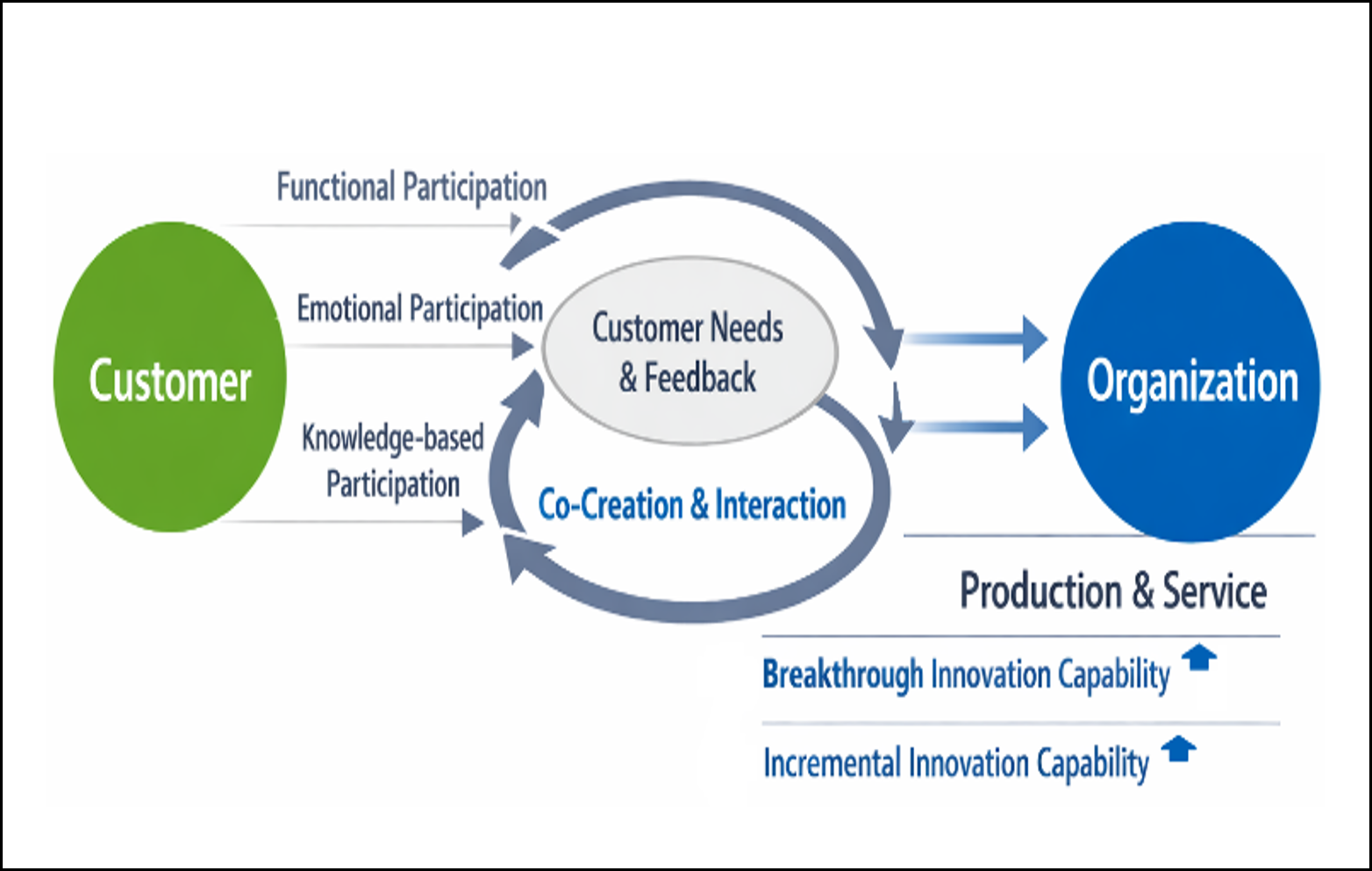
This study investigates how distinct forms of customer participation, i.e.: functional, emotional, and knowledge-based, affect incremental and breakthrough innovation capabilities, and ultimately new product performance. Grounded in the customer-driven innovation model and dynamic capabilities theory, the research adopts a quantitative approach using survey data from Malaysian firms engaged in new product development. The results reveal that functional and emotional customer participation significantly enhance both types of innovation capabilities, whereas knowledge-based participation shows no direct influence. Moreover, neither incremental nor breakthrough innovation capabilities exhibit a direct effect on product performance, highlighting the critical role of effective commercialization strategies in transforming innovation into tangible results. These findings advance theoretical understanding by unpacking the differentiated effects of customer engagement on innovation outcomes and offer actionable insights for firms seeking to optimize customer co-creation and innovation pathways.
Article Details

This work is licensed under a Creative Commons Attribution-NonCommercial-NoDerivatives 4.0 International License.
References
Acar, Y. (2024). Turkish adaptation, validation and reliability of the U.S. Adult Food Security Survey Module in university students. Public Health Nutrition, 27(1), e45. https://doi.org/10.1017/S1368980024000223
Adomako, S., & Tran, M. D. (2024). Scaling up sustainable innovation: Stakeholder ties, eco-product innovation, and new product performance. Sustainable Development, 32(1), 624–634.
Agarwal, P. (2023). Role of consumption emotions on customer satisfaction: An empirical study. Psychology and Education, 55, 693–700.
Al-Khatib, A. W., & Al-Ghanem, E. M. (2022). Radical innovation, incremental innovation, and competitive advantage: The moderating role of technological intensity—Evidence from the manufacturing sector in Jordan. European Business Review, 34(3), 344–369.
Ankrah, S. T., He, Z., Arku, J. K., & Asare-Kyire, L. (2024). Enhancing customer perception of co-production knowledge sharing: Navigating scepticism and leveraging prosociality to unlock active feedback behaviour in co-creation. Journal of Knowledge Management, 29(2), 442–479. https://doi.org/10.1108/JKM-01-2024-0076
Anning-Dorson, T. (2026). Customer collaboration and firm outcomes in hospitality: A contingency perspective on knowledge integration and contextual factors. International Journal of Hospitality Management, 133, Article 104527. https://doi.org/10.1016/j.ijhm.2025.104527
Arrozak, J. (2024). The effect of work environment, OHS, and job satisfaction on employee performance: A case study of a private defense company in Indonesia. International Journal of Innovation in Enterprise System, 5(1), 78–89. https://doi.org/10.25124/ijies.v5i01.113
Audretsch, D. B., Belitski, M., & Chowdhury, F. (2024). Knowledge investment and search for innovation: Evidence from UK firms. The Journal of Technology Transfer, 49(4), 1387–1410. https://doi.org/10.1007/s10961-023-10045-7
Azhar, K., Wel, C., & Hamid, S. (2024). Examining loyalty of social media influencers: The effects of self-disclosure and credibility. Pakistan Journal of Commerce and Social Sciences, 18(2), 358–379. https://doi.org/10.64534/commer.2024.044
Bag, S., Routray, S., Shrivastav, S. K., Roubaud, D., Benabdellah, A. C., & Grebinevych, O. (2025). Utilizing artificial intelligence for stakeholder engagement and social innovation in addressing climate change. Journal of Global Information Management, 32(1), 1–31. https://doi.org/10.4018/JGIM.366588
Bari, N., Chimhundu, R., & Chan, K. C. (2024). Interrelation between sustainable dynamic capabilities, corporate sustainability, and sustained competitive advantage. Sustainability, 16(7), Article 2864. https://doi.org/10.3390/su16072864
Bazelais, P., Lemay, D. J., & Doleck, T. (2024). User acceptance and adoption dynamics of ChatGPT in educational settings. Eurasia Journal of Mathematics, Science and Technology Education, 20(2), Article em2393. https://doi.org/10.29333/ejmste/14151
Binsaeed, R. H., Yousaf, Z., Grigorescu, A., Chitescu, R. I., Nassani, A. A., & Samoila, A (2023). Customer engagement and customer relationship management capabilities’ effects on innovation performance and customer distrust’s moderating role. Sustainability, 15(12), Article 9475. https://doi.org/10.3390/su15129475
Blank, T. H. (2024). Developing incremental innovation in the high-tech industry: The effect of age and tenure in research and development teams. Cross Cultural & Strategic Management, 31(2), 289–308. https://doi.org/10.1108/CCSM-04-2023-0054
Chen, J., & Liu, L. (2019). Customer participation and green product innovation in SMEs: The mediating role of opportunity recognition and exploitation. Journal of Business Research, 119, 151–162. https://doi.org/10.1016/j.jbusres.2019.05.033
Cheng, W., & Song, W. (2024). The impact of heterogeneity in executive teams on breakthrough innovation: Mediated by organizational resilience. Frontiers in Artificial Intelligence and Applications. https://doi.org/10.3233/FAIA240266
Cohen, J. (1988). Statistical power analysis for the behavioral sciences (2nd ed.). Lawrence Erlbaum Associates.
Dawes, J. (2008). Do data characteristics change according to the number of scale points used? An experiment using 5-point, 7-point and 10-point scales. International Journal of Market Research, 50(1), 61–104. https://doi.org/10.1177/147078530805000106
Dean, T., Zhang, H., & Xiao, Y. (2024). Customer involvement in co-development: Problem-solving and decision-making in new product development. European Journal of Marketing, 58(6), 1520–1542. https://doi.org/10.1108/EJM-12-2022-0917
Desouza, K. C., Awazu, Y., Jha, S., Dombrowski, C., Papagari, S., Baloh, P., & Kim, J. Y. (2008). Customer-driven innovation. Research-Technology Management, 51(3), 35–44. https://doi.org/10.1080/08956308.2008.1165750
Fan, Z., Li, Y., Wu, Y., Peng, T., Peng, Z., & Xue, J. (2023). Idiosyncratic deals and breakthrough innovation: Based on the paradox theory perspective. Research Square. https://doi.org/10.21203/rs.3.rs-3393825/v1
Fasanmi, O. O., Comfort, A. B., & Oyedele, O. M. (2025). Exploring the role of innovation on economic performance of manufacturing firms in Nigeria. Journal of Economics, Finance and Management Studies, 8(1), 694–706. https://doi.org/10.47191/jefms/v8-i1-67
Feng, W., & Liu, R. (2024). The role of innovation capabilities upgradation and digitalization in value co-creation and PSS innovation performance. Industrial Marketing Management, 123, 330–344. https://doi.org/10.1016/j.indmarman.2024.11.003
Gan, Y., Ji, Y., Jiang, S., Liu, X., Feng, Z., Li, Y., & Liu, Y. (2021). Integrating aesthetic and emotional preferences in social robot design: An affective design approach with Kansei engineering and deep convolutional generative adversarial networks. International Journal of Industrial Ergonomics, 83, Article 103128. https://doi.org/10.1016/j.ergon.2021.103128
Gui, L., Lei, H., & Le, P. B. (2022). Determinants of radical and incremental innovation: The influence of transformational leadership, knowledge sharing and knowledge-centered culture. European Journal of Innovation Management, 25(5), 1221–1241.
Harrington, M. (2025). Why and how to investigate biological materials processing: A cross-disciplinary approach for inspiring sustainable materials fabrication. Accounts of Materials Research, 6(3), 294–305. https://doi.org/10.1021/accountsmr.4c00334
Hassan, R., Nasr, M., Abdelrahman, H. H., & Hassan, M. G. (2024). Sharing endodontic research on social media platforms: Is it effective? A 10-year timeline analysis. Australian Endodontic Journal. https://doi.org/10.1111/aej.12887
Hazell, E., Goldman, I., Rabie, B., Norins, J., Chirau, T., & Gupta, T. (2024). Using co-creation to address monitoring and evaluation challenges: The experience of South Africa’s evaluation hackathon. Evaluation, 30(1), 82–99. https://doi.org/10.1177/13563890231223174
Jones, L., Barnett, A., & Vagenas, D. (2025). Linear regression reporting practices for health researchers: A cross-sectional meta-research study. PLOS ONE, 20(3), e0305150. https://doi.org/10.1371/journal.pone.0305150
Khan, O., & Hinterhuber, A. (2024). Antecedents and consequences of procurement managers’ willingness to pay for sustainability: A multi-level perspective. International Journal of Operations & Production Management, 44(13), 1–33. https://doi.org/10.1108/IJOPM-02-2023-0135
Kubitskyi, S., Yeremenko, D., Danylenko, V., Bataiev, S., & Varaksina, E. (2024). Evaluating the impact of innovative technologies on global competitiveness through modelling. Multidisciplinary Science Journal, 6, Article 2024ss0710. https://doi.org/10.31893/multiscience.2024ss0710
Kurniawan, R. B., V. N., A. T. A., & Syamil, A. (2024). The relationship between knowledge management, dynamic capability and project success in Indonesian construction industry. International Journal for Multidisciplinary Research, 6(4). https://doi.org/10.36948/ijfmr.2024.v06i04.23858
Lemire, M., Soulieres, I., & Saint-Amour, D. (2024). The effect of age on executive functions in adults is not sex specific. Journal of the International Neuropsychological Society, 30(5), 489–498. https://doi.org/10.1017/S1355617723011487
Li, W. (2024). Examining the reliability and validity of measuring scales related to informatization instructional leadership using PLS-SEM approach. Dinamika Jurnal Ilmiah Pendidikan Dasar, 16(1), Article 12. https://doi.org/10.30595/dinamika.v16i1.19768
Liu, S., Wang, S., & Tung, H. C. (2024). A comprehensive decision-making approach for strategic product module planning in mass customization. Mathematics, 12(11), Article 1745. https://doi.org/10.3390/math12111745
Ma, D., & Wu, W. (2024). Experience as a double-edged sword: CEO experience and power on breakthrough innovation. Management Decision, 63(1), 338–367. https://doi.org/10.1108/MD-12-2023-2268
Maier, L., & Baccarella, C. V. (2024). The psychological and behavioral consequences of customer empowerment in new product development: Situational framework, review, and research agenda. Journal of Product Innovation Management, 42(1), 220–252. https://doi.org/10.1111/jpim.1273
Mayr, S., Duller, C., & Baschinger, M. (2024). Achieving sustainable reorganization after bankruptcy: Empirical evidence from formal proceedings of Austrian SMEs. International Journal of Strategic Management, 24(1), 67–90. https://doi.org/10.18374/ijsm-24-1.4
Mboungou, M. (2024). Evaluating customer emotions in coffee shop reviews using machine learning. International Journal of Science and Research Archive, 12(2), 820–827. https://doi.org/10.30574/ijsra.2024.12.1.0895
Mihailovic, J. (2024). Collaborative servitization in service-oriented company: The case study of a telco company. PLOS ONE, 19(5), e0302943. https://doi.org/10.1371/journal.pone.0302943
Monazah, H. (2024). Investigating the factor structure and validation of the multidimensional scale of acceptance of collective violence among teenagers: An exploratory and confirmatory factor analysis. Iranian Journal of Psychiatry and Behavioral Sciences, 18(2). https://doi.org/10.5812/ijpbs-13799
Mota, R. d. O., Filho, M. G., Ganga, G. M. D., Silva, J. M. N. d., & Mendes, G. H. d. S. (2024). Assessing the drivers and capabilities for faster product launch: A scale for time-to-market reduction in start-ups. R&D Management, 55(1), 127–164. https://doi.org/10.1111/radm.12688
Nguyen, D. D., Hien, N., & Hao, D. Q. (2024). New product development in the fast fashion industry: A case study in Vietnam. International Journal of Services and Operations Management, 48(1), 136–154. https://doi.org/10.1504/IJSOM.2024.10064078
Nugroho, D. (2025). New product development with a customer-centric approach to meet dynamic market needs. Eduvest – Journal of Universal Studies, 5(2), 1545–1557. https://doi.org/10.59188/eduvest.v5i2.1712
Parwati, I. A., & Martini, I. A. O. (2024). Exploration of co-creation strategy: On the “collaboration for innovation” program in the digital era. Jurnal Ilmu Sosial Mamangan, 13(1), 135–145. https://doi.org/10.22202/mamangan.v13i1.806
Phi, H. D., Hai, V. P. T., Duy, T. N., & Van, V. N. (2024). The impact of digital transformation on the competitive advantage of businesses: Case study of logistics service providers in Ho Chi Minh City, Vietnam. International Journal of Management and Economics Invention, 10(7). https://doi.org/10.47191/ijmei/v10i7.07
Podsakoff, P. M., MacKenzie, S. B., Lee, J., & Podsakoff, N. P. (2003). Common method biases in behavioral research: A critical review of the literature and recommended remedies. Journal of Applied Psychology, 88(5), 879–903. https://doi.org/10.1037/0021-9010.88.5.879
Prayogo, R. A., & Ariadi, G. (2024). Influence of service quality on purchase decision with customer satisfaction and hedonistic view as mediating variables. KnE Social Sciences. https://doi.org/10.18502/kss.v9i14.16133
Rai, S. K., Singh, J. P., Kumar, K., & Alhamzi, K. H. M. (2024). An empirical exploration of e-agriculture system acceptance, satisfaction, and usage. International Journal of Electronic Government Research, 20(1), 1–26. https://doi.org/10.4018/IJEGR.344814
Rashid, M. S. M., Alli, H., Rahman, A. R. A., & Kamarudin, K. M. (2024). User involvement in new product development process to determine product success characteristics. Advance. https://doi.org/10.22541/au.171550294.41530599/v1
Ren, X. (2023). Refinement system, market competitiveness and innovation capability: Inputs to small medium enterprises’ high-quality development framework. International Journal of Research Studies in Management, 11(13), 49–66. https://doi.org/10.5861/ijrsm.2023.1163
Ribeiro, P., Ramos, R. F., & Moro, S. (2024). Restaurant containment measures and perceived service quality: Implications for future pandemics. Consumer Behavior in Tourism and Hospitality, 19(1), 116–130. https://doi.org/10.1108/CBTH-06-2023-0081
Sari, D. N., Susilowati, C., & Moko, W. (2024). Leveraging dynamic capabilities to drive innovation and enhance business performance. International Journal of Research in Business and Social Science, 13(5), 85–95. https://doi.org/10.20525/ijrbs.v13i5.3584
Seliniotaki, A. K., Bougioukas, K. I., Lithoxopoulou, M., Moutzouri, S., Diamanti, E., Ziakas, N., & Mataftsi, A. (2024). Mydriasis for retinopathy of prematurity screening in Europe: A cross-sectional online survey. European Journal of Ophthalmology, 34(6), 1803–1809. https://doi.org/10.1177/11206721241234952
Sondari, T., Sari, N. Z. M., & Nuraliati, A. (2025). Service-dominant logic in the hotel industry: Pathway to brand awareness and loyalty. Asian Management and Business Review, 231–245. https://doi.org/10.20885/ambr.vol5.iss1.art1
Teece, D. J. (2018). Dynamic capabilities as (workable) management systems theory. Journal of Management & Organization, 24(3), 359–368. https://doi.org/10.1017/jmo.2017.75
Tjahjadi, B., Soewarno, N., Hariyati, H., Nafidah, L. N., Kustiningsih, N., & Nadyaningrum, V. (2020). The role of green innovation between green market orientation and business performance: Its implication for open innovation. Journal of Open Innovation: Technology, Market, and Complexity, 6(4), Article 173.
Veerappan, N. N., & Pradeesh, N. P. (2023). Role of interpersonal trust on the relationship between employee innovative behaviour and customer participation: Evidence from the hospitality industry in Sri Lanka. Asian Journal of Marketing Management, 2(1), 41–64. https://doi.org/10.31357/ajmm.v2i01.6251
Wang, L., Qiao, T., Wang, X., Chen, W., & Ye, P. (2025). The impact of work–family conflict on early childhood teachers’ occupational well-being: The chain mediating role of psychological empowerment and job crafting. Frontiers in Public Health, 12. https://doi.org/10.3389/fpubh.2024.1513514
Woodward, E. (2023). Increasing consumer engagement: Tools to engage service users in quality improvement or implementation efforts. Frontiers in Health Services, 3. https://doi.org/10.3389/frhs.2023.1124290
Yan, J., Rahman, A. A., Tong, T., Kamarulzaman, N. H., & Sidek, S. (2025). A study of Chinese enterprises’ business models to determine the impact of dynamic capabilities on innovation and performance. PLOS ONE, 20(1), e0310854. https://doi.org/10.1371/journal.pone.0310854
Yuk, H., Hwang, E., Garrett, T. C., & Lee, J. (2025). The paradox of customer participation: The role of perceived risk in technology-based innovation. International Journal of Consumer Studies, 49(3). https://doi.org/10.1111/ijcs.70062
Yusof, M. M., & Rahim, N. Z. A. (2024). Innovating together: Unveiling open innovation, co-creation, and social media in Malaysian telecommunications. International Journal of Academic Research in Business and Social Sciences, 14(1), 1531–1542. https://doi.org/10.6007/ijarbss/v14-i1/20577
Yustian, O. (2025). Digital transformation, change management, and organizational resilience in the culinary sector in West Java. IOP Conference Series: Earth and Environmental Science, 1460(1), Article 012008. https://doi.org/10.1088/1755-1315/1460/1/012008
Zaefarian, G., Katsikeas, C. S., Najafi-Tavani, Z., & Robson, M. J. (2024). Unpacking when and how customer involvement as co-developer affects supplier new product performance. Journal of the Academy of Marketing Science, 53(3), 876–906. https://doi.org/10.1007/s11747-024-01066-1
Zahari, A. S. M., Mahmood, R., & Baniamin, R. M. R. (2023). The effect of customer knowledge management on organizational performance. International Journal of Academic Research in Business and Social Sciences, 13(4), 183–195. https://doi.org/10.6007/ijarbss/v13-i4/16515
Zhang, J., Wang, D. T., Tse, C. H., & Tse, S. Y. (2023). Enhancing subsidiary innovation capability through customer involvement in new product development: A contingent knowledge source perspective. Journal of Product Innovation Management, 41(1), 86–111. https://doi.org/10.1111/jpim.12700
Zhou, C., Jiang, L., & Kaner, J. (2023a). Study on imagery modeling of electric recliner chair: Based on combined GRA and Kansei engineering. Applied Sciences, 13(24), Article 13345. https://doi.org/10.3390/app132413345
Zhou, J., Qian, C., & Li, C. (2023b). Political connection heterogeneity and firm innovation: An investigation of privately controlled, publicly listed firms in China. Journal of Product Innovation Management, 41(5), 972–998. https://doi.org/10.1111/jpim.1271