
Teacher’s emotional intelligence as a catalyst for stronger student-teacher relationship: a systematic literature review
Article Sidebar
Main Article Content
Abstract
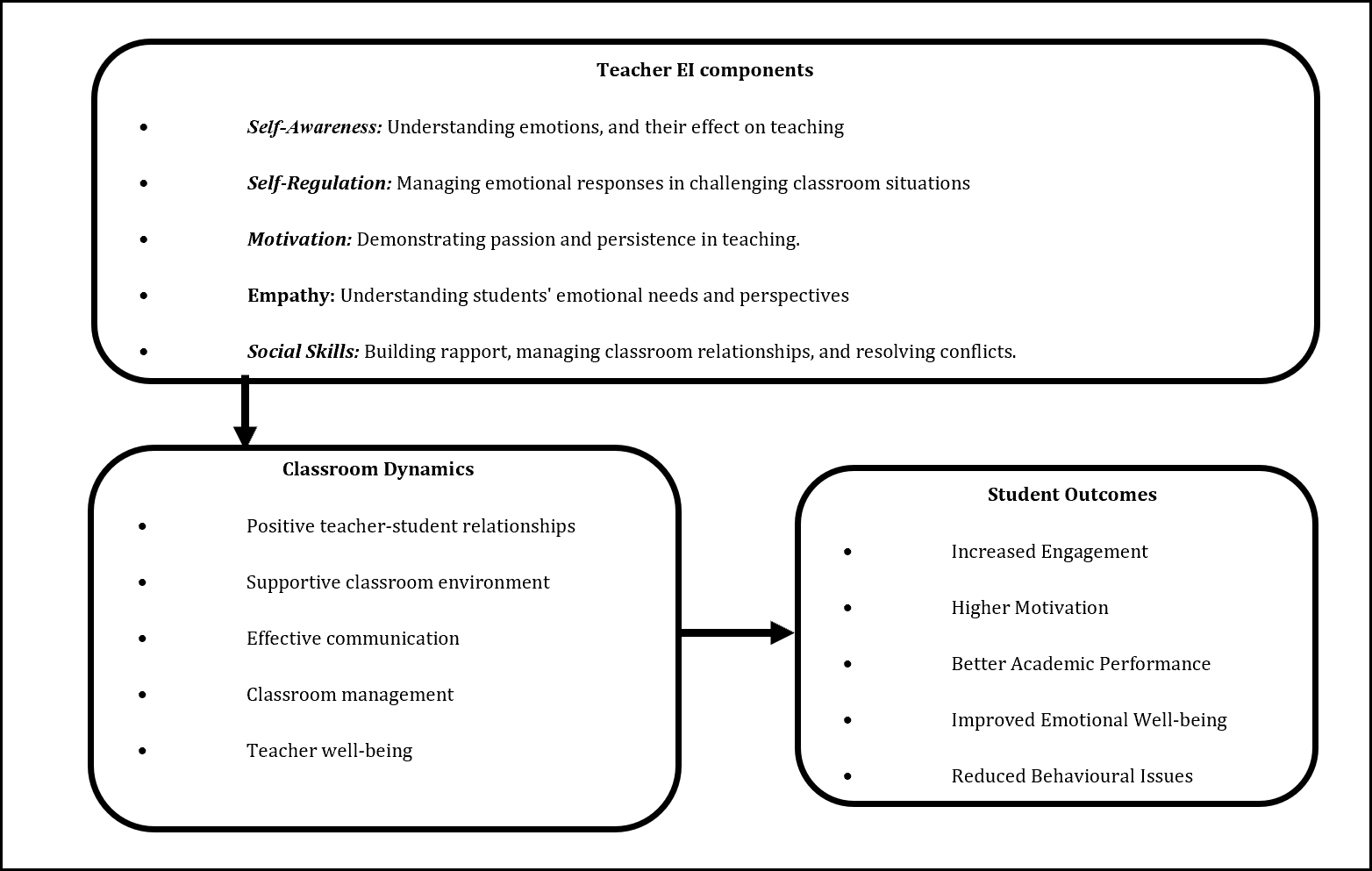
Emotional intelligence (EI) is a key factor influencing teacher effectiveness in fostering positive student-teacher bonds. The objective of this systematic literature review was to examine the influence of teacher EI on student-teacher relationship and highlight gaps in the existing literature. To make sure a thorough review process, Preferred Reporting Items for Systematic Reviews and Meta-Analyses guidelines were followed. Articles published between 2021 and 2025 were retrieved from ERIC, ScienceDirect, and JSTOR, resulting in a total of 11 articles reviewed in this paper. The journals were reviewed following an inclusion and exclusion criteria. The findings reveal that key teacher EI indeed play a crucial role in building trust, improving student motivation, and managing classroom dynamics effectively. Teachers with high EI foster a positive learning environment, enhance student participation, and reduce behavioral issues. The review identifies gaps in the literature, including a lack of longitudinal studies, limited research in diverse cultural contexts, and insufficient focus on intervention-based approaches to develop EI in teachers. The study's implications emphasize the need for teacher training programs to integrate EI development to enhance student-teacher relationship. Future research should explore cross-cultural comparisons and intervention strategies to further understand the long-term impact of teacher EI on education.
Article Details

This work is licensed under a Creative Commons Attribution-NonCommercial-NoDerivatives 4.0 International License.
References
Alam, A., & Ahmad, M. (2018). The role of teachers’ emotional intelligence in enhancing student achievement. Journal of Asia Business Studies, 12(1), 31–43. https://doi.org/10.1108/JABS-08-2015-0134
Alqassab, M., & Leon, J. (2024). Motivational messages from teachers before exams: Links to intrinsic motivation, engagement, and academic performance. Teaching and Teacher Education, 151, 104750. https://doi.org/10.1016/j.tate.2024.104750
Arias-Pastor, M., Van Vaerenbergh, S., Fernandez-Solana, J., & Gonzalez-Bernal, J. J. (2023). Secondary education teacher training and emotional intelligence: Ingredients for attention to diversity in an inclusive school for all. Education Sciences, 13(5), 519. https://doi.org/10.3390/educsci13050519
Belay, S., & Dejene, W. (2024). Testing and validating the collaborative for academic, social, and emotional learning (CASEL) model in the context of Ethiopian secondary schools: Factorial analysis. Social Sciences & Humanities Open, 10, 101128. https://doi.org/10.1016/j.ssaho.2024.101128
Berastegui-Martinez, J., Caba-Collado, M. A. de la, & Perez-Escoda, N. (2023). The impact of the Sentituz programmes on emotional competence and social climate in the classroom. International Journal of Emotional Education, 15(2), 169–174.
Bjereld, Y., Thornberg, R., & Hong, J. S. (2024). Why don’t all victims tell teachers about being bullied? A mixed-methods study on how direct and indirect bullying and student–teacher relationship quality are linked with bullying disclosure. Teaching and Teacher Education, 148, 104664. https://doi.org/10.1016/j.tate.2024.104664
Brackett, M. A., Rivers, S. E., & Salovey, P. (2011). Emotional intelligence: Implications for personal, social, academic, and workplace success. Social and Personality Psychology Compass, 5(1), 88–103. https://doi.org/10.1111/j.1751-9004.2010.00334.x
Braun, S. S., & Hooper, A. L. (2024). Social and emotional competencies predict pre-service teachers’ occupational health and personal well-being. Teaching and Teacher Education, 147, 104654. https://doi.org/10.1016/j.tate.2024.104654
Caires, S., Alves, R., Martins, A., Magalhaes, P., & Valente, S. (2023). Promoting socio-emotional skills in initial teacher training: An emotional educational programme. International Journal of Emotional Education, 15(1), 21–33.
Chaidi, I., & Drigas, A. (2022). Theories—Models of emotional intelligence. Scientific Electronic Archives, 15(12). https://doi.org/10.36560/151220221638
Chamizo-Nieto, M. T., Arrivillaga, C., Rey, L., & Extremera, N. (2021). The role of emotional intelligence, the teacher–student relationship, and flourishing on academic performance in adolescents: A moderated mediation study. Frontiers in Psychology, 12, 695067. https://doi.org/10.3389/fpsyg.2021.695067
Cherniss, C., & Goleman, D. (Eds.). (2001). The emotionally intelligent workplace: How to select for, measure, and improve emotional intelligence in individuals, groups, and organizations. Jossey-Bass.
Chukwudi, A. R.-A. (2014). Emotional intelligence and teacher efficacy as predictors of teacher effectiveness among pre-service teachers in some Nigerian universities. International Journal of Evaluation and Research in Education, 3(2), 85–90. https://doi.org/10.11591/ijere.v3i2.3858
Coronado-Maldonado, I., & Benitez-Marquez, M.D. (2023). Emotional intelligence, leadership, and work teams: A hybrid literature review. Heliyon, 9(10), e20356. https://doi.org/10.1016/j.heliyon.2023.e20356
Cristovao, A. M., Valente, S., Rebelo, H., & Ruivo, A. F. (2023). Emotional education for sustainable development: A curriculum analysis of teacher training in Portugal and Spain. Frontiers in Education, 8, 1165319. https://doi.org/10.3389/feduc.2023.1165319
Davis, H. A. (2003). Conceptualizing the role and influence of student–teacher relationships on children’s social and cognitive development. Educational Psychologist, 38(4), 207–234. https://doi.org/10.1207/S15326985EP3804_2
Drigas, A., Papoutsi, C., & Skianis, C. (2023). Being an emotionally intelligent leader through the nine-layer model of emotional intelligence: The supporting role of new technologies. Sustainability, 15(10), 8103. https://doi.org/10.3390/su15108103
Durham, M. R. P., Smith, R., Cloonan, S., Hildebrand, L. L., Woods-Lubert, R., Skalamera, J., Berryhill, S. M., Weihs, K. L., Lane, R. D., Allen, J. J. B., Dailey, N. S., Alkozei, A., Vanuk, J. R., & Killgore, W. D. S. (2023). Development and validation of an online emotional intelligence training program. Frontiers in Psychology, 14, 1221817. https://doi.org/10.3389/fpsyg.2023.1221817
Falcon, S., Alonso, J. B., & Leon, J. (2023). Teachers’ engaging messages, students’ motivation to learn and academic performance: The moderating role of emotional intensity in speech. Teaching and Teacher Education, 136, 104375. https://doi.org/10.1016/j.tate.2023.104375
Gkintoni, E., Farmakopoulou, I., & Theodoratou, M. (2023). Neuromusic education in cognition and quality-of-life promotion: An outline. Technium Social Sciences Journal, 40, Article 8347. https://doi.org/10.47577/tssj.v40i1.8347
Goleman, D. (1995). Emotional intelligence. Bantam Books.
Hagelskamp, C., Brackett, M. A., Rivers, S. E., & Salovey, P. (2013). Improving classroom quality with the RULER approach to social and emotional learning: Proximal and distal outcomes. American Journal of Community Psychology, 51(3–4), 530–543. https://doi.org/10.1007/s10464-013-9570-x
Hamer, L., Ross, W., & Holland, A. (2024). The whole thing needs a shake-up: A mixed-method study examining teachers’ perspectives on social and emotional skills in schools. Teaching and Teacher Education, 148, 104708. https://doi.org/10.1016/j.tate.2024.104708
Hen, M., & Sharabi-Nov, A. (2014). Teaching the teachers: Emotional intelligence training for teachers. Teaching Education, 25(4), 375–390. https://doi.org/10.1080/10476210.2014.908838
Kant, R., & Shanker, A. (2021). Relationship between emotional intelligence and burnout: An empirical investigation of teacher educators. International Journal of Evaluation and Research in Education, 10(3), 966. https://doi.org/10.11591/ijere.v10i3.21255
Khalfaoui, A., Garcia-Carrion, R., & Villardon-Gallego, L. (2021). A systematic review of the literature on aspects affecting positive classroom climate in multicultural early childhood education. Early Childhood Education Journal, 49(1), 71–81. https://doi.org/10.1007/s10643-020-01054-4
Krstic, K. (2015). Attachment in the student–teacher relationship as a factor of school achievement. Inovacije u Nastavi, 28(3), 167–188. https://doi.org/10.5937/inovacije1503167K
Luo, T., & Derakhshan, A. (2024). Examining the role of classroom climate and teacher–student relationships in EFL students’ perceived learning outcomes: A self-determination theory perspective. Learning and Motivation, 88, 102062. https://doi.org/10.1016/j.lmot.2024.102062
Luque-Reca, O., Garcia-Martinez, I., Pulido-Martos, M., Lorenzo Burguera, J., & Augusto-Landa, J. M. (2022). Teachers’ life satisfaction: A structural equation model analyzing the role of trait emotion regulation, intrinsic job satisfaction, and affect. Teaching and Teacher Education, 113, 103668. https://doi.org/10.1016/j.tate.2022.103668
Lyanda, J. N., & Owidi, S. O. (2025). Affective pedagogy and emotional intelligence in online learning: Enhancing teacher–student relationships. Research Journal of Education, Teaching and Curriculum Studies, 3(1), 15–25. https://doi.org/10.58721/rjetcs.v3i1.891
Macaday-Quioco, D. (2024). The prevalent skills and competencies of emotional intelligence for effective educational leadership: A systematic review of literature. International Journal of Multidisciplinary Research and Analysis, 7(10). https://doi.org/10.47191/ijmra/v7-i10-22
Mammadov, S., & Avci, A. H. (2024). A meta-analytic review of personality and teacher–student relationships. Journal of Personality. Advance online publication. https://doi.org/10.1111/jopy.12986
Mayer, J. D., Caruso, D. R., & Salovey, P. (2016). The ability model of emotional intelligence: Principles and updates. Emotion Review, 8(4), 290–300. https://doi.org/10.1177/1754073916639667
Mayer, J. D., Salovey, P., Caruso, D. R., & Sitarenios, G. (2001). Emotional intelligence as a standard intelligence. Emotion, 1(3), 232–242. https://doi.org/10.1037/1528-3542.1.3.232
Mercer, N., & Howe, C. (2012). Explaining the dialogic processes of teaching and learning: The value and potential of sociocultural theory. Learning, Culture and Social Interaction, 1(1), 12–21. https://doi.org/10.1016/j.lcsi.2012.03.001
Meszaros, A., & Szaloki, R. (2023). The need and opportunities for developing emotional intelligence in education. Opus et Educatio, 9(4). https://doi.org/10.3311/ope.526
Mishar, R., & Bangun, Y. R. (2014). Create the EQ modelling instrument based on Goleman and Bar-On models and psychological defense mechanisms. Procedia – Social and Behavioral Sciences, 115, 394–406. https://doi.org/10.1016/j.sbspro.2014.02.446
Mohzana, M., Ulimaz, A., Fuadi, T. M., Rofi’i, A., Hukubun, Y., & Putra, A. P. (2025). Meningkatkan komitmen kerja guru: Analisis peran motivasi intrinsik dan emotional intelligence. Edu Cendikia: Jurnal Ilmiah Kependidikan, 4(3), 1709–1715. https://doi.org/10.47709/educendikia.v4i03.5489
Morales-Verdejo, J. (2025). Students’ and teachers’ social representations of the student–teacher relationships at disadvantaged secondary schools in Chile. International Journal of Educational Research Open, 8, 100432. https://doi.org/10.1016/j.ijedro.2024.100432
Murturi, D. (2024). The relationship between teachers’ emotional intelligence on job burnout and teaching effectiveness. International Journal of Management Studies and Social Science Research, 6(4), 304–311. https://doi.org/10.56293/IJMSSSR.2024.5130
Nikolova, S., & Mancheva, R. (2022). The relationship between emotional intelligence and burnout syndrome in Greek teachers in remote learning situations. Psychological Thought, 15(1), 242–264. https://doi.org/10.37708/psyct.v15i1.678
Pattiasina, P. J., Zamakhsari, A., & Halim, C. (2024). Exploring the role of emotional intelligence training in enhancing teacher–student relationships and academic performance. International Education Trend Issues, 2(2), 206–213. https://doi.org/10.56442/ieti.v2i2.713
Petrides, K. V., Sanchez-Ruiz, M.-J., Siegling, A. B., Saklofske, D. H., & Mavroveli, S. (2018). Emotional intelligence as personality: Measurement and role of trait emotional intelligence in educational contexts. In K. V. Keefer, J. D. A. Parker, & D. H. Saklofske (Eds.), Emotional intelligence in education (pp. 49–81). Springer. https://doi.org/10.1007/978-3-319-90633-1_3
Ritchie, K. C., Young, C., Hayre, K., Stemmler, P., King, S., & McGonnell, M. (2023). Exploring teachers’ emotions in Eastern Canada: Understanding positive, neutral and negative experiences. Social Sciences & Humanities Open, 8(1), 100674. https://doi.org/10.1016/j.ssaho.2023.100674
Saleh, A. Y., & Hibatullah, M. D. A. (2023). The role of emotional intelligence in teacher perception of student–teacher relationships. Jurnal Pendidikan Progresif, 13(2), 803–816. https://doi.org/10.23960/jpp.v13.i2.202350
Salovey, P., & Mayer, J. D. (1990). Emotional intelligence. Imagination, Cognition and Personality, 9(3), 185–211. https://doi.org/10.2190/DUGG-P24E-52WK-6CDG
Shahab, S., Habib, A., Aziz, Z., & Ayub, A. (2025). The influence of emotional intelligence on effective teaching and classroom management: A comparative study of Pakistan and developed nations. The Critical Review of Social Sciences Studies, 3(1), 1035–1051. https://doi.org/10.59075/j74rma84
Spilt, J. L., Koomen, H. M. Y., & Thijs, J. T. (2011). Teacher wellbeing: The importance of teacher–student relationships. Educational Psychology Review, 23(4), 457–477. https://doi.org/10.1007/s10648-011-9170-y
Stark, K., & Koslouski, J. (2021). The emotional job demands of special education: A qualitative study of alternatively certified novices’ emotional induction. Teacher Education and Special Education, 44(1), 60–77. https://doi.org/10.1177/0888406420931497
Sun, Y., Zhou, G., & Deng, X. (2024). Emotional intelligence and joyful teaching: Pathways to enhanced student engagement and achievement. Lecture Notes in Education Psychology and Public Media, 52(1), 163–168. https://doi.org/10.54254/2753-7048/52/20241533
Tormey, R. (2021). Rethinking student–teacher relationships in higher education: A multidimensional approach. Higher Education, 82(5), 993–1011. https://doi.org/10.1007/s10734-021-00711-w
Trad, M., Alayoubi, M. O., Abdul Khalek, R., & Khaddage-Soboh, N. (2022). Assessing the influence of emotional intelligence on teachers’ performance in Lebanese private education institutions. Higher Education, Skills and Work-Based Learning, 12(3), 556–573. https://doi.org/10.1108/HESWBL-12-2020-0268
Tuxford, L. M., & Bradley, G. L. (2015). Emotional job demands and emotional exhaustion in teachers. Educational Psychology, 35(8), 1006–1024. https://doi.org/10.1080/01443410.2014.912260
Valente, S., Lourenco, A. A., Alves, P., & Dominguez-Lara, S. (2020). The role of the teacher’s emotional intelligence for efficacy and classroom management. CES Psicología, 13(2), 18–31. https://doi.org/10.21615/cesp.13.2.2
Xiang, D., Qin, G., & Zheng, X. (2022). The influence of student–teacher relationship on school-age children’s empathy: The mediating role of emotional intelligence. Psychology Research and Behavior Management, 15, 2735–2744. https://doi.org/10.2147/PRBM.S380689