
Strategic spending: a sectoral analysis of government expenditure and its impact on Malaysia’s economy and income distribution
Article Sidebar
Main Article Content
Abstract
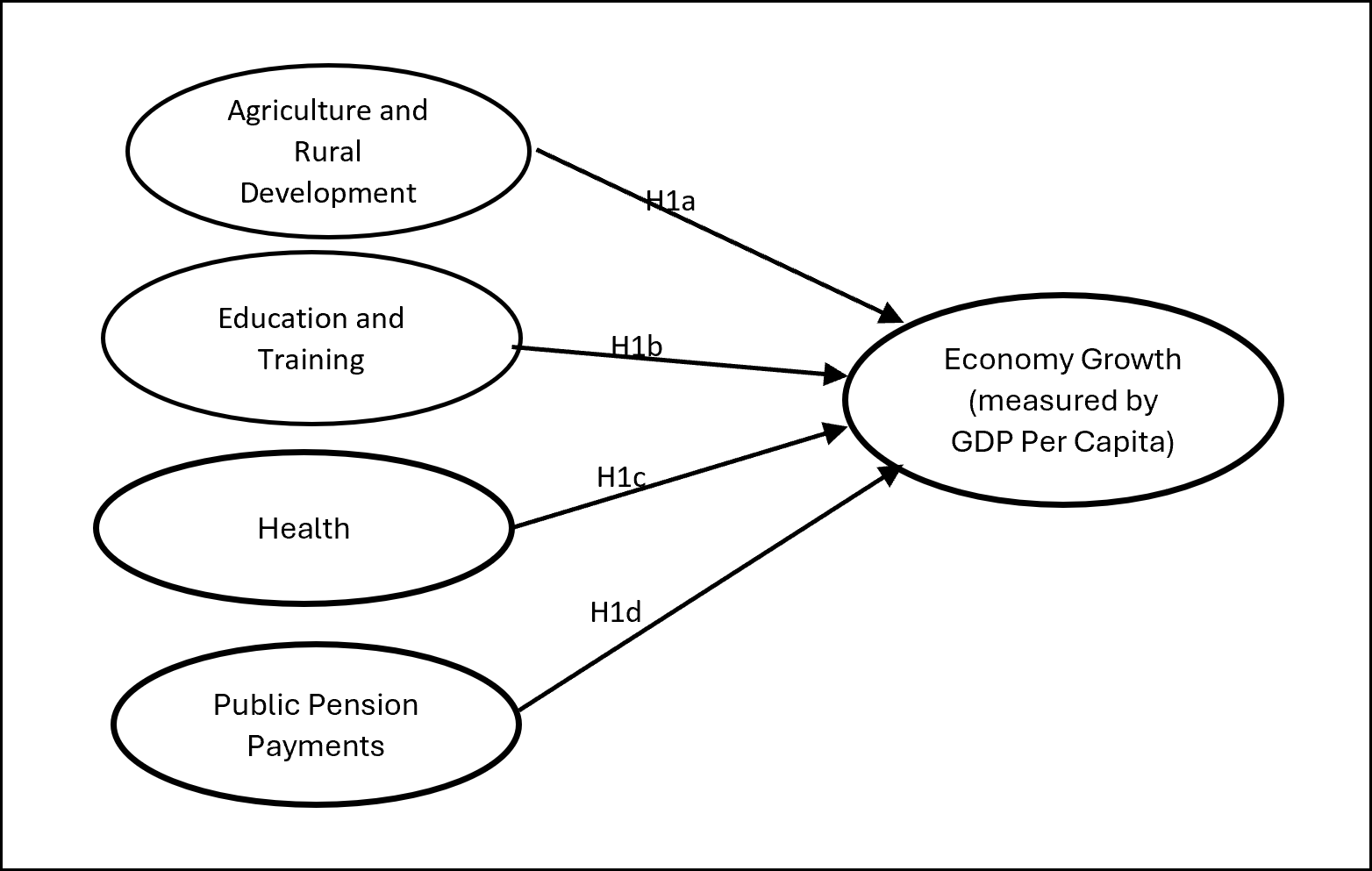
Persistent income inequality and uneven economic development remain pressing challenges in Malaysia despite decades of public investment across key sectors. This study investigates the sectoral allocation of government spending and its impact on economic growth and income distribution, focusing on four critical areas: public pension payments, agriculture and rural development, education and training, and healthcare. Motivated by concerns about rising public debt, inefficient fiscal allocation, and growing public dissatisfaction, this study addresses a gap in the literature by providing a comparative long-term analysis of spending effectiveness across key sectors. Using time series data from 1980 to 2021 and applying the autoregressive distributed lag (ARDL) model, the study reveals that spending on agriculture and rural development and education and training significantly contribute to long-term economic growth. By contrast, health and pension expenditures were found to be statistically insignificant in driving growth. Regarding income inequality, only agriculture and rural development spending show a long-term impact, while pension spending has short-run significance. This study makes a novel contribution by jointly examining the effects of government spending on both economic growth and income inequality across key sectors, providing actionable insights for more focused and efficient fiscal policymaking. The findings highlight the importance of prioritizing productive sectors, re-evaluating pension policies, and ensuring transparency in fiscal management to enhance growth and equity outcomes in Malaysia.
Article Details

This work is licensed under a Creative Commons Attribution-NonCommercial-NoDerivatives 4.0 International License.
References
Abdelli, H., Gheraia, Z., Sekrafi, H., & Abid, M. (2024). The asymmetric impact of government expenditure on economic growth: evidence from a NARDL model. International Journal of Advanced and Applied Sciences, 11(3), 92-101.
Abdul Rahman, M. I., & Lau, W. Y. (2024). An overview of the pension system in Malaysia. In Pension at Stake: Issues and solutions to defined benefit pension scheme in Malaysia (pp. 1-19). Springer Nature Singapore. https://doi.org/10.1007/978-981-97-2324-9_1
Afonso, A., Schuknecht, L., & Tanzi, V. (2005). Public sector efficiency: an international comparison. Public choice, 123(3), 321-347.
Ahmed, T., Khan, K. S., & Naeem, M. (2019). The effect of public spending on agricultural growth: evidence from 1972 to 2014 in Pakistan. Sarhad Journal of Agriculture, 35(2), 349-357.
Albassam, B. A. (2022). Government spending and economic growth in the Middle East and North Africa region. International Review of Administrative Sciences, 88(4), 1124-1140. doi:https://journals.sagepub.com/doi/suppl/10.1177/0020852320969802
Ali, A. O., Mohamed, J., & Mohamed, M. O. (2024). Asymmetric modeling of the fiscal policy-economic growth nexus in Somalia. Cogent Economics & Finance, 12, 1-13. doi:10.1080/23322039.2024.2312372
Barro, R. J. (1991). Economic growth in a cross-section of countries. The Quarterly Journal of Economics, 106(2), 407-443. https://doi.org/10.2307/2937943
Can, C. K., & Aktas, E. E. (2022). Quantifying the optimal long-run level of government expenditures in Turkey: 1968-2019. Ekonomski vjesnik: Review of Contemporary Entrepreneurship, Business, and Economic Issues, 35(1), 69-86.
Clements, B., Gupta, S., & Jalles, J. T. (2025). Public spending and inclusive growth in developing Asia. Public Finance Review, 53(2), 139-168.
Elmendorf, D. W., & Mankiw, N. G. (1999). Government debt. Handbook of macroeconomics, 1, 1615-1669.
FlyMalaysia. (2023, June 29). Malaysia's national debt - everything you need to know. Retrieved from https://www.flymalaysia.org/malaysias-national-debt-everything-you-need-to-know/
Fong, K. (7 October, 2022). Budget deficit in 2023 only about RM400 mil less than record high in 2022. Retrieved from The Edge Market: https://www.theedgemarkets.com/article/budget-deficit-2023-only-about-rm400-mil-less-record-high-2022
Gaddah, M., Munro, A., & Quartey, P. (2015). The rich or the poor: who gains from public education spending in Ghana?. International Journal of Social Economics, 42(2), 112-131.
Gamal, A. A. M., Pyng, C. H., Hussin, M. Y. M., Tha, G. P., & Viswanathan, K. K. (2022). Shadow economy and selected macroeconomic variables affecting economic growth in Malaysia. Montenegrin Journal of Economics, 18(2), 19-28.
Goh, H. H., & Aznan, M. S. B. M. (2023). The optimal government size and economic growth: a comparative study between Malaysia and South Korea. Heliyon, 9(12), e22834. https://doi.org/10.1016/j.heliyon.2023.e22834
Gustafsson, J. (2022). Public pension policy and the equity-efficiency trade-off. Journal of Economics, 125(3), 717-752.
Hamzah, K. S. B. (2011). The association between government expenditure and economic growth in Malaysia (Master's thesis). Ritsumeikan Asia Pacific University, Malaysia.
Hota, S. P. (2023). Education infrastructure, expenditure, enrollment & economic development in Odisha, India. International Journal of Educational Development, 103, 102903.
Keynes, J. M. (1936). The General Theory of Employment, Interest and Money. London: Macmillan.
Khalid, M. A., & Rosli, Z. (2025). Income inequality and ethnic gaps persist in Malaysia - 2016-2022. WID.world. https://wid.world/news-article/income-inequality-and-ethnic-gaps-persist-in-malaysia-2016-2022/
Lian, C., Pei, J., & Li, J. (2024). Income inequality effect of government investment behavior: Comparisons based on different investment areas, different. Heliyon, 10(5), e26452. doi:https://doi.org/10.1016/j.heliyon.2024.e26452
Ndaguba, E. A., & Hlotywa, A. (2021). Public health expenditure and economic development: the case of South Africa between 1996 and 2016. Cogent Economics & Finance, 9(1), 1905932. https://doi.org/10.1080/23322039.2021.1905932
Parui, P., & Prettner, K. (2025). Public provision of healthcare and basic research: What are the joint effects on economic growth and welfare?. Journal of Economic Growth, 30, 383-415. https://doi.org/10.1007/s10887-024-09250-2
Pesaran, M. H., Shin, Y., & Smith, R. J. (2001). Bounds testing approaches to the analysis of level relationships. Journal of applied econometrics, 16(3), 289-326.
Ragayah, H. M. Z. (2008). Income inequality in Malaysia. Asian Economic Policy Review, 3(1), 114-132.
Ramos-Herrera, M. D. C., & Sosvilla-Rivero, S. (2025). Pension expenditures and old-age poverty in OECD countries. National Accounting Review, 7(1), 28-58.
Seefeldt, B. (2018). The impact of education expenditures on income inequality: Evidence from US states.
Sharma, N., Srivastava, A., & Khanna, S. (2022). Government expenditure, economic growth and human development. 2022 IEEE Delhi Section Conference (DELCON), New Delhi, India, 2022, pp. 1-8, doi:10.1109/DELCON54057.2022.9753274.
Shi, X. (2024). Anti-corruption campaign and economic growth in Chinese cities: the dichotomous mechanism of network-based political competition. European Journal of Political Economy, 83, 102549.
Smith, A. (1776). The wealth of nations. Sutherland, C. K. A. Methuen & Co.
Sukoharsono, E. G. (2025). Rural transformation: the challenge of sustainable agriculture, environmental pollution, urban-rural income inequality and ageing rural population. Journal of Environmental Accounting and Management, 13(01), 1-12.
Thangiah, G., Said, M. A., Majid, H. A., Reidpath, D., & Su, T. T. (2020). Income inequality in quality of life among rural communities in Malaysia: a case for immediate policy consideration. International journal of environmental research and public health, 17(23), 8731.
Uchida, Y., & Ono, T. (2024). Life expectancy and politics of public education and pension with endogenous fertility. Journal of Economic Dynamics and Control, 168, 104995.
Wijeweera, A., & Garis, T. (2009). Wagner's law and social welfare: the case of the Kingdom of Saudi Arabia. Applied Econometrics and International Development, 9(2), 199-209.
Wong, C. Y., Lee, H. S., Chong, S. C. (2020). The impacts of bilateral trade and foreign direct investment on Malaysia's economic growth: the roles of Singapore. International Journal of Business and Society, 21(1), 419-432. https://doi.org/10.33736/ijbs.3261.2020
Yeap, C. (8 November, 2021). The State of the Nation: Economic Report: 68 sen of every RM1 earned goes to salaries, pension, debt service charges in 2021 and 2022. The Edge Markets, https://www.theedgemarkets.com/article/state-nation-economic-report-68-sen-every-rm1-earned-goes-salaries-pension-debt-service
Zahiid, S. J. (6 February, 2023). Health minister admins scale of problem facing emergency departments at public hospitals. Malaymail, https://www.malaymail.com/news/malaysia/2023/02/06/health-minister-admits-scale-of-problem-facing-emergency-departments-at-public-hospitals/53624
Zulkifli, S. A., Effendi, N. A., & Shafai, N. A. (2022). The impact of government expenditure on economic growth in Malaysia. Advances in Business Research International Journal. 8(1), 21-32. https://doi.org/10.24191/abrij.v8i1.17823