
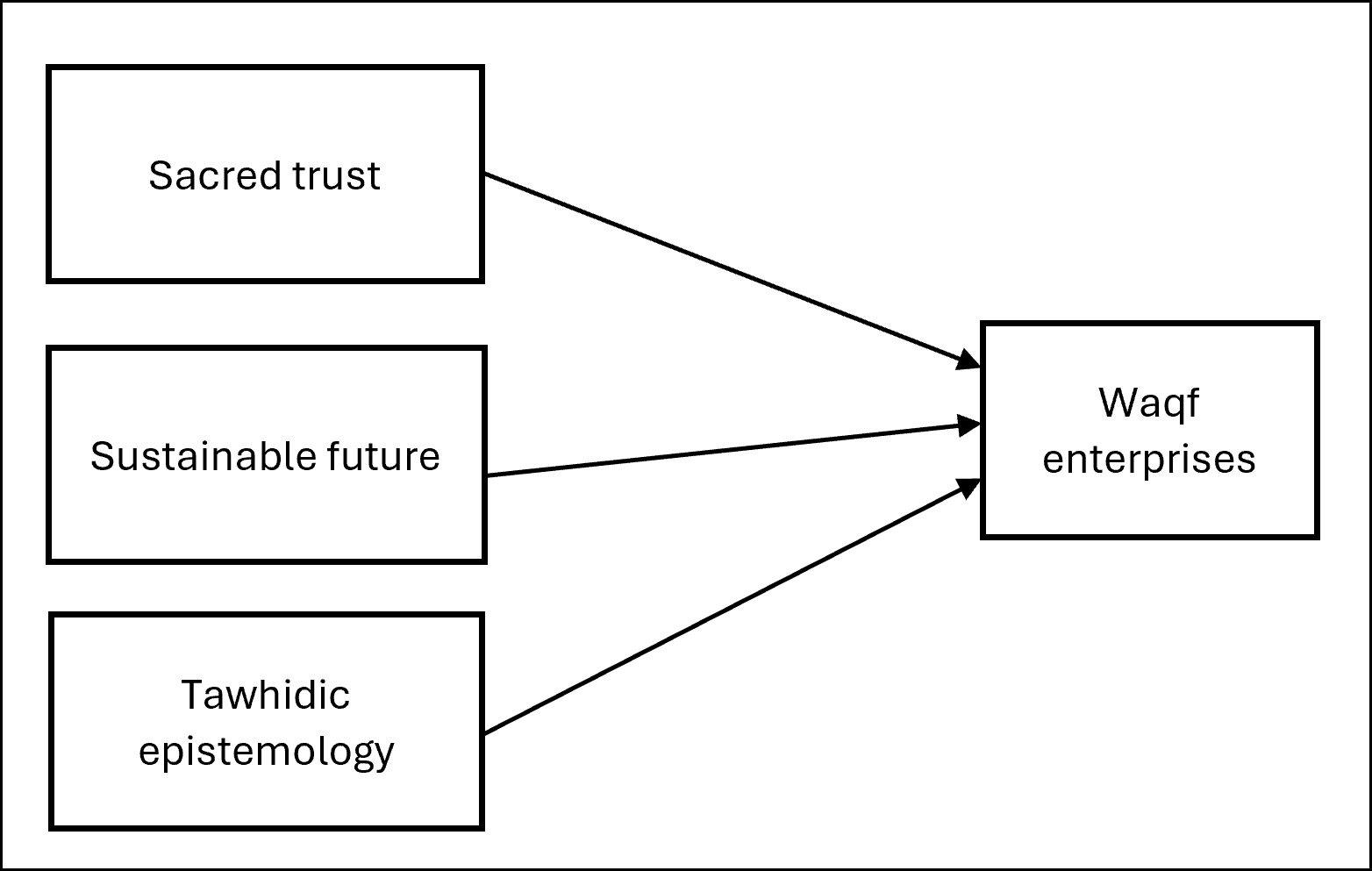
Sacred trust and sustainable future: embedding tawhidic epistemology values in waqf enterprises
Article Sidebar
Main Article Content
Abstract
This study investigates the sustainability of waqf-based enterprises through the lens of tawhidic epistemology, positioning waqf not merely as a philanthropic mechanism but also as a divinely inspired economic model grounded in ubudiyyah (servitude to Allah), adl (justice), and intergenerational equity. The primary objective is to identify the underlying drivers that enable waqf enterprises to sustain their operations while fulfilling their Shari’ah-compliant fiduciary and social mission. Adopting a qualitative methodology, this research draws on in-depth semi-structured interviews with 15 waqf managers from various Malaysian states, selected for their leadership roles in managing active waqf entities across diverse institutional settings. Thematic analysis revealed five interdependent sustainability drivers: (1) value-based leadership rooted in taqwa (God-consciousness), (2) collaborative governance that balances Shari’ah and operational needs, (3) stakeholder trust and engagement, (4) adaptive innovation responsive to contemporary challenges, and (5) mission-centricity anchored in amanah (ethical stewardship). These findings contribute to both theoretical and practical discourse by proposing a spiritually anchored sustainability model for waqf enterprises.
Article Details

This work is licensed under a Creative Commons Attribution-NonCommercial-NoDerivatives 4.0 International License.
References
Abd Aziz, N. A., Sapuan, N. M., and Tamyez, P. F. M. (2023). Waqf for higher education institutions: A conceptual review. Journal of Advanced Research in Business and Management Studies, 31(1), 1–12.
Abd Malib, M., Ahmad Mustafa, M. M., Markom, R., Rabu, N., Shafiei Ayub, M. S., and Ibrahim, K. (2024). Waqf governance: A paradigm shift towards the sustainability of waqf benefit. Global Business and Management Research, 16(2), 167–180.
Abdul Latif, S., Nik Din, N. M., and Mustapha, Z. (2018). The role of good waqf governance in achieving sustainable development. Environment-Behaviour Proceedings Journal, 3(7), 113–117.
Abdullah, M. (2018). Waqf, sustainable development goals (SDGs) and maqasid al-shariah. International Journal of Social Economics, 45(1), 158–172.
Akhtar, J. (2025). Waqf-based environmental initiatives: Collaborative partnerships with government for sustainable development. In M. Shahbaz and F. Shahzad (Eds.), Government influences on eco-friendly practices in business (pp. 177–206). IGI Global.
Ali, Z., Anjum, G. M., Iqbal, J., and Ahmad, I. (2024). The role of Islamic values in promoting social justice and community welfare. International Research Journal of Management and Social Sciences, 5(1), 575–585.
Al-Jayyousi, O., Tok, E., Saniff, S., Wan Hasan, W., Janahi, N., and Yesuf, A. J. (2022). Re-thinking sustainable development within Islamic worldviews: A systematic literature review. Sustainability, 14(12), 7300.
Ayub, M., Khan, K., and Ismail, M. (2024). Waqf in Islamic economics and finance: An instrument for socioeconomic welfare. Taylor and Francis.
Bachri, S., and Rosyadi, I. (2024). The potential and challenges of waqf in overcoming economic crises and recessions. Al-Afkar: Journal for Islamic Studies, 7(1), 56–78.
Crick, J. M. (2021). Qualitative research in marketing: What can academics do better? Journal of Strategic Marketing, 29(5), 390–429.
Demir, H. I. (2025). The commercialization of faith and its impact on volunteerism and fundraising. In E. Aslan (Ed.), Business, economy and commerce in the name of God: Prospects and pitfalls (pp. 117–128). Springer Nature Switzerland.
Douglas, H. (2022). Sampling techniques for qualitative research. In M. R. Islam, N. Khan, and R. Baikady (Eds.), Principles of social research methodology (pp. 415–426). Springer Nature Singapore.
Drisko, J. W. (2025). Transferability and generalization in qualitative research. Research on Social Work Practice, 35(1), 102–110.
Eisenhart, M., and Jurow, A. S. (2011). Teaching qualitative research. In N. K. Denzin and Y. S. Lincoln (Eds.), The SAGE handbook of qualitative research (4th ed., pp. 669–714). Sage Publications.
Firmansah, Y. (2025). Sustainability in small business settings through tacit knowledge transfer across generations: Lessons learned from waqf-based organizations. In T. O. Olubiyi, S. D. Suppiah, and C. Chidoko (Eds.), The future of small business in Industry 5.0 (pp. 265–300). IGI Global Scientific Publishing.
Flick, U., Mills, K. A., and Rowe, L. (2025). Quality in big qualitative research. In U. Flick (Ed.), The SAGE handbook of qualitative research quality. Sage Publications.
Hamzah, M. (2024). The role and legal aspects of infaq, sadaqah, and waqf in realizing economic equality and people’s welfare. Al-Iqtishadiyah: Ekonomi Syariah dan Hukum Ekonomi Syariah, 10(1), 107–124.
Hasan, R., Ahmad, A. U. F., and Siraj, S. A. (2022). Building trust in waqf management: Implications of good governance and transparent reporting. The Singapore Economic Review, 67(1), 459–475.
Hoque, M. N., and Abdullah, M. F. (2021). The world’s oldest university and its financing experience: A study on Al-Qarawiyyin University (859–990). Journal of Nusantara Studies, 6(1), 24–41.
Iman, A. H. M., and Mohammad, M. T. S. H. (2017). Waqf as a framework for entrepreneurship. Humanomics, 33(4), 419–440.
Ishak, A. H., Mohamad, S. N. A., Abd Latib, N. A., and Anwari, A. S. (2025). Waqf as a sustainable economic institution for community welfare. Environment-Behaviour Proceedings Journal, 10(31), 325–330.
Ismail, S., Hassan, M. K., and Rahmat, S. (2023). Islamic social finance: Waqf, endowment, and SMEs. Edward Elgar Publishing.
Kamaruddin, M. I. H., Hanefah, M. M., and Masruki, R. (2024). Challenges and prospects in waqf reporting practices in Malaysia. Journal of Financial Reporting and Accounting, 22(3), 752–765.
Khalid, J., and Usman, M. (2022). Waqf as a financial instrument for the development of social enterprises in Pakistan. Journal of Contemporary Business and Islamic Finance, 2(2), 153–172.
Kireçci, M. A. (2025). Humanitarianism, philanthropy, and humanitarian diplomacy. In H. Z. Kavak (Ed.), Understanding humanitarian diplomacy (pp. 1–17). Routledge.
Köhler, T., Rumyantseva, M., and Welch, C. (2025). Qualitative restudies: Research designs for retheorizing. Organizational Research Methods, 28(1), 32–57.
Lamido, A. A., and Haneef, M. A. (2021). Shifting the paradigms in waqf economics: Towards renewed focus on socioeconomic development. Islamic Economic Studies, 29(1), 18–32.
Le, L., and Saad, N. M. (2023). Exploring the frontier in microfinance: Faith-based and interfaith microfinance collaboration in conflict-affected environments. Journal of Islamic Finance, 12(1), 32–47.
Mahardika, S. G., and Tanweer, A. (2025). Environmentally friendly waqf model: A response to sustainable economic development and the presence of a circular economy. Journal of Islamic Economics and Business Ethics, 2(1), 68–93.
Mahmud, S., and Noordin, N. H. (2024). Constructive collaboration in ensuring the sustainability of waqf fund in Malaysia: A case study of the MyWakaf initiative. Journal of Islamic Social Finance, 2(2), 1–17.
Manaf, A. W. A., Siong, W. H., and Razak, H. A. (2025). Legal barriers and opportunities in the digital transformation of waqf management in Malaysia: A critical analysis. AZKA International Journal of Zakat and Social Finance, 6(1), 137–157.
Maulidizen, A. (2024). The role of temporary waqf in improving the social welfare of the Muslim community. Journal of Ecohumanism, 3(8), 2578–2587.
Muhammad, A. A., Ardo, A. M. A., Aliyu, S. A. A., and Muhammad, Z. J. (2025). Waqf as an Islamic endowment: A solution for improving educational attainment in Northern Nigerian communities. ITQAN: Journal of Islamic Economics, Management, and Finance, 4(1), 44–50.
Mustapha, Z. (2024). From solidarity to prosperity: Exploring the impact of Islamic waqf on economic development. Insights from the Kuwaiti experience. International Journal of Economic Perspectives, 18(12), 2400–2422.
Nasiri, A., Noori, A., and Salleh, M. C. M. (2019). Acceptance and practices of cash waqf among university students. International Journal of Academic Research in Accounting, Finance and Management Sciences, 9(3), 38–48.
Raja Adnan, R. A. B., Abdul Mutalib, M., and Ab Aziz, M. R. (2022). Factors necessary for effective corporate waqf management for Malaysian public healthcare. ISRA International Journal of Islamic Finance, 14(1), 73–88.
Ramdani, R., Widiastuti, T., and Mawardi, I. (2024). Implementation of Islamic values in waqf governance: A systematic literature review. Journal of Islamic Marketing, 15(8), 1925–1941.
Rashid, Z. A. N., Mazri, N. M., Rosele, M. I., and Abdullah, L. (2025). Dawabit fiqhiyyah in waqf and its application in waqf management. Al-Qanatir: International Journal of Islamic Studies, 34(1), 1–14.
Razan, S. (2025). Designing of waqf-business units toward financial sustainability on the pesantren-based university: A case study at the University of Darussalam Gontor. Doctoral dissertation, Universitas Darussalam Gontor.
Rohana, N. A. M., Rameli, M. F. P., Surtahman, A. W., Razak, A. Q. A., Halim, F. H., and Amin, S. M. (2024). Waqf for education in Malaysia: Historical implementation, types, and significance. Global Business and Management Research, 16(2S), 135–150.
Rohim, A. N., and Yetty, F. (2025). Contribution of Islamic economy in achieving Sustainable Development Goals (SDGs). Review of Islamic Social Finance and Entrepreneurship, 6(1), 56–69.
Rusydiana, A. S., Sukmana, R., Laila, N., and Riani, R. (2025). Waqf development models for Sustainable Development Goals: An analytic network process approach. International Journal of Islamic Finance and Sustainable Development, 17(1), 51–74.
Sinollah, S., Bisri, H., and Adam, S. M. (2025). Philosophical study of Islamic economics: Theological and empirical perspectives. Al-Insyiroh: Jurnal Studi Keislaman, 11(1), 1–19.
Sudi, D. M., Sarif, A., Wang, Y., and Zou, G. (2024). Optimizing waqf as a socio-economic financing instrument in the digital era. Sharia Oikonomia Law Journal, 2(2), 139–150.
Sukmana, R., and Trianto, B. (2025). The effect of Islamic financial literacy on business performance with emphasis on the role of Islamic financial inclusion: A case study in Indonesia. Journal of Islamic Marketing, 16(1), 166–192.
Thomas, F. B. (2022). The role of purposive sampling technique as a tool for informal choices in social sciences research methods. Just Agriculture, 2(5), 1–8.
Tisdell, E. J., Merriam, S. B., and Stuckey-Peyrot, H. L. (2025). Qualitative research: A guide to design and implementation. John Wiley and Sons.
Usman, M., and Faruqi, M. Y. (2024). Understanding waqf, its role and practice: A revisit. International Research Journal of Arabic and Islamic Studies, 4(1), 60–82.
Yusof, M. A. (2025). Waqf-driven inclusive prosperity: Exploring the intersection of Islamic finance, fintech, and Sustainable Development Goals. In M. R. Ab Aziz, F. Johari, and A. Rafiki (Eds.), Digitalization of Islamic finance (pp. 303–334). IGI Global Scientific Publishing.