
Financing green futures: renewable energy investment and economic growth in Germany
Article Sidebar
Main Article Content
Abstract
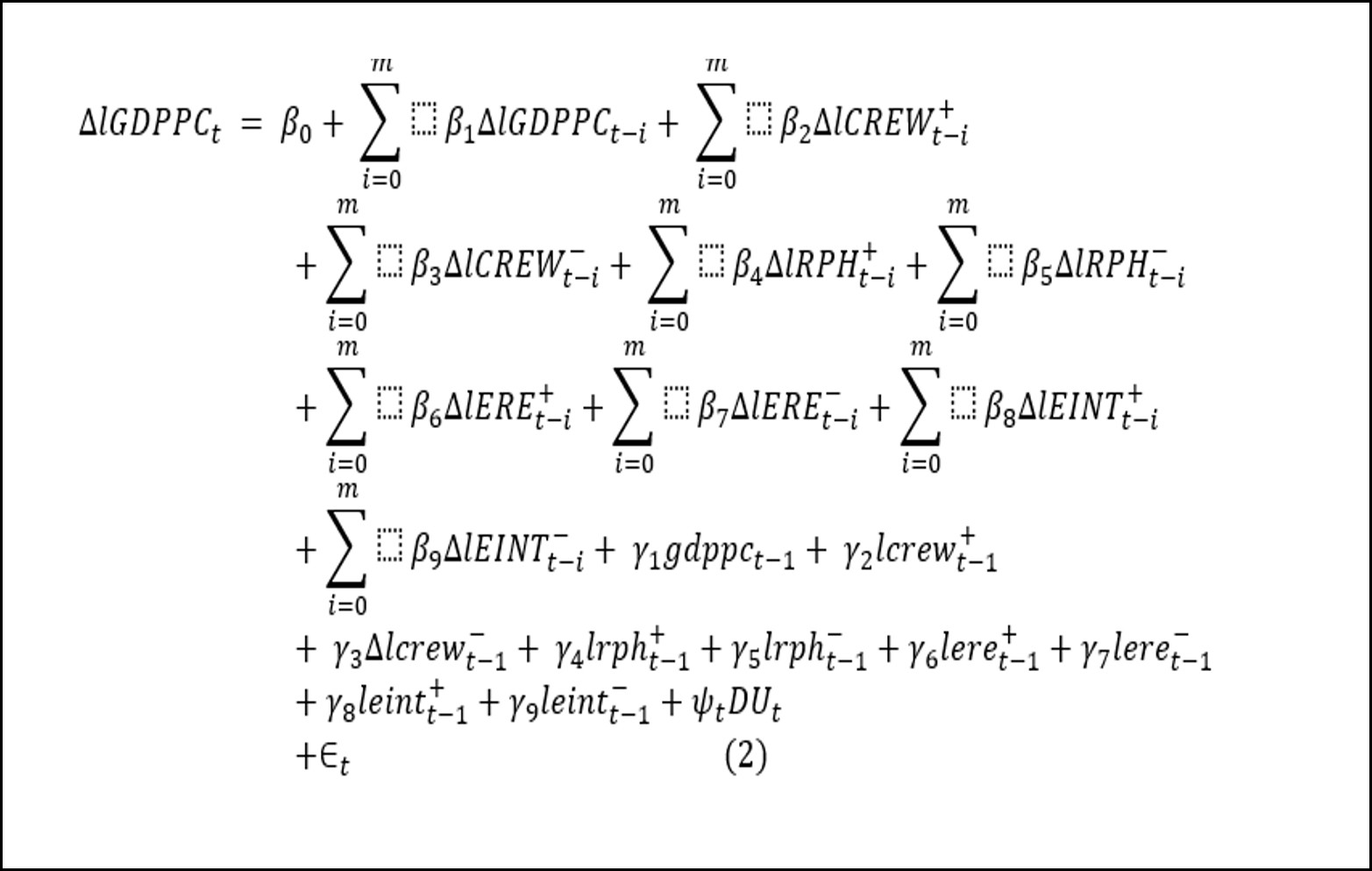
Global efforts to mitigate greenhouse gas emissions have been driven by increasingly evident adverse impacts of climate change. Countries are adopting renewable energy sources, such as solar, wind, hydropower, geothermal, and bioenergy, which provide cleaner alternatives to fossil fuels. Investments in renewable energy facilitate the decarbonization of the energy sector, while simultaneously stimulating the economy through job creation, technological advancement, and innovation. This study examines the relationship between renewable energy financing and economic growth in Germany. Annual time series data from 1986 to 2022 and a Nonlinear Autoregressive Distributed Lag model were used. The research findings indicate a correlation between renewable energy financing and economic growth. The study indicates that a disturbance in combustible renewable energy and waste will, according to the long-term findings, exert a negative impact of 0.21 on economic growth. In general, financing renewable energy is believed to play a role in Germany’s economic growth. The study recommends that policymakers enhance their funding for colleges and research institutions to develop more viable ways to enhance renewable energy production and adoption.
Article Details

This work is licensed under a Creative Commons Attribution-NonCommercial-NoDerivatives 4.0 International License.
References
Ashfaq, S., Liangrong, S., Waqas, F., Gulzar, S., Mujtaba, G., & Nasir, R. M. (2024). Renewable energy and green economic growth nexus: Insights from simulated dynamic ARDL. Gondwana Research, 127, 288-300.
Baidoo, E., Yeboah, F., & Opoku, R. A. (2020). Renewable energy, economic growth and environmental sustainability nexus in Ghana: Evidence from an ARDL bounds testing approach. Renewable Energy, 153, 1166-1177.
Bertsch, V., Jochem, P., & Hoffmann, V. H. (2021). Renewable energy financing and economic growth: evidence from Germany. Energy Policy, 153, 112291.
Borhanazad, H., & German-Ramirez, A. (2019). Economic growth and renewable energy sources in Germany. Energy Economics, 84, 104495.
Eicke, A., Khanna, T., & Hirth, L. (2020). Locational investment signals: how to steer the siting of new generation capacity in power systems? The Energy Journal, 41(6), 281-304. https://doi.org/10.5547/01956574.41.6.aeic
Guris, B. (2018). A flexible Fourier form nonlinear unit-root test based on ESTAR adjustment and structural breaks. MPRA Paper 83472, University Library of Munich, Germany.
Hafeez, M., Chunhui, Y., Strohmaier, D., Ahmed, M., & Jie, L. (2018) Does finance affect environmental degradation: evidence from one belt and one road initiative region? Environmental Science and Pollution Research, 25, 9579-9592. https://doi.org/10.1007/s11356-018-1317-7
International Renewable Energy Agency (IRENA). (2019). Renewable energy and jobs - Annual review 2019. Retrieved from https://www.irena.org/-/media/Files/IRENA/Agency/Publication/2019/May/IRENA_RE_Jobs_Annual_Review_2019.pdf
Jacobs, J. V., Hettinger, L. J., Huang, Y. H., Jeffries, S., Lesch, M. F., Simmons, L. A., Verma, S. K., & Willetts, J. L. (2019). Employee acceptance of wearable technology in the workplace. Applied ergonomics, 78, 148-156. https://doi.org/10.1016/j.apergo.2019.03.003
Li, C., Lin, B., & Liu, H. (2021). Renewable energy investments and economic growth: Evidence from the Belt and Road Initiative countries. Renewable and Sustainable Energy Reviews, 144, 111005.
Martinot, E., Lutsey, N., & Jiang, Y. (2012). Renewable energy markets in developing countries. Annual Review of Environment and Resources, 37, 349-379.
Ouedraogo, N. S. (2018). Renewable energy consumption and economic growth: New insights into the cointegration relationship. Energy Policy, 115, 193-206.
Panwar, N. L., Kaushik, S. C., & Kothari, S. (2011). Role of renewable energy sources in environmental protection: A review. Renewable and Sustainable Energy Reviews, 15(3), 1513-1524.
Shahbaz, M., Khraief, N., & Czudaj, R. L. (2020). Renewable energy consumption-economic growth nexus in G7 countries: New evidence from a nonlinear ARDL approach. Economics Bulletin, 40(4), 2828-2843.
Shahbaz, M., Nasir, M. A., & Roubaud, D. (2018). Environmental degradation in France: The effects of FDI, financial development, and energy innovations. Energy Economics, 74, 843-857. https://doi.org/10.1016/j.eneco.2018.07.020
Shin, Y., Pesaran, M. H., & Smith, R. J. (2001). Bounds testing approaches to the analysis of level relationships. Journal of Applied Econometrics, 16(3), 289-326. https://doi.org/10.1002/jae.616
Shin, Y., Yu, B., & Greenwood-Nimmo, M. (2014). Modelling asymmetric cointegration and dynamic multipliers in a nonlinear ARDL framework. In: Sickles, R., & Horrace, W. (eds) Festschrift in Honor of Peter Schmidt. Springer, New York, NY. https://doi.org/10.1007/978-1-4899-8008-3_9
Sovacool, B. K., Baker, L., & Nugent, D. (2019). National energy financing institutions and sustainable energy transitions. Nature Energy, 4(5), 434-442.
Tamazian, A., & Bhaskara Rao, B. (2010). Do economic, financial and institutional developments matter for environmental degradation? Evidence from transitional economies. Energy Economics, 32(1), 137-145. https://doi.org/10.1016/j.eneco.2009.04.004
Tamazian, A., Chousa, J. P., & Vadlamannati, K. C. (2009). Structural breaks and energy efficiency: Evidence from Fiji. Energy Policy, 37(10), 3959-3966.