
Monetary policy transmission to Islamic bank financing in Indonesia: evidence from a Structural VAR Approach
Article Sidebar
Main Article Content
Abstract
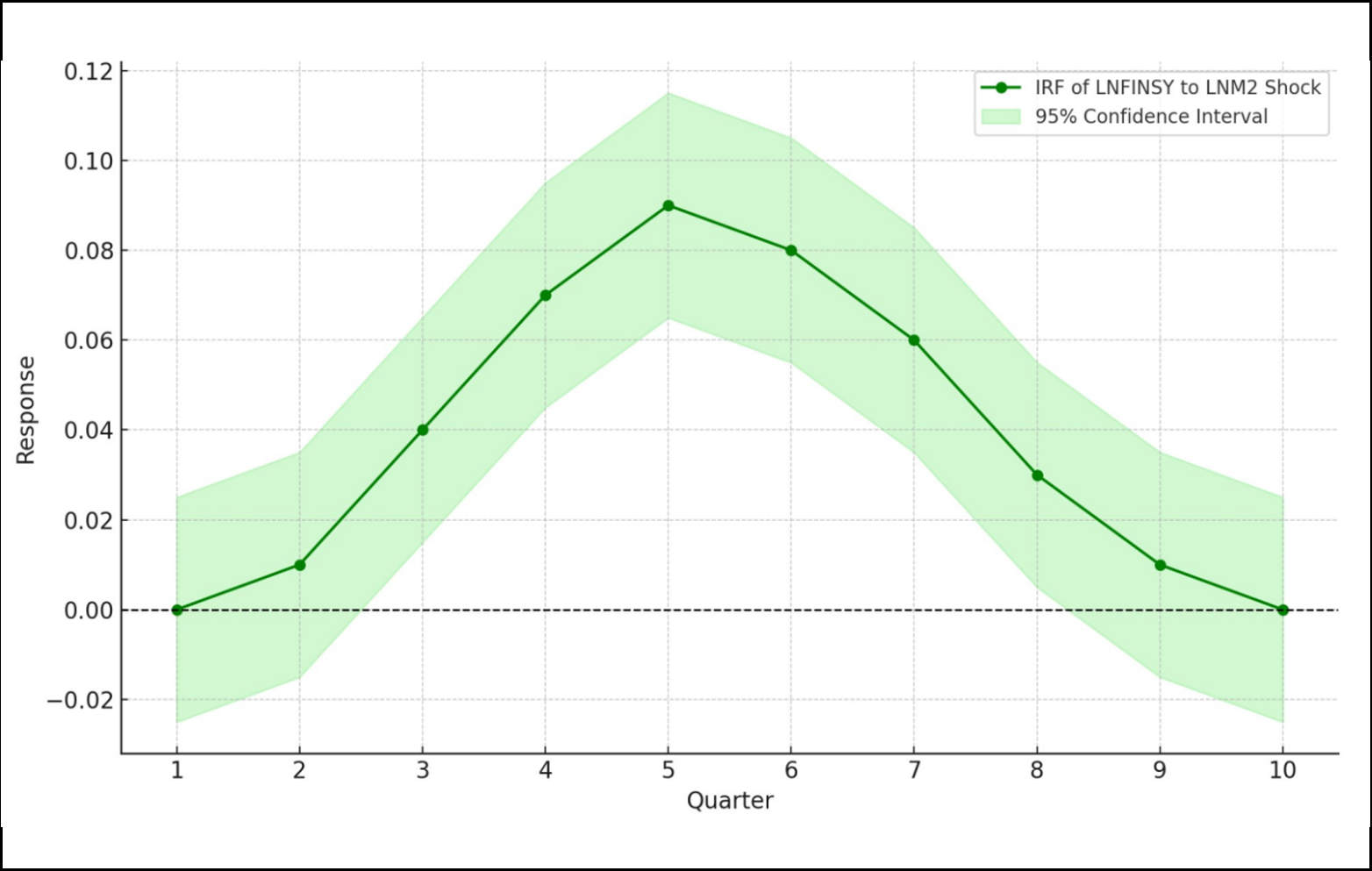
This study investigates the dynamic effects of monetary policy shocks on Islamic bank financing in Indonesia using a Structural Vector Autoregression (SVAR) approach. Within the context of a dual banking system, the analysis focuses exclusively on the Islamic segment, employing quarterly data from 2010 to 2023 to capture both normal and volatile macroeconomic conditions. The results reveal that Islamic bank financing is significantly responsive to changes in the policy rate, despite its interest-free foundation, largely due to benchmarking practices such as the use of the BI 7-Day Reverse Repo Rate. Additionally, expansionary monetary shocks via money supply positively influence financing, highlighting the role of liquidity in supporting Shariah-compliant credit growth. Inflation shocks exert a negative and persistent impact, indicating the importance of price stability in maintaining Islamic credit momentum. Exchange rate fluctuations, while statistically significant, demonstrate a relatively minor and transitory effect due to the limited foreign currency exposure of Islamic banks in Indonesia. Forecast Error Variance Decomposition (FEVD) confirms that interest rate and money supply shocks are the most dominant sources of variance in Islamic bank financing, followed by inflation and exchange rate shocks. The findings suggest that, although Islamic banks operate under distinct principles, they remain intricately linked to the conventional macro-financial system. The study underscores the need for Shariah-aligned policy instruments and robust macroeconomic management to enhance monetary transmission effectiveness within Islamic financial institutions.
Article Details

This work is licensed under a Creative Commons Attribution-NonCommercial-NoDerivatives 4.0 International License.
References
Abduh, M., & Omar, M. A. (2012). Islamic banking and economic growth: The Indonesian experience. International Journal of Islamic and Middle Eastern Finance and Management, 5(1), 35-47. https://doi.org/10.1108/17538391211216811
Alqahtani, F., & Mayes, D. G. (2018). Financial stability of Islamic banking and the global financial crisis: Evidence from the Gulf Cooperation Council. Economic Systems, 42(2), 346-360. https://doi.org/10.1016/j.ecosys.2017.09.001
Badar, M. (2024). Impact of monetary policy rate on conventional and Islamic banking. International Journal of Economics, 9(1), 1-20. https://doi.org/10.47604/ijecon.2275
Borio, C. (2022). Monetary policy in the grip of a pincer movement (BIS Working Papers No. 1079). Bank for International Settlements.
Boukhatem, J., & Djelassi, M. (2022). The bank-lending channel of monetary policy transmission in a dual banking system: Empirical evidence from panel VAR modeling. Cogent Economics & Finance, 10(1). https://doi.org/10.1080/23322039.2022.2107765
Cihak, M., & Hesse, H. (2010). Islamic banks and financial stability: An empirical analysis. Journal of Financial Services Research, 38, 95-113. https://doi.org/10.1007/s10693-010-0089-0
Dumitrescu, C. (2008). Monetary policy transmission mechanisms. Revue Europeenne du Droit Social, 58(1), 177-188.
Gok, R., Hammoudeh, S., Ajmi, A. N., & Balcilar, M. (2025). Return spillovers between Islamic and conventional banking rates: Evidence from emerging Islamic countries. Borsa Istanbul Review, 25, 972-998. https://doi.org/10.1016/j.bir.2025.05.012
Haron, S., & Azmi, W. N. W. (2008). Determinants of Islamic and conventional deposits in the Malaysian banking system. Managerial Finance, 34, 276-291. https://doi.org/10.1108/03074350810891017
Hasan, Z. (2020). The impact of COVID-19 on Islamic banking in Indonesia during the pandemic era. Journal of Entrepreneurship and Business, 8(2), 19-32. https://doi.org/10.17687/jeb.0802.03
Hasan, Z. (2021). The effect of profit sharing financing and receivables towards total assets in Islamic banking: Case study in BNI Syariah. Labuan E-Journal of Muamalat and Society, 15, 62-74.
Hasan, Z. (2022). Prospect of Islamic electronic money in Indonesia: Case study on the LinkAja application. Jurnal Ekonomi Syariah Indonesia, 12(1), 1-13.
Hendrian, S. (2024). Monetary policy dynamics and macroeconomic stability: A post-pandemic empirical study in Indonesia. Journal of Economics, Technology and Business (JETBIS), 3(5), 295-304. https://doi.org/10.57185/g1xha744
Husin, M. M. (2019). Monetary policy transmission via financing channel for Islamic banks in Malaysia. Account and Financial Management Journal, 4(7), 1978-1989. https://doi.org/10.33826/afmj/v4i7.01
Iqbal, M., Kurniawati, D., Ridarmelli, & Junaeni, I. (2025). Economic stability and financing quality: Key determinants of Islamic bank growth. Theoretical and Practical Research in Economic Fields, 16(2), 384-398. https://doi.org/10.14505/tpref.v16.2(34).09
Jamar, N., Asiah, A., Alena, M., & Yunus, P. (2025). Monetary policy transmission channels through interest rate and inflation in Indonesia: VECM analysis 2018-2024. Journal of Artificial Intelligence and Digital Business (RIGGS), 4(3), 8636-8646. https://doi.org/10.31004/riggs.v4i3.3283
Kasri, R. A., & Kassim, S. H. (2009). Empirical determinants of saving in the Islamic banks: Evidence from Indonesia. SSRN. https://doi.org/10.2139/ssrn.1685226
Kilian, L., & Lutkepohl, H. (2017). Structural vector autoregressive analysis. Cambridge University Press. https://doi.org/10.1017/9781108164818
Lucky, M. (2024). Analisis pembiayaan bank syariah dan instrumen moneter syariah terhadap stabilitas moneter di Indonesia. Journal of Sharia Economics, 5(1), 111-125. https://doi.org/10.22373/jose.v5i1.4327
Marpaung, M., & Lubis, I. S. (2026). Islamic monetary instruments and central bank policy: A systematic literature review on effectiveness, transmission channels, and macroeconomic outcomes. EPaper Bisnis: International Journal of Entrepreneurship and Management, 3(1), 39-49. https://doi.org/10.61132/epaperbisnis.v3i1.692
Mayakkannan, R., Bajpai, R. D., Bajpai, A., & Koti, K. (2025). How central bank policies influence inflation and market stability in the post-pandemic era. Journal of Information Systems Engineering and Management, 10(51), 120-133.
Mubarok, F., Wibowo, M., Utomo, K. W., & Rahman, S. U. (2025). Islamic banking portfolios in Indonesia: Assessing the impact of economic turbulence and market dynamics on credit. Journal of Islamic Economics and Finance Studies, 6(1), 223-241. https://doi.org/10.47700/jiefes.v6i1.10937
Nisa, K., Andriansyah, Y., & Hasan, B. B. (2023). Determinants of profitability in Indonesian Islamic banks: Financial and macroeconomic insights. Journal of Islamic Economics Lariba, 9(2), 567-590. https://doi.org/10.20885/jielariba.vol9.iss2.art14
Otoritas Jasa Keuangan. (2023). Sharia banking statistics: December 2023. https://www.ojk.go.id
Ritonga, K., Imsar, & Rahmani, N. A. B. (2025). The influence of macroeconomic factors on murabahah financing performance at Bank Syariah Indonesia. Journal of Finance and Islamic Banking, 8(1), 95-110. https://doi.org/10.22515/jfib.v8i1.12154
Rizvi, S. A., Juhro, S. M., & Narayan, P. K. (2021). Understanding market reaction to COVID-19 monetary and fiscal stimulus in major ASEAN countries. Buletin Ekonomi Moneter Dan Perbankan, 24(3), 313-334. https://doi.org/10.21098/bemp.v24i3.1690
Rohmana, Y., & Utami, S. A. (2023). Inflation through the transmission of Islamic and conventional monetary policy in Indonesia. Amwaluna: Jurnal Ekonomi dan Keuangan Syariah, 7(1), 29-57. https://doi.org/10.29313/amwaluna.v7i1.11214
Rudiansyah, R. (2020). Telaah gharar, riba, dan maisir dalam perspektif transaksi ekonomi Islam. Al-Huquq: Journal of Indonesian Islamic Economic Law, 2(1), 98-110. https://doi.org/10.19105/alhuquq.v2i1.2818
Suhendi, & Siregar, K. (2025). The impact of inflation on Indonesia's economic growth from an Islamic economic perspective. Journal of Scientific Insights, 376-390. https://doi.org/10.69930/jsi.v2i4.456
Uluyol, B. (2026). Beyond prohibitions: Unveiling the hidden dynamics of Islamic economics and finance. Journal of Islamic Monetary Economics and Finance, 12(1), 81-106. https://doi.org/10.21098/jimf.v12i1.2781
Virolainen, S. (2025). A statistically identified structural vector autoregression with endogenously switching volatility regime. Journal of Business & Economic Statistics, 1-20. https://doi.org/10.1080/07350015.2024.2322090