
The paradox of oil and sustainable development: evidence from OPEC and non-OPEC countries
Article Sidebar
Main Article Content
Abstract
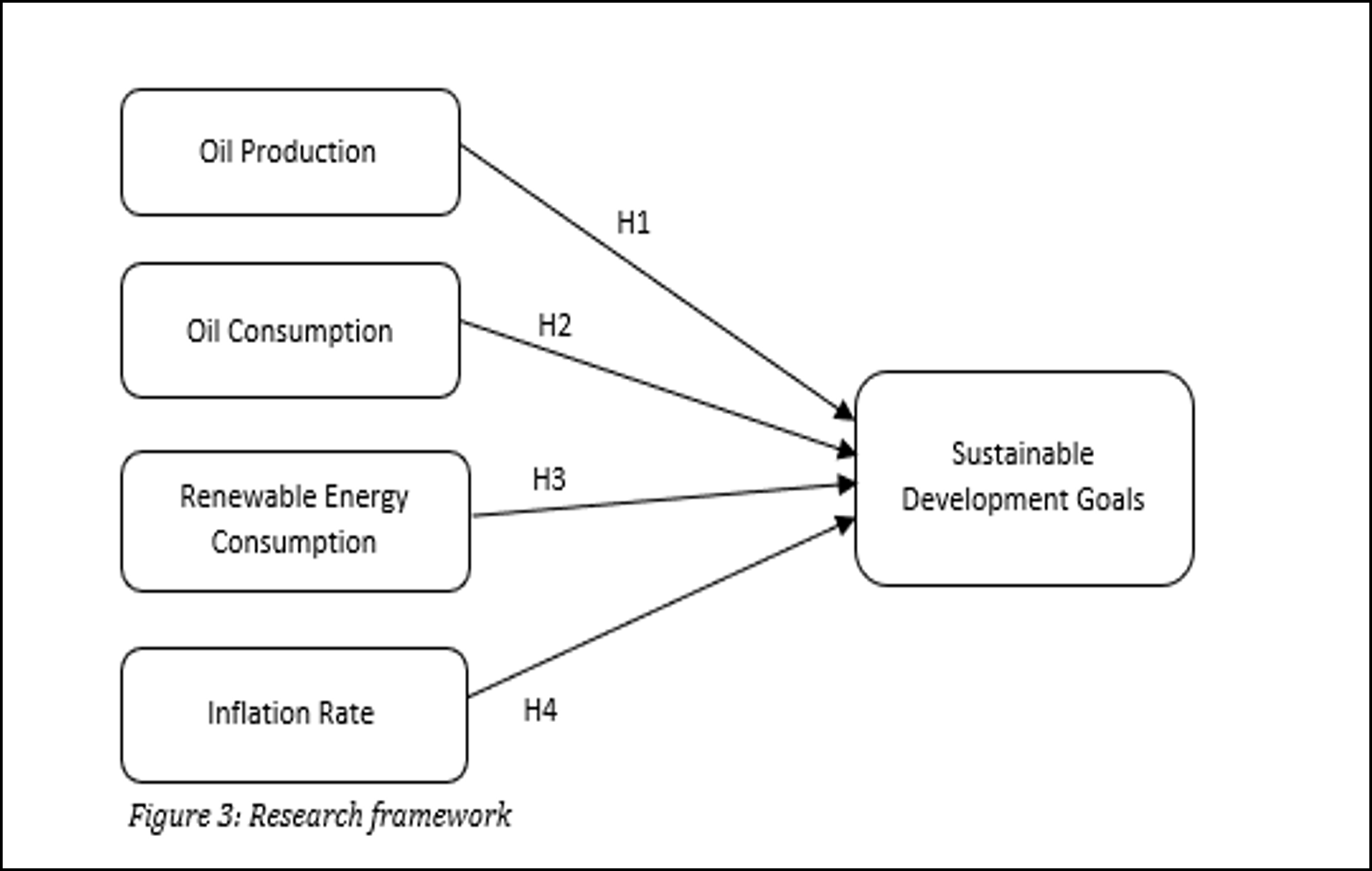
The energy factor plays a critical role in achieving the Sustainable Development Goals (SDGs). Due to a lack of research comparing different energy perspectives in relation to the SDGs, this paper examines the impact of renewable energy, oil consumption, oil production, and inflation on the achievement of the SDGs. The study focuses on eight countries from the Organization of the Petroleum Exporting Countries (OPEC) and eight non-OPEC countries, covering the period from 2000 to 2022. Through quantitative analysis, using fixed effects models and random effects models with panel data, the study examines how fluctuations in oil production and consumption, as well as renewable energy adoption and inflation, are linked to progress towards achieving the SDGs. The results show that renewable energy consumption and oil consumption have a positive impact on the overall achievement of the SDGs, but oil production has a negative impact on the overall achievement of the SDGs. In addition, the surprising result is that oil consumption contributes more to the achievement of the Sustainable Development Goals and only negatively impacts climate change (SDG 13). The study highlights the urgent need for a balanced approach to energy management, emphasizing the transition to renewable energy to ensure long-term sustainability.
Article Details

This work is licensed under a Creative Commons Attribution-NonCommercial-NoDerivatives 4.0 International License.
References
Adebayo, T.S., Akadiri, S. S., Adamu, Y., & Williams, G. O. O. (2023). Disaggregated energy consumption and ecological footprint: Proposing an SDG framework for newly industrialised countries. International Journal of Oil, Gas and Coal Technology, 32(4), 417–439. https://doi.org/10.1504/ijogct.2023.129579
Alamsyah, Z., Mara, A., Rayesa, N. F., Hamid, E., Yanita, M., Fauzia, G., & Napitupulu, D. (2023). Oil palm contribution to SDGs achievement: A case study in main oil palm producing provinces in Indonesia. E3S Web of Conferences, 373, 04030. https://doi.org/10.1051/e3sconf/202337304030
Alnafrah, I., & Bogatov, A. (2025). Comparative fiscal governance policy: Evaluating the causal impact of fiscal councils on economic performance. Economic Systems, 49(3), 101307. https://doi.org/10.1016/j.ecosys.2025.101307
Alnuaim, S. (2018). Energy, environment, and social development: What does sustainability mean for oil and gas? Journal of Petroleum Technology, 70(12), 10–11. https://doi.org/10.2118/1218-0010-jpt
Amin, N., Shabbir, M. S., Song, H., & Abbass, K. (2024). Renewable energy consumption and its impact on environmental quality: A pathway for achieving sustainable development goals in ASEAN countries. Energy & Environment, 35(2), 644–662. https://doi.org/10.1177/0958305x221134113
Atigala, P., Maduwanthi, T., Gunathilake, V., Sathsarani, S., & Jayathilaka, R. (2022). Driving the pulse of the economy or the dilution effect: Inflation impacting economic growth. PLOS ONE, 17(8), e0273379. https://doi.org/10.1371/journal.pone.0273379
Bala, U., & Lee, C. (2018). Asymmetric impacts of oil price on inflation: An empirical study of African OPEC member countries. Energies, 11(11), 3017. https://doi.org/10.3390/en11113017
Belloumi, M., Aljazea, A., & Alshehry, A. S. (2023). Study of the impact of crude oil prices on economic output and inflation in Saudi Arabia. Resources Policy, 86, 104179. https://doi.org/10.1016/j.resourpol.2023.104179
Benhamed, A., & Gassouma, M. S. (2023). Preventing oil shock inflation: Sustainable development mechanisms vs. Islamic mechanisms. Sustainability, 15, 9837.
Bittencourt, M., Van Eyden, R., & Seleteng, M. (2015). Inflation and economic growth: Evidence from the Southern African Development Community. South African Journal of Economics, 83(3), 411–424. https://doi.org/10.1111/saje.12075
Bloch, H., Rafiq, S., & Salim, R. (2015). Economic growth with coal, oil and renewable energy consumption in China: Prospects for fuel substitution. Economic Modelling, 44, 104–115. https://doi.org/10.1016/j.econmod.2014.09.017
Ecer, F., Pamucar, D., Zolfani, S. H., & Eshkalag, M. K. (2019). Sustainability assessment of OPEC countries: Application of a multiple attribute decision making tool. Journal of Cleaner Production, 241, 118324. https://doi.org/10.1016/j.jclepro.2019.118324
Etang, A., Hounsa, T., & Pape, U. J. (2022). Impact of high inflation on household livelihoods in urban South Sudan. Policy Research Working Papers, 10210. https://doi.org/10.1596/1813-9450-10210
Fakher, H., & Goldansaz, S. A. (2015). Investigating the impact of growth of petroleum products consumption on economic development with a system dynamics approach in developing countries. Iranian Economic Review, 19(3), 279–293. https://doi.org/10.22059/ier.2015.56848
Frankel, J. A. (2012). The natural resource curse: A survey of diagnoses and some prescriptions. HKS Faculty Research Working Paper Series RWP12-014, John F. Kennedy School of Government, Harvard University.
Girdzijauskas, S., Streimikiene, D., Griesiene, I., Mikalauskiene, A., & Kyriakopoulos, G. L. (2022). New approach to inflation phenomena to ensure sustainable economic growth. Sustainability, 14(1), 518. https://doi.org/10.3390/su14010518
Gujarati, D. N., & Porter, D. C. (2009). Basic econometrics (5th ed.). McGraw Hill Inc., New York.
He, X., Khan, S., Ozturk, I., & Murshed, M. (2023). The role of renewable energy investment in tackling climate change concerns: Environmental policies for achieving SDG-13. Sustainable Development, 31(3), 1888–1901. https://doi.org/10.1002/sd.2491
International Energy Agency. (2021). Sustainable recovery: World energy outlook special report. https://www.iea.org/reports/sustainable-recovery
International Labour Organization. (2026). Labour statistics for the Sustainable Development Goals (SDGs). ILOSTAT. https://ilostat.ilo.org/topics/sdg/
International Renewable Energy Agency. (2020). Measuring the socio economics of transition: Focus on jobs (Staff Technical Paper 2/2020). https://www.irena.org/Technical
Papers/Measuring the socio economics of transition Focus on jobs
Ite, U. E. (2022). Achieving sustainable development goals through corporate social responsibility. In U. Idemudia, F. X. D. Tuokuu, & T. A. Liedong (Eds.), Business and sustainable development in Africa: Medicine or placebo? (pp. 179–202). Routledge. https://doi.org/10.4324/9781003038078-10
Khan, U. (2023). Effects of oil consumption, urbanization, economic growth on greenhouse gas emissions: India via quantile approach. International Journal of Energy Economics and Policy, 13(3), 171–176. https://doi.org/10.32479/ijeep.14225
Lee, H. S., Cheng, F. F., Chong, S. C., & Sia, B. K. (2018). Influence of macroeconomics factors and legal stability to the insurance growth in the ASEAN-5 countries. Jurnal Ekonomi Malaysia, 52(2), 219–229.
Lin, B., & Moubarak, M. (2014). Renewable energy consumption–economic growth nexus for China. Renewable and Sustainable Energy Reviews, 40, 111–117. https://doi.org/10.1016/j.rser.2014.07.128
McGrath, J. J., Al-Hamzawi, A., Alonso, J., Altwaijri, Y., Andrade, L. H., Bromet, E. J., Bruffaerts, R., Caldas de Almeida, J. M., Chardoul, S., Chiu, W. T., Degenhardt, L., Demler, O. V., Ferry, F., Gureje, O., Haro, J. M., Karam, E. G., Karam, G., Khaled, S. M., Kovess-Masfety, V., Magno, M., Medina-Mora, M. E., Moskalewicz, J., Navarro-Mateu, F., Nishi, D., Plana-Ripoll, O., Posada-Villa, J., Rapsey, C., Sampson, N. A., Stagnaro, J. C., Stein, D. J., Ten Have, M., Torres, Y., Vladescu, C., Woodruff, P. W., & Zarkov, Z. (2023). Age of onset and cumulative risk of mental disorders: A cross-national analysis of population surveys from 29 countries. The Lancet Psychiatry, 10(9), 668–681.
Mensah, J. (2019). Sustainable development: Meaning, history, principles, pillars, and implications for human action: Literature review. Cogent Social Sciences, 5(1), 1–21. https://doi.org/10.1080/23311886.2019.1653531
Naceur, K. B. (2019). How the oil and gas industry is contributing to sustainability. Journal of Petroleum Technology, 71(03), 38–39. https://doi.org/10.2118/0319-0038-jpt
Ofuoku, A., Emuh, F., & Ezeonu, O. (2014). Social impact assessment of crude oil pollution on small scale farmers in oil producing communities of the Central Agricultural Zone of Delta State, Nigeria. Asian Journal of Agriculture and Rural Development, 4(3), 233–241. https://doi.org/10.22004/ag.econ.198404
Organisation for Economic Co-operation and Development. (2022). The role of fossil fuels in a sustainable energy transition. https://www.oecd.org/environment/the-role-of-fossil-fuels-in-a-sustainable-energy-transition.htm
Payamfar, M., Shokri, K. S., Shojaei, M., & Asl, N. M. (2023). The impact of renewable energy consumption on sustainable economic welfare index in selected countries (1990–2020). Journal of Renewable and New Energy, 10(1), 46–69. https://doi.org/10.52547/jrenew.10.1.46
Penna, A. N. (2022). SDG 7 – A history of fossil fuel consumption and its replacement with renewable sources of energy. In M. Gutmann & D. Gorman (Eds.), Before the UN Sustainable Development Goals: A historical companion (pp. 210–240). Oxford Academic. https://doi.org/10.1093/oso/9780192848758.003.0008
Perez, A. V., Sera, A. S., & Santos, R. D. (2018). Sustainable energy development: Its postulates and principles in the community. International Journal of Social Sciences and Humanities, 2(2), 214–225. https://doi.org/10.29332/ijssh.v2n2.167
Pickard, S., & Scott, A. (2020, August 19). FAQ 2: Oil and gas, poverty and economic development. ODI. https://odi.org/en/about/our-work/climate-and-sustainability/faq-2-oil-and-gas-poverty-and-economic-development/
Puspaningtyas, M., & Mukhlis, M. (2022). The important role of inflation in developing economic growth and its impact on information communication and technology. Tamansiswa Accounting Journal International, 4(1), 66–71. https://doi.org/10.54204/taji/vol412022010
Rick, K., Marten, I., & von Lonski, U. (2022, October 14). Untapped reserves: Promoting gender balance in oil and gas. BCG Global. https://www.bcg.com/publications/2017/energy-environment-people-organization-untapped-reserves
Sachs, J. D., Lafortune, G., Fuller, G., & Iablonovski, G. (2025). Sustainable development report 2025: Financing sustainable development to 2030 and mid-century. Dublin University Press, Dublin, Ireland.
Sadorsky, P. (2009). Renewable energy consumption and income in emerging economies. Energy Policy, 37(10), 4021–4028. https://doi.org/10.1016/j.enpol.2009.05.003
Tampubolon, F. R. S., Yuwono, A. S., Tambunan, A. H., & Achsani, N. A. (2022). Renewable energy consumption and its environmental impacts: A meta-regression analysis. Environmental Quality Management, 32(3), 43–55. https://doi.org/10.1002/tqem.21886
Tracking SDG 7: Energy progress report 2019 – Arab region (pp. 43–57). United Nations eBooks. https://doi.org/10.18356/9789210056663c006
United Nations Economic and Social Commission for Western Asia. (2023). Renewable energy.
United Nations. (2015). Transforming our world: The 2030 agenda for sustainable development. https://sdgs.un.org/2030agenda
Vasiljeva, M. V., Ponkratov, V. V., Vatutina, L., Volkova, M., Ivleva, M. I., Romanenko, E. V., Kuznetsov, N., Semenova, N. N., Kireeva, E., Goncharov, D. K., & Elyakova, I. D. (2022). Crude oil market functioning and sustainable development goals: Case of OPEC++-participating countries. Sustainability, 14(8), 4742. https://doi.org/10.3390/su14084742
World Commission on Environment and Development. (1987). Our common future: Report of the World Commission on Environment and Development. Oxford University Press. https://archive.org/details/ourcommonfuture00worl
Yasmeen, R., & Shah, W. U. H. (2025). Impact of business cycles on energy poverty: Exploring the significance with sustainable development goals in newly industrialized economies. Applied Energy, 378, 124777. https://doi.org/10.1016/j.apenergy.2024.124777
Zhao, H. (2019). Energy: The “Achilles’ heel” of China? In H. Zhao (Ed.), The economics and politics of China’s energy security transition (pp. 151–172). Academic Press. https://doi.org/10.1016/b978-0-12-815152-5.00007-5