Integrating knowledge and action: a review of sustainability education and energy literacy strategies
Article Sidebar
Main Article Content
Abstract
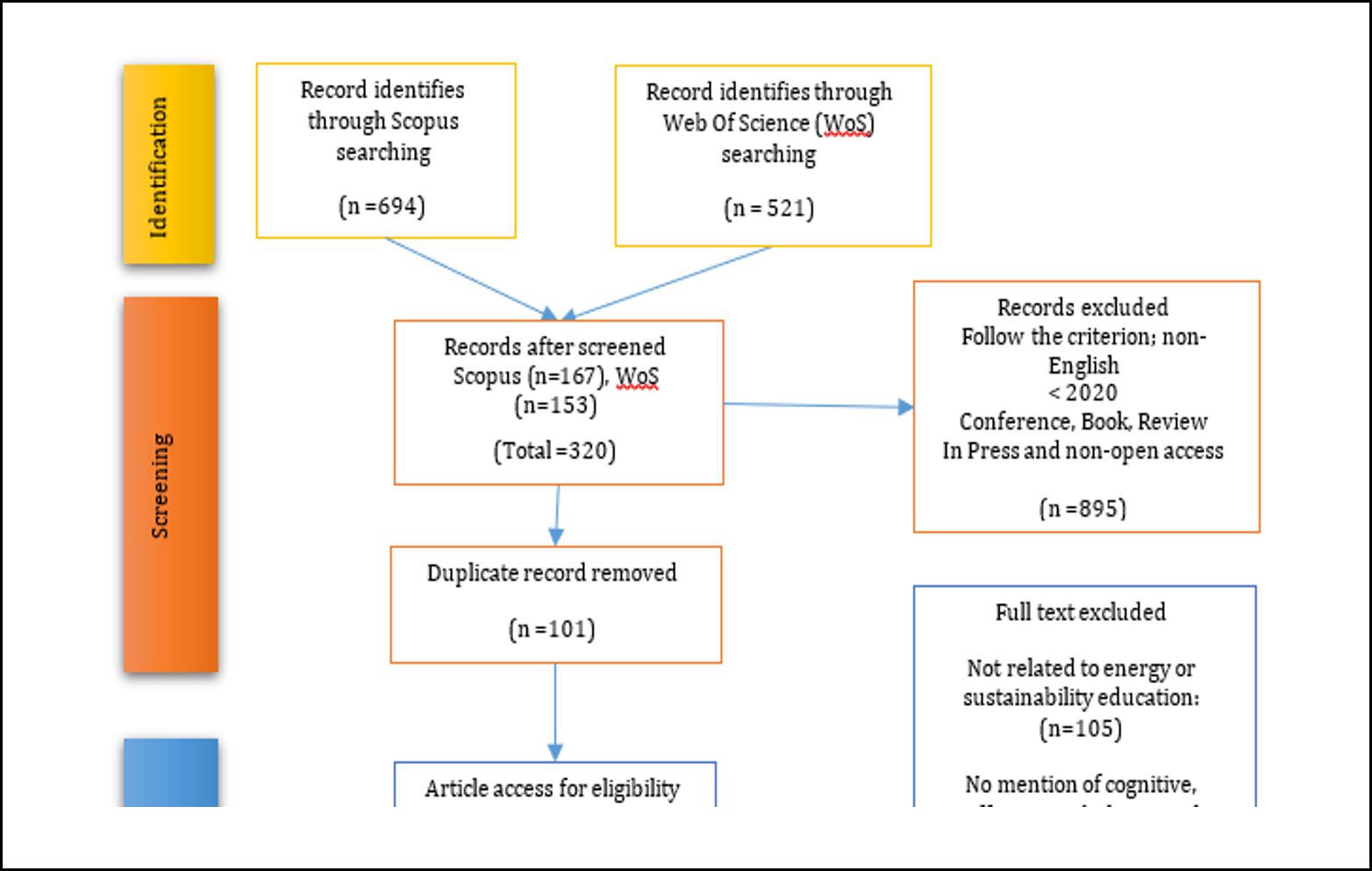
This systematic literature review (SLR) investigates the impact of cognitive, emotional, and behavioural aspects in sustainability and energy literacy education. Focusing on recent research published from 2020 to 2024, the study employs the Preferred Reporting Items for Systematic Reviews and Meta-Analyses (PRISMA) methodology to select, evaluate, and synthesise pertinent literature. The results reveal that whilst cognitive comprehension of sustainability is extensively covered, there remain deficiencies in nurturing emotional engagement and encouraging behavioural modifications amongst students. The analysis underscores the significance of cross-disciplinary methods, including project-based learning (PBL) and arts-integrated sustainability education, in effectively addressing these shortcomings. Moreover, the review identifies obstacles such as limited resources, inadequate teacher training, and difficulties in curriculum integration as impediments to successful implementation. The study concludes by outlining effective practices and approaches for enhancing energy literacy and sustainability education across various educational contexts.
Article Details

This work is licensed under a Creative Commons Attribution-NonCommercial-NoDerivatives 4.0 International License.
References
Agueda Gras-Velazquez, & Fronza, V. (2020). Sustainability in formal education: Ways to integrate it now. IUL Research, 1(2), 154–175. https://doi.org/10.57568/iulres.v1i2.84
Alkaher, I., Goldman, D., & Aram, I. (2024). An environmental and sustainability education center in Israel as a “street-level policy entrepreneur” for promoting teachers as change agents for sustainability. Environmental Education Research, 1–26. https://doi.org/10.1080/13504622.2024.2335612
Altassan, A. (2023). Sustainable integration of solar energy, behavior change, and recycling practices in educational institutions: A holistic framework for environmental conservation and quality education. Sustainability, 15(20), 15157. https://doi.org/10.3390/su152015157
Ardyansyah, A., & Rahayu, S. (2023). Development and implementation of augmented reality-based card game learning media with environmental literacy in improving students’ understanding of carbon compounds. Orbital: The Electronic Journal of Chemistry, 15(2), 118–126. https://doi.org/10.17807/orbital.v15i2.17617
Avelar, A. B. A., & Farina, M. C. (2022). The relationship between the incorporation of sustainability in higher education and the student’s behavior: Self-reported sustainable behavior scale. International Journal of Sustainability in Higher Education, 23(7), 1749–1767. https://doi.org/10.1108/IJSHE-07-2021-0260
Bruno, B., Cackowski, C., Frederick, J., Vincent, R., Bennett, A., Böttjer-Wilson, D., Engels, J., Flight, C., Lang, A., Lawrence, L., Smith, B., & Takacs, J. (2024). Applied education programming: Four exemplars in environmental literacy and teacher professional development. Oceanography, 37(1), 54–59. https://doi.org/10.5670/oceanog.2024.204
Chien, S.-I., Su, C., Chou, C.-C., & Wang, H.-H. (2021). Research insights and challenges of secondary school energy education: A dye-sensitized solar cells case study. Sustainability, 13(19), 10581. https://doi.org/10.3390/su131910581
Hernandez Gonzalez, F. (2023). Exploring the affordances of place-based education for advancing sustainability education: The role of cognitive, socio-emotional and behavioural learning. Education Sciences, 13(7), 676. https://doi.org/10.3390/educsci13070676
Herranen, J., Yavuzkaya, M., & Sjöström, J. (2021). Embedding chemistry education into environmental and sustainability education: Development of a didaktik model based on an eco-reflexive approach. Sustainability, 13(4), 1746. https://doi.org/10.3390/su13041746
Jäggle, G., Posekany, A., Lepuschitz, W., Koppensteiner, G., Zakall, S., Vincze, M., & Merdan, M. (2024). Educational practices for improvement of sustainability education at secondary school level. Science Activities, 61(4), 207–216. https://doi.org/10.1080/00368121.2024.2376758
Martins, A., Madaleno, M., & Dias, M. F. (2020). Energy literacy: What is out there to know? Energy Reports, 6, 454–459. https://doi.org/10.1016/j.egyr.2019.09.007
Muhamad, M. M., Syed Abdullah, S. I. S., & Mohamad Arsad, N. (2021). The theocentric worldview: Sustainability education for religion and spiritual. Jurnal Ilmiah Peuradeun, 9(2), 275. https://doi.org/10.26811/peuradeun.v9i2.587
Mulders, M., & Träg, K. H. (2023). Presence and flow as moderators in XR-based sustainability education. Sustainability, 15(23), 16496. https://doi.org/10.3390/su152316496
Ogunyemi, B., Ifegbesan, A., Benedict, H. T., Ogunsanya, A. O., Iyunade, O. T., Olubela, A., Itasanmi, B., & Edewor, K. (2022). Knowledge, perceptions and readiness of Nigeria’s beginning teachers for sustainability education. Journal of Teacher Education for Sustainability, 24(2), 180–194. https://doi.org/10.2478/jtes-2022-0024
Okada, A., & Gray, P. (2023). A climate change and sustainability education movement: Networks, open schooling, and the ‘CARE-KNOW-DO’ framework. Sustainability, 15(3), 2356. https://doi.org/10.3390/su15032356
Page, M. J., McKenzie, J. E., Bossuyt, P. M., Boutron, I., Hoffmann, T. C., Mulrow, C. D., Shamseer, L., Tetzlaff, J. M., Akl, E. A., Brennan, S. E., Chou, R., Glanville, J., Grimshaw, J. M., Hróbjartsson, A., Lalu, M. M., Li, T., Loder, E. W., Mayo-Wilson, E., McDonald, S., … Moher, D. (2021). The PRISMA 2020 statement: An updated guideline for reporting systematic reviews. The BMJ, 372. https://doi.org/10.1136/bmj.n71
Page, M. J., Moher, D., Bossuyt, P. M., Boutron, I., Hoffmann, T. C., Mulrow, C. D., Shamseer, L., Tetzlaff, J. M., Akl, E. A., Brennan, S. E., Chou, R., Glanville, J., Grimshaw, J. M., Hróbjartsson, A., Lalu, M. M., Li, T., Loder, E. W., Mayo-Wilson, E., McDonald, S., … McKenzie, J. E. (2021). PRISMA 2020 explanation and elaboration: Updated guidance and exemplars for reporting systematic reviews. The BMJ, 372. https://doi.org/10.1136/bmj.n160
Pillan, M., Costa, F., & Caiola, V. (2023). How could people and communities contribute to the energy transition? Conceptual maps to inform, orient, and inspire design actions and education. Sustainability (Switzerland), 15(19), 1–31. https://doi.org/10.3390/su151914600
Qu, M., Zollet, S., & Chiya, A. (2024). Island art sustainability education: A case study of Osakikamijima, Japan. Shima: The International Journal of Research into Island Cultures, 18(1), 68–88. https://doi.org/10.21463/shima.221
Stylos, G., Gavrilakis, C., Goulgouti, A., & Kotsis, K. T. (2023). Investigating energy literacy of pre-service primary school teachers in Greece. Interdisciplinary Journal of Environmental and Science Education, 19(4), e2318. https://doi.org/10.29333/ijese/13725
Xiao, Z., Duritan, M. J. M., & Jia, R. (2024). Resourceful futures: Integrating responsible mining and green education for sustainable development in developing and emerging economies. Resources Policy, 88, 104377. https://doi.org/10.1016/j.resourpol.2023.104377