
Reframing online learning in Malaysian higher education: a user-centred synthesis of student experience and regional digital challenges
Article Sidebar
Main Article Content
Abstract
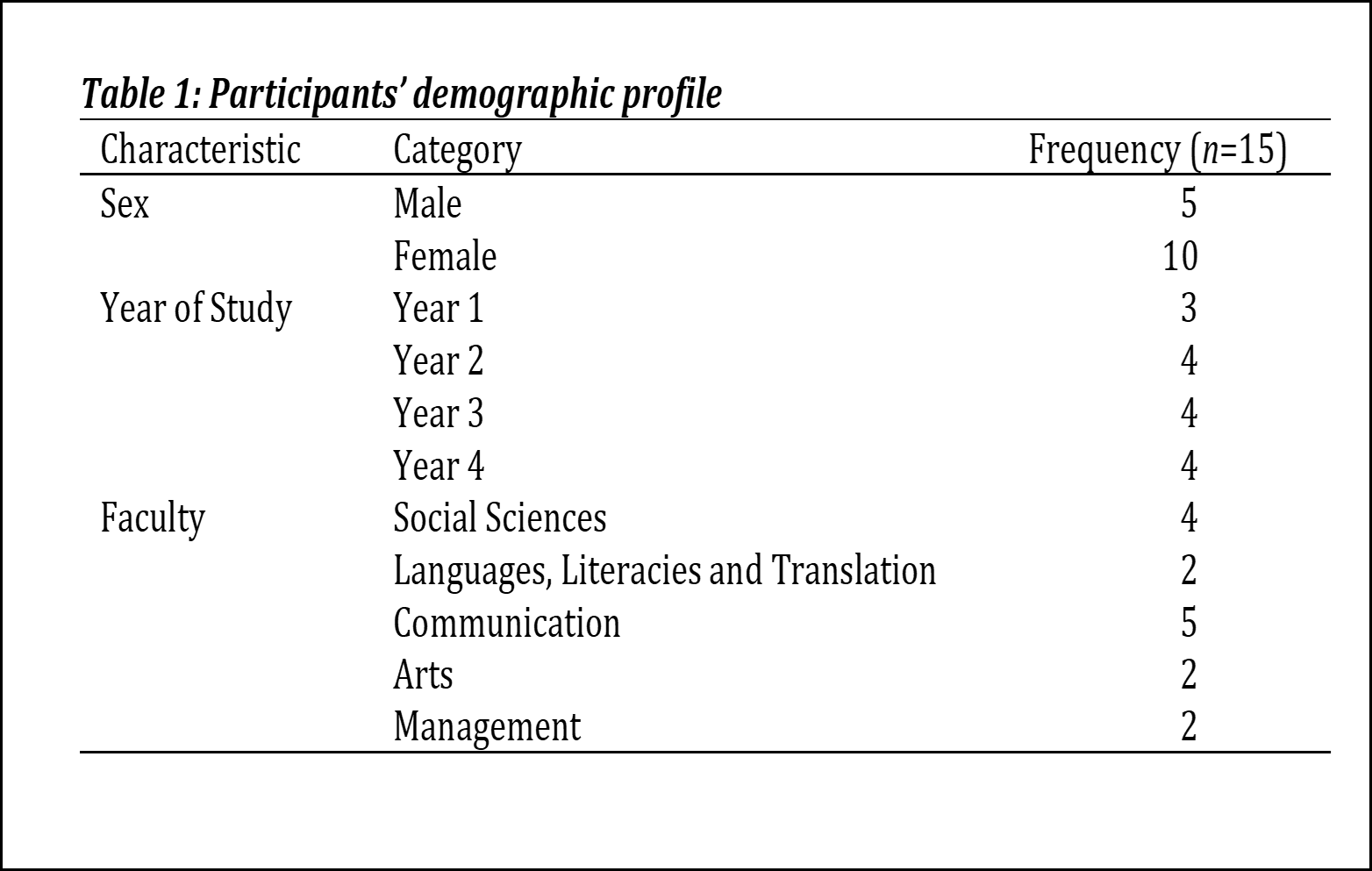
This study explores the experiences of undergraduate students at Universiti Sains Malaysia (USM) in navigating online learning environments, with a focus on user-centred perspectives and regional digital challenges in Malaysian higher education. As digital learning becomes increasingly embedded within higher education ecosystems, understanding students’ experiences is essential for developing more inclusive and responsive learning environments. Employing a qualitative research design, data were collected through semi-structured interviews with 15 purposively selected students from diverse academic and regional backgrounds. Thematic analysis revealed several recurring challenges, including unstable internet connectivity, limited interaction with lecturers and peers, difficulties in self-regulation, and reduced access to learning resources. Despite these challenges, students adopted various coping strategies such as structured time management, collaborative learning, and the use of digital productivity tools. The findings highlight the importance of improving digital infrastructure, strengthening learner support systems, and implementing user-centred pedagogical approaches that enhance engagement and accessibility. This study contributes to ongoing discussions on developing more equitable, resilient, and student-responsive digital learning ecosystems within Malaysian higher education.
Article Details

This work is licensed under a Creative Commons Attribution-NonCommercial-NoDerivatives 4.0 International License.
References
Adnan, M., & Anwar, K. (2020). Online learning amid the COVID-19 pandemic: Students’ perspectives. Journal of Pedagogical Sociology and Psychology, 2(1), 45–51. https://doi.org/10.33902/JPSP.2020.61309
Al-Kumaim, N. H., Mohammed, F., Gazem, N. A., Fazea, Y., Alhazmi, A. K., & Dakkak, O. (2021). Exploring the impact of transformation to fully online learning during COVID-19 on Malaysian university students’ academic life and performance. International Journal of Interactive Mobile Technologies, 15(05), 140. https://doi.org/10.3991/ijim.v15i05.20203
Almusharraf, N., & Khahro, S. (2020). Students’ satisfaction with online learning experiences during the COVID-19 pandemic. International Journal of Emerging Technologies in Learning, 15(21), 246–267. https://doi.org/10.3991/ijet.v15i21.15647
Al-Sa'di, A., & McPhee, C. C. A. (2021). User-centred design in educational applications: A systematic literature review. Proceedings of the 2021 International Conference on Engineering Technologies and Computer Science, 105–111. https://doi.org/10.1109/EnT52731.2021.00025
Almenara, A. P., Humanes, J., & Granollers, T. (2023). MPIu+aX, user-centred design methodology that empathizes with the user and generates a better accessible experience (from theory to practice). Proceedings of the XXIII International Conference on Human Computer Interaction, 1, 1–3. https://doi.org/10.1145/3612783.3612795
Araka, E., Maina, E., Gitonga, R., Oboko, R. O., & Kihoro, J. M. (2021). University students’ perception on the usefulness of learning management system features in promoting self-regulated learning in online learning. International Journal of Education and Development Using Information and Communication Technology, 17(1), 45–64.
Azlan, C. A., Wong, J. H. D., Tan, L. K., Huri, M. S. N. A., Ung, N. M., & Pallath, V. (2020). Teaching and learning of postgraduate medical physics using internet-based platforms during the COVID-19 pandemic: A case study from Malaysia. Physica Medica, 80, 10–16. https://doi.org/10.1016/j.ejmp.2020.10.002
Balta-Salvador, R., Olmedo-Torre, N., Pena, M., & Renta-Davids, A.-I. (2021). Academic and emotional effects of online learning during the COVID-19 pandemic on engineering students. Education and Information Technologies, 26(6), 7407–7434. https://doi.org/10.1007/s10639-021-10593-1
Braun, V., & Clarke, V. (2006). Using thematic analysis in psychology. Qualitative Research in Psychology, 3(2), 77–101. https://doi.org/10.1191/1478088706qp063oa
Castro, M. D. B., & Tumibay, G. M. (2021). A literature review: Efficacy of online learning courses for higher education institutions using meta-analysis. Education and Information Technologies, 26, 1367–1385. https://doi.org/10.1007/s10639-019-10027-z
Cobern, W., & Adams, B. (2020). Establishing survey validity: A practical guide. International Journal of Assessment Tools in Education, 7(3), 404–419. https://doi.org/10.21449/ijate.781366
EMIR Research. (2023). Hybrid tertiary education in Malaysia: Are we ready? https://www.emirresearch.com/hybrid-tertiary-education-in-malaysia-are-we-ready/
Figueroa, R. B., Nguyen, M. H., Ali, A., Kimura, L. N., Marisa, M., Jameel, A. H., & Gelisan, L. A. (2026). Integrating emerging technologies in virtual learning environments: A comparative study of perceived needs among open universities in five Southeast Asian countries. Journal of Educators Online, 23(1), 5. https://doi.org/10.9743/JEO.2026.23.1.5
Haleem, A., Javaid, M., Qadri, M. A., & Suman, R. (2022). Understanding the role of digital technologies in education: A review. Sustainable Operations and Computers, 3, 275–285. https://doi.org/10.1016/j.susoc.2022.05.004
Hussin, A. A. (2018). Education 4.0 made simple: Ideas for teaching. International Journal of Education and Literacy Studies, 6(3), 92–98. https://doi.org/10.7575/aiac.ijels.v.6n.3p.92
Jafar, A., Dollah, R., Mittal, P., Idris, A., Kim, J. E., Abdullah, M. S., Joko, E. P., Tejuddin, D. N. A., Sakke, N., Zakaria, N. S., Mapa, M. T., & Vun Hung, C. (2023). Readiness and challenges of e-learning during the COVID-19 pandemic era: A space analysis in Peninsular Malaysia. International Journal of Environmental Research and Public Health, 20(2), 905. https://doi.org/10.3390/IJERPH20020905
Law, K. L. S., & Kaur, H. (2025). Exploring the experiences and challenges of online learning at a private university in Malaysia. International Journal of Management, Finance and Accounting, 6(1), 277–307. https://doi.org/10.33093/ijomfa.2025.6.1.10
Mariana, R. R., & Nurjanah, N. (2023). Teacher digital literacy and instructional innovation in Southeast Asia: Comparative insights from global educational systems. Sinergi International Journal of Education, 1(3), 121–137. https://doi.org/10.61194/education.v1i3.583
Mohamad, F. F., & Yusuf, S. (2022). COVID-19 and the impact of online learning on higher institution students’ health. Malaysian Journal of Social Sciences and Humanities, 7(9), e001756. https://doi.org/10.47405/mjssh.v7i9.1756
Moreno, R. (2022). Managing user knowledge across boundaries: The case for software startups to adopt user-centred design (Doctoral dissertation, Loughborough University). https://hdl.handle.net/2134/14602710
Panadero, E. (2017). A review of self-regulated learning: Six models and four directions for research. Frontiers in Psychology, 8, Article 422. https://doi.org/10.3389/fpsyg.2017.00422
Palinkas, L. A., Horwitz, S. M., Green, C. A., Wisdom, J. P., Duan, N., & Hoagwood, K. (2015). Purposeful sampling for qualitative data collection and analysis in mixed method implementation research. Administration and Policy in Mental Health, 42(5), 533. https://doi.org/10.1007/S10488-013-0528-Y
Picciano, A. G. (2019). Theories and frameworks for online education: Seeking an integrated model. Online Learning, 23(1), 166–190. https://doi.org/10.24059/olj.v21i3.1225
Rapanta, C., Botturi, L., Goodyear, P., Guardia, L., & Koole, M. (2020). Online university teaching during and after the COVID-19 crisis: Refocusing teacher presence and learning activity. Postdigital Science and Education, 2, 923–945. https://doi.org/10.1007/s42438-020-00155-y
Raes, A., Vanneste, P., Pieters, M., Windey, I., Van Den Noortgate, W., & Depaepe, F. (2020). Learning and instruction in the hybrid virtual classroom: An investigation of students’ engagement and the effect of quizzes. Computers and Education, 143, 103682. https://doi.org/10.1016/j.compedu.2019.103682
Sangsuwan, W., Saithong, P., & Polpinij, J. (2025). Transforming higher education with digital solutions: A user-centred design framework for developing student handbook applications. European Journal of Educational Research, 15(1), 79–99. https://doi.org/10.12973/eu-jer.15.1.79
Seaba, V. S. (2021). A comparative study of student performance in traditional and online learning environments. Open Journal of Educational Development, 2(2), 12–25. https://doi.org/10.52417/ojed.v2i2.876
Tate, T., & Warschauer, M. (2022). Equity in online learning. Educational Psychologist, 57(3), 192–206. https://doi.org/10.1080/00461520.2022.2062597
Tong, Y., Lu, W., Zhao, Z., Lai, S., & Shi, T. (2024). MMDFND: Multi-modal multi-domain fake news detection. Proceedings of the 32nd ACM International Conference on Multimedia, 1178–1186. https://doi.org/10.1145/3664647.3681317
Yuli Endang Lestari, Y., Yuslim Alif Pudin, Y. A., & Vishnu Murti Wibowo, V. M. (2024). The impact of digital learning policies on educational equity in rural Indonesian schools. International Journal of Educational Evaluation and Policy Analysis, 1(2), 13–19. https://doi.org/10.62951/ijeepa.v1i2.74