
Roots and retail: identity-driven consumption in Sabah, Malaysia
Article Sidebar
Main Article Content
Abstract
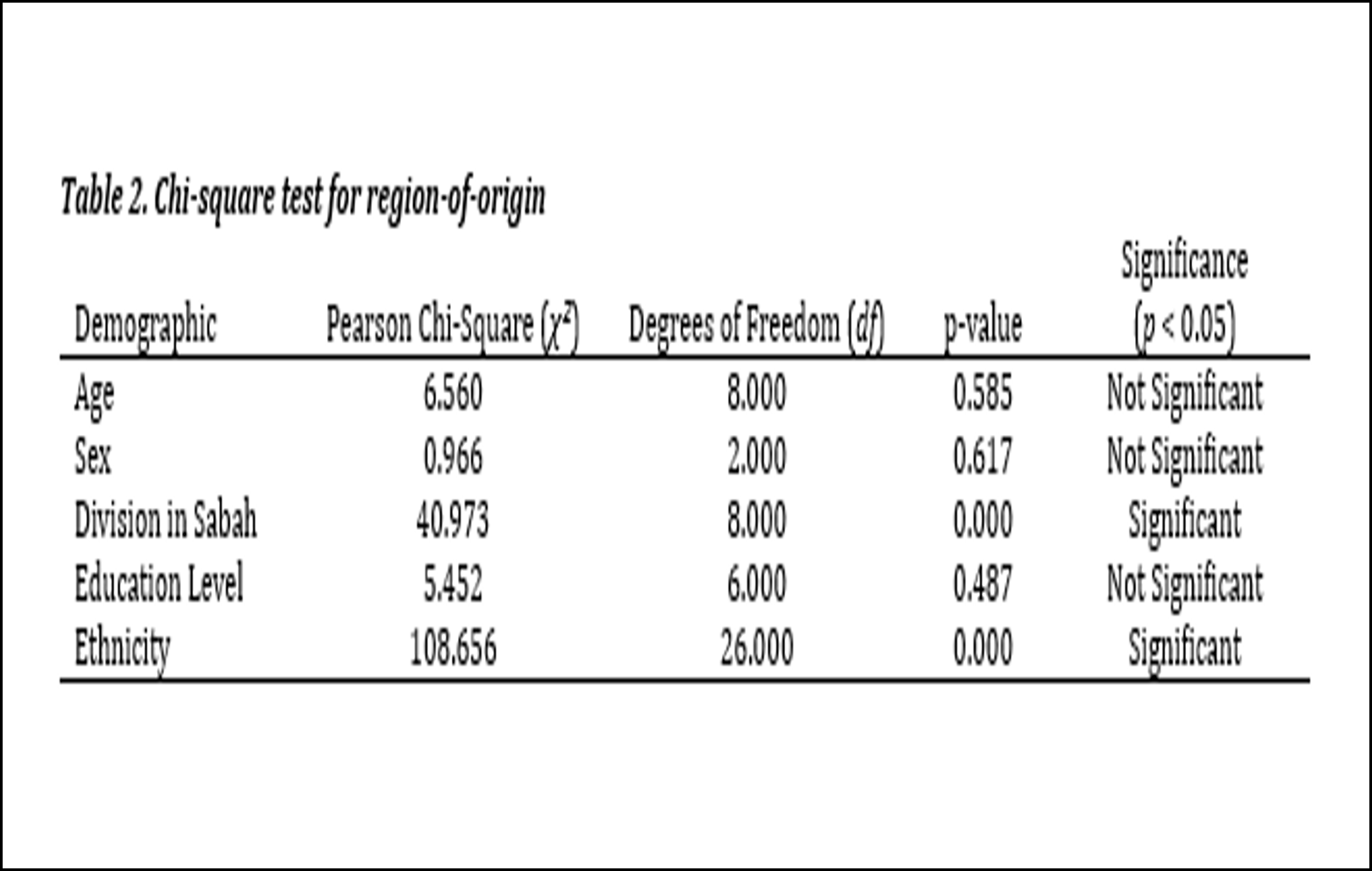
In culturally diverse regions such as Sabah and Malaysia, local identity and pride frequently influence consumer purchasing decisions, even amidst economic uncertainties. This study investigates how region-of-origin shapes consumer behavior regarding locally produced fast-moving consumer goods (FMCG), specifically rice, coffee, and chocolate. While country-of-origin often serves as a heuristic cue of quality on a global scale, exploring the impact of the region of origin within the context of everyday food and beverage consumption in regions such as Sabah provides novel insights. Utilizing data from an online survey conducted between July and August 2024, this study examined demographic variables including age, sex, geographic location, ethnicity, and educational background among 356 Sabah consumers who had previously purchased local FMCG products. The findings show that residents of the West Coast and individuals from the Kadazan/Dusun communities exhibit stronger preferences for products associated with their region. In contrast, factors such as age, sex, and education had no significant influence. The results emphasize that local identity and cultural ties drive consumer preferences for regional products, offering fresh insights from the Southeast Asian context to the existing literature. Consequently, businesses targeting this region may benefit from emphasizing region-of-origin in their marketing strategies to foster consumer loyalty. Nonetheless, this study acknowledges the limitations inherent in the self-reported data collection within Sabah. Future research should address these constraints by employing cross-cultural comparisons, broader regional analyses, and more diversified survey methodologies.
Article Details

This work is licensed under a Creative Commons Attribution-NonCommercial-NoDerivatives 4.0 International License.
References
Abdul Rahman, N., Esa, M. S., Mokhtar, S., & Sharif Adam, S. D. (2022). Perception of Brunei Malays in the acceptance of traditional food 'kelupis' in Sabah. Journal of Tourism, Hospitality and Environment Management, 7(29), 281-293. https://doi.org/10.35631/jthem.729019
Aldi, M., & Adisaputra, W. (2024). Optimizing brand loyalty: the effectiveness of influencer marketing and digital content campaigns mediated by consumer trust. Inspiration: Jurnal Teknologi Informasi Dan Komunikasi, 14(1), 63-73. https://doi.org/10.35585/inspir.v14i1.80
Bannor, R. K., & Abele, S. (2021). Consumer characteristics and incentives to buy labelled regional agricultural products. World Journal of Entrepreneurship, Management and Sustainable Development, 17(4), 872-888. https://doi.org/10.1108/WJEMSD-12-2020-0173
Bilkey, W. J., & Nes, R. (1982). Country-of-origin effects on product evaluations. Journal of International Business Studies, 13(Spring/Summer), 89-100. https://doi.org/10.1057/palgrave.jibs.8490539
Bissinger, K., & Herrmann, R. (2021). Regional origin outperforms all other sustainability characteristics in consumer price premiums for honey: empirical evidence for Germany. Journal of Economic Integration, 36(1), 162-184. https://doi.org/10.11130/jei.2021.36.1.162
Bryman, A. (2016). Social Research Methods (5th ed.). Oxford University Press.
Buchynska, O., Davlikanova, E., Lylyk, I., & Yashkina, O. (2021). Relationship between gender stereotype consumers of adverting and their attitude towards sexist advertising. Marketing and Digital Technologies, 5(4), 71-87. https://doi.org/10.15276/mdt.5.4.2021.6
Chacko, P. S. (2024). Effect of product evaluation on purchase intention toward white goods: mediating role of country of origin. Kelaniya Journal of Management, 13(1), 56-67. https://doi.org/10.4038/kjm.v13i1.7797
Chang, M. L. D., Lajuni, N., & Yong, K. (2023). The influence of social media influencers on the purchase behavior of local products in Sabah. Proceeding of the 7th International Conference on Family Business and Entrepreneurship. President University.
Charton-Vachet, F., Lombart, C., & Louis, D. (2020). Impact of attitude towards a region on purchase intention of regional products: the mediating effects of perceived value and preference. International Journal of Retail & Distribution Management, 48(7), 707-725. https://doi.org/10.1108/IJRDM-09-2019-0315
Chen, B. (2021). When foreign brands appear local, and local brands appear foreign: the asymmetric effects of foreign branding in developing countries. Asia Pacific Journal of Marketing and Logistics, 33(1), 145-161. https://doi.org/10.1108/APJML-06-2019-0396
Correia, R., Aksionova, E., Venciute, D., Sousa, J., & Fontes, R. (2025). User-generated content's influence on tourist destination image: a generational perspective. Consumer Behavior in Tourism and Hospitality, 20(2), 167-185. https://doi.org/10.1108/CBTH-11-2023-0208
Cvijanovic, D., Ignjatijevic, S., Tankosic, J. V., & Cvijanovic, V. (2020). Do local food products contribute to sustainable economic development? Sustainability (Switzerland), 12(7), 2847. https://doi.org/10.3390/su12072847
D'Acunto, F., Malmendier, U., & Weber, M. (2021). Gender roles produce divergent economic expectations. Proceedings of the National Academy of Sciences of the United States of America, 118(21), e2008534118. https://doi.org/10.1073/pnas.2008534118
Damanik, J., Priyambodo, T. K., Wibowo, M. E., Pitanatri, P. D. S., & Wachyuni, S. S. (2023). Travel behaviour differences among Indonesian youth in generations Y and Z: pre-, during and post-travel. Consumer Behavior in Tourism and Hospitality, 18(1), 35-48. https://doi.org/10.1108/CBTH-07-2021-0184
De Nisco, A., & Oduro, S. (2022). Partitioned country-of-origin effect on consumer behavior: a meta-analysis. Journal of International Consumer Marketing, 34(5), 592-615). https://doi.org/10.1080/08961530.2021.2022062
Dudziak, A., Stoma, M., & Osmolska, E. (2023). Analysis of consumer behaviour in the context of the place of purchasing food products with particular emphasis on local products. International Journal of Environmental Research and Public Health, 20(3), 2413. https://doi.org/10.3390/ijerph20032413
Dukic, S., Sokolov-Mladenovic, S., & Stankovic, J. (2023). The influence of loyalty programs on loyal consumer behavior. Marketing, 54(3), 157-168. https://doi.org/10.5937/mkng2303157D
Durbul, A., Ferto, I., & Zaien, S. (2021). Is organic food good for health and the environment? Regional and Business Studies, 13(2), 11-30. https://doi.org/10.33568/rbs.2919
Fallas Rodriguez, P., Viquez Barrantes, D., Cortes-Munoz, M., & Cubero Castillo, E. (2022). Thinking of an appellation of origin? Proving the sensory typicity of traditional fresh Turrialba cheese. International Journal of Dairy Technology, 75(1), 246-257. https://doi.org/10.1111/1471-0307.12815
Fam, K. S., Syed Annuar, S. N., Tan, K. L., Lai, F. H., & Ingko, I. A. (2020). touring destination and intention to consume indigenous food: a case of Kadazan-Dusun food in Sabah. British Food Journal, 122(6), 1883-1896. https://doi.org/10.1108/BFJ-08-2019-0635
Fang, Y. X., Gill, S. S., Kunasekaran, P., Rosnon, M. R., Talib, A. T., & Abd Aziz, A. (2022). Digital divide: an inquiry on the native communities of Sabah. Societies, 12(6), 148. https://doi.org/10.3390/soc12060148
Fang, Y. X., S. Gill, S., Rosnon, M. R., & Choo, Y. K. (2025). Exploring the role of ICT in promoting and preserving Kadazan-Dusun culture. Pertanika Journal of Social Sciences and Humanities, 33(S1), 39-54. https://doi.org/10.47836/pjssh.33.S1.03
Fernandez-Ferrin, P., Bande, B., Martin-Consuegra, D., Diaz, E., & Kastenholz, E. (2020). Sub-national consumer ethnocentrism and the importance of the origin of food products: an exploratory analysis. British Food Journal, 122(3), 995-1010. https://doi.org/10.1108/BFJ-09-2019-0746
Filete, C. A., Moreira, T. R., dos Santos, A. R., dos Santos Gomes, W., Guarconi, R. C., Moreli, A. P., Augusto, M. I., de Oliveira Abreu, R., Simmer, M. M. B., Caliman, A. D. C., Guimaraes, C. V., da Silva Berilli, S., Ferrao, M. A. G., da Fonseca, A. F. A., Partelli, F. L., Berilli, A. P. C. G., da Silva Oliveira, E. C., & Pereira, L. L. (2022). The new standpoints for the Terroir of Coffea Canephora from Southwestern Brazil: Edaphic and sensorial perspective. Agronomy, 12(8), 1931. https://doi.org/10.3390/agronomy12081931
Ge, J., Jo, M. S., & Sarigollu, E. (2023). how does cultural tightness-looseness affect attitudes toward a local vs foreign brand transgression? International Marketing Review, 40(6) 1456-1479. https://doi.org/10.1108/IMR-06-2022-0151
Goedertier, F., Weijters, B., & Van den Bergh, J. (2024). Are consumers equally willing to pay more for brands that aim for sustainability, positive societal contribution, and inclusivity as for brands that are perceived as exclusive? Generational, Gender, and Country Differences. Sustainability, 16(9), 3879. https://doi.org/10.3390/su16093879
Hanchukova, O., Velikova, N., & Koo, B. (2024). Cheers to local! Exploring consumer ethnocentrism in the context of regional wines. British Food Journal, 126(9), 3584-3603. https://doi.org/10.1108/BFJ-03-2024-0217
Harun, M. F., Al Bakry, N. S., Abd Rahman, K. E., Vincent Amos, F., & Johari, M. H. (2023). Semiotic and cultural analysis on local product brand name. International Journal of Academic Research in Business and Social Sciences, 13(1), 751-765. https://doi.org/10.6007/ijarbss/v13-i1/15884
Hasanzade, V., Elshiewy, O., & Toporowski, W. (2022). Consumer preferences and their willingness to pay for local products (by means of consumer ethnocentrism): an abstract. In F. Pantoja & S. Wu (Eds.), From Micro to Macro: Dealing with Uncertainties in the Global Marketplace (pp. 255-256). Springer, Cham. https://doi.org/10.1007/978-3-030-89883-0_72
Ho, K. F. X., Liu, F., & Tarabashkina, L. (2024). A Closer look at geographical indicators: how food labels influence product values, authenticity and willingness to pay premium prices. Asia Pacific Journal of Marketing and Logistics, 36(4), 837-861. https://doi.org/10.1108/APJML-11-2022-0926
Hong, E. J., & Kangas, M. (2022). The relationship between beliefs about emotions and emotion regulation: a systematic review. In Behaviour Change,39(4), 205-234. https://doi.org/10.1017/bec.2021.23
Hoskins, J., Verhaal, J. C., & Griffin, A. (2021). How within-country consumer product (or brand) localness and supporting marketing tactics influence sales performance. European Journal of Marketing, 55(2), 565-592. https://doi.org/10.1108/EJM-11-2018-0787
Hossain, S., Hossen, M. S. B., Zim, S. K., & Hebabi, I. El. (2024). Cultural dynamics and consumer behavior: an in-depth analysis of Chinese preferences for western imported products. GSC Advanced Research and Reviews, 20(3), 158-167. https://doi.org/10.30574/gscarr.2024.20.3.0345
Intharacks, J., Chikweche, T., & Stanton, J. (2023). The influence of ethnic identity on consumer behavior: Filipino and Lao consumers in Australia. Journal of International Consumer Marketing, 35(1), 63-78. https://doi.org/10.1080/08961530.2022.2055689
Ishra, R., Khanam, R., & Soar, J. (2022). Influence of food safety concerns on safe food purchasing at rural and urban consumers in Bangladesh. Appetite, 179, 106306. https://doi.org/10.1016/j.appet.2022.106306
Ittersum, K. van. (2001). The Role of Region of Origin in Consumer Decision-Making and Choice. Mansholt Graduate School. http://library.wur.nl/WebQuery/wurpubs/fulltext/82514
Ivanova, N., Volkova, A., & Patosha, O. (2022). The relationship between social identity and consumer behaviour. DIEM: Dubrovnik International Economic Meeting, 7(1), 72-79. https://doi.org/10.17818/DIEM/2022/1.8
Jad'ud'ova, J., Badida, M., Badidova, A., Markova, I., Tahunova, M., & Hroncova, E. (2020). Consumer behavior towards regional eco-labels in Slovakia. Sustainability (Switzerland), 12(12), 5146. https://doi.org/10.3390/su12125146
Jadudova, J., Stastna, M., Markova, I., & Hroncova, E. (2023). Regional labelling as a tool for supporting rural development: a Slovak case study. Agriculture (Switzerland), 13(5), 1053. https://doi.org/10.3390/agriculture13051053
Johansson, J. K., Douglas, S. P., & Nonaka, I. (1985). Assessing the impact of country of origin on product evaluations: a new methodological perspective. Journal of Marketing Research, 22(4), 388-396. https://doi.org/10.2307/3151584
Kankam, G. (2022). The Impact of COVID-19 Pandemic on the competence of business managers as mediation on the performance of fast-moving consumer goods in Ghana. Marketing and Branding Research, 9(1), 1-17. https://doi.org/10.33844/mbr.2022.60332
Kautish, P., & Khare, A. (2022). Antecedents of sustainable fashion apparel purchase behavior. Journal of Consumer Marketing, 39(5), 475-487. https://doi.org/10.1108/JCM-04-2020-3733
Kervyn, N., Fiske, S. T., & Malone, C. (2022). social perception of brands: warmth and competence define images of both brands and social groups. Consumer Psychology Review, 5(1), 51-68. https://doi.org/10.1002/arcp.1074
Kim, M., Lee, H., Kim, S., & Choi, L. (2024). The role of attachment to K-celebrity from a destination marketing perspective. Consumer Behavior in Tourism and Hospitality, 19(2), 221-236. https://doi.org/10.1108/CBTH-08-2023-0109
Kireeva, I. V., Kukva, E. S., Lyausheva, S. A., Zhade, Z. A., & Ilyinova, N. A. (2024). The potential of regional branding in strengthening russian national identity (cases of Adygea, Kabardino-Balkaria and Dagestan). Russian Journal of Regional Studies, 32(3), 368-387. https://doi.org/10.15507/2413-1407.127.032.202402.368-387
Kunjuraman, V. (2022). Local community participation challenges in community-based ecotourism development in Sabah, Malaysian Borneo. Community Development Journal, 57(3), 487-508. https://doi.org/10.1093/cdj/bsaa065
Kurusic, D., Macura, P., & Bandic, N. (2023). Consumer preferences towards imported food products in the Republic of Srpska. Marketing, 54(2), 123-135. https://doi.org/10.5937/mkng2302123k
Lanfranchi, A. G., Strehlau, S., Borini, F. M., & Melo, P. L. de R. (2021). Does origin matter? the impact of the institutional environment of the origin country on the internationalization of franchise chains. Multinational Business Review, 29(1), 96-115. https://doi.org/10.1108/MBR-01-2020-0020
Laszlo, V., & Wahlen, S. (2024). Exploring young consumer's understanding of local food through proximity and social representations. Frontiers in Sustainable Food Systems, 8. 1464548. https://doi.org/10.3389/fsufs.2024.1464548
Lee, J. Y., Pavasopon, N., Napasintuwong, O., & Nayga, R. M. (2020). Consumers' valuation of geographical indication-labeled food: the case of Hom Mali rice in Bangkok*. Asian Economic Journal, 34(1), 79-96. https://doi.org/10.1111/asej.12196
Liu, Q., Cao, J., Li, S., Wei, Y., & Ma, C. (2024). How hand-made affects consumers' perceived nutritional quality of organic food. Frontiers in Nutrition, 11, 1448751. https://doi.org/10.3389/fnut.2024.1448751
Lohan, A., Ganguly, A., & Kumar, C. (2020). 'What's foreign is better': a fuzzy analysis to evaluate factors that influence foreign product choice among Indian consumers. International Journal of the Analytic Hierarchy Process, 12(3). https://doi.org/10.13033/ijahp.v12i3.743
Maheswari, V., & Kannan, G. (2024). Exploring Brand Preference in Fast-Moving Consumer Goods: A Comparative Study of Rural and Urban Consumers in Salem. ShodhKosh: Journal of Visual and Performing Arts, 5(1), 1679-1690. https://doi.org/10.29121/shodhkosh.v5.i1.2024.1808
Malthus, C. (2017). The good research guide: for small-scale social research projects. Higher Education Research & Development, 36(4), 872-874. https://doi.org/10.1080/07294360.2017.1281284
Mehta, R. (2020). Gender-based differences in consumer decision-making styles: implications for marketers. Decision, 47(3), 319-329. https://doi.org/10.1007/s40622-020-00252-8
Meisin, E. K. R., & Gisip, I. A. (2022). The effect of cultural product attractiveness on Sabah local handicraft product performance: the mediating effect of product innovation. International Journal of Academic Research in Economics and Management Sciences, 11(3), 582-493. https://doi.org/10.6007/ijarems/v11-i3/14914
Merlino, V. M., Sciullo, A., Pettenati, G., Sottile, F., Peano, C., & Massaglia, S. (2022). "Local production": what do consumers think? Sustainability (Switzerland), 14(6), 3623. https://doi.org/10.3390/su14063623
Miljanovic, M. (2023). Presentation of the perceptual map of local wine brands. Marketing, 54(2), 103-111. https://doi.org/10.5937/mkng2302103m
Mohd. Yakin, H. S., Totu, A., Lokin, S. A., Sintang, S., & Mahmood, N. (2022). Tamu: its roles as a medium of cultural identity preservation among Sabah ethnic in the era of information technology and industrial revolution 4.0. E-Bangi Journal of Social Science and Humanities, 19(5), 152-162. https://doi.org/10.17576/ebangi.2022.1905.10
Nickel, K., Orth, U. R., & Kumar, M. (2020). Designing for the genders: the role of visual harmony. International Journal of Research in Marketing, 37(4), 697-713. https://doi.org/10.1016/j.ijresmar.2020.02.006
Organisation for Economic Co-operation and Development (OECD). (2022). OECD Employment Outlook 2022. OECD Publishing. https://doi.org/10.1787/1bb305a6-en
Osei, F., Owusu, J. D., & Kankam-Kwarteng, C. (2024). The strategic effect of hedonic and utilitarian value in building brand trust and brand satisfaction. International Journal of Entrepreneurship, Business and Creative Economy, 4(2), 66-79. https://doi.org/10.31098/ijebce.v4i2.2233
Pasirayi, S., Fennell, P. B., & Follmer, K. B. (2023). #Activism: investor reactions to corporate sociopolitical activism. Business and Society, 62(4), 704-744. https://doi.org/10.1177/00076503221110457
Pasquine, M., Moen, O., & Geo, R. G. (2022). Where are you from? the influence of an unfamiliar sub-national region of origin from familiar and unfamiliar countries on quality perceptions and purchase intentions. International Journal of Export Marketing, 5(1), 32. https://doi.org/10.1504/ijexportm.2022.127774
Popovic-Sevic, N., Jeremic, A., Slijepcevic, M., & Ilic, M. (2021). marketing focused on the online brand community: the example of Zara. Marketing, 52(1), 32-42. https://doi.org/10.5937/markt2101032p
Praxmarer-Carus, S., & Gathen, C. (2023). Advertising eco-friendly behavior to young adults: "sweat" or "do good"? Journal of Advertising Research, 63(3), 255-273. https://doi.org/10.2501/jar-2023-018
Rasyid, R. A., Ratnasari, V., & Anshori, M. Y. (2024). The effect of buy local campaign and consumer ethnocentrism on brand love among Indonesian youth consumers. Journal of Ecohumanism, 3(8), 9522-9543. https://doi.org/10.62754/joe.v3i8.5568
Reddy, G., & Dam, R. M. van. (2020). Food, culture, and identity in multicultural societies: insights from Singapore. Appetite, 149, 104633. https://doi.org/10.1016/j.appet.2020.104633
Riefler, P. (2020). Local versus global food consumption: the role of brand authenticity. Journal of Consumer Marketing, 37(3), 317-327. https://doi.org/10.1108/JCM-02-2019-3086
Rutherford, G., & Tuntivivat, S. (2024). Social-ecological semiotics and the complex organization of psyche, language, and culture. Culture & Psychology, 30(4), 871-886. https://doi.org/10.1177/1354067X241236726
Sabur, M. (2025). The role of cultural marketing in promoting local products to international markets: a case study in Indonesia. International Journal of Social and Human, 2(1), 10-18. https://doi.org/10.59613/b410w756
Saenz-Navajas, M. P., & Jeffery, D. W. (2021). Perspectives on wines of provenance: sensory typicality, quality, and authenticity. ACS Food Science and Technology, 2(8), 1371-1377. https://doi.org/10.1021/acsfoodscitech.1c00128
Sanchez-Bravo, P., Edgar Chambers, V., Noguera-Artiaga, L., Lopez-Lluch, D., Edgar Chambers, I. V., Carbonell-Barrachina, A. A., & Sendra, E. (2020). Consumers-attitude towards the sustainability of different food categories. Foods, 9(11), 1608. https://doi.org/10.3390/foods9111608
Santeramo, F. G., Lamonaca, E., Carlucci, D., De Devitiis, B., Seccia, A., Viscecchia, R., & Nardone, G. (2020). On the relevance of the region-of-origin in consumers studies. Bio-Based and Applied Economics, 9(2), 137-154. https://doi.org/10.13128/bae-8337
Septianto, F., Japutra, A., Sung, B., & Seo, Y. (2022). The interaction effect of country-of-origin positioning and cultural distance on international advertising effectiveness: a construal level perspective. International Marketing Review, 39(4), 931-954. https://doi.org/10.1108/IMR-10-2021-0291
Shen, D., Liu, F., & Richards, J. (2021). Branded there, made here? how country equity influences fashion product consumers in China. Journal of Global Fashion Marketing, 12(4), 291-308. https://doi.org/10.1080/20932685.2021.1939757
Shimp, T. A., & Sharma, S. (1987). Consumer ethnocentrism: construction and validation of the CETSCALE. Journal of Marketing Research, 24(3), 280. https://doi.org/10.2307/3151638
Silver, I., Newman, G., & Small, D. A. (2021). Inauthenticity aversion: moral reactance toward tainted actors, actions, and objects. Consumer Psychology Review, 4(1), 104318. https://doi.org/10.1002/arcp.1064
Siswanto, H. A., & Rudiatin, E. (2024). Cross-border trade Malaysia-Indonesia: involvement of Buton early immigrants. BASKARA: Journal of Business and Entrepreneurship, 6(2), 199-212. https://doi.org/10.54268/baskara.v6i2.21613
Soonsan, N., Thongmun, S., & Phakdee-auksorn, P. (2024). Understanding the gastronomy tourists' characteristics and perceptions: a cluster analysis of visitors to a creative city of gastronomy. Consumer Behavior in Tourism and Hospitality, 19(2), 253-267. https://doi.org/10.1108/CBTH-08-2023-0126
Sorrentino, A., Ferretti, M., Risitano, M., Del Chiappa, G., & Okumus, F. (2022). The influence of the onboard servicescape on cruisers' experiential state, delight and memorability. Consumer Behavior in Tourism and Hospitality, 17(1), 17-41. https://doi.org/10.1108/CBTH-11-2020-0258
Sun, B. L. (2024). Gender vs gender identity: which influences word-of-mouth communication more, and its implications for self-brand connection? in the case of Airbnb. Consumer Behavior in Tourism and Hospitality, 19(2), 297-309. https://doi.org/10.1108/CBTH-09-2022-0167
Tangit, T. M. (2023). Conceptualizing the language and cultural ideologies of the Kadazandusun in Sabah, Malaysian Borneo. In M. Hadzantonis & A. H. Omar (Eds.), The GLOCAL Proceedings: The GLOCAL Conference in Asia 2022 (pp. 167-178). The GLOCAL, the Global Council for Anthropological Linguistics Publishers. https://doi.org/10.47298/cala2022.5-1
Tarabashkina, L., Schepis, D., & Purchase, S. (2024). Country-of-origin, region-of-origin or terroir branding to entice premium price? the curious case of geographic place origin construal and psychic distance. Journal of Consumer Behaviour, 23(4), 2093-2109. https://doi.org/10.1002/cb.2327
Teeken, B., Garner, E., Agbona, A., Balogun, I., Olaosebikan, O., Bello, A., Madu, T., Okoye, B., Egesi, C., Kulakow, P., & Tufan, H. A. (2021). Beyond "women's traits": exploring how gender, social difference, and household characteristics influence trait preferences. Frontiers in Sustainable Food Systems, 5, 1-13. https://doi.org/10.3389/fsufs.2021.740926
Turcic, I., Cerovic, L., & Maradin, D. (2022). Willingness to pay price premium for products of Croatian family farms. Society and Economy, 44(3), 337-352. https://doi.org/10.1556/204.2022.00008
Unal, U., & Tascioglu, M. (2022). Sustainable, therefore reputable: linking sustainability, reputation, and consumer behaviour. Marketing Intelligence and Planning, 40(4), 497-512. https://doi.org/10.1108/MIP-03-2022-0102
Uzar, D. (2022). Consumers' knowledge of products with geographical indications in Serbia. Facta Universitatis, Series: Economics and Organization, 19(23), 199-211. https://doi.org/10.22190/fueo220806015u
Velarde-Mendivil, A., Camarena-Gomez, D., & Salgado-Beltran, L. (2021). Preferences towards the brand and origin of garlic (Allium Sativum L.). Revista de La Facultad de Agronomia, Universidad Del Zulia, 38(3), 733-750. https://doi.org/10.47280//revfacagron(luz).v38.n3.15
Verma, M., & Naveen, B. R. (2021). COVID-19 impact on buying behaviour. The Journal for Decision Makers, 46(1), 27-40. https://doi.org/10.1177/02560909211018885
Vishkin, A., Kitayama, S., Berg, M. K., Diener, E., Gross-Manos, D., Ben-Arieh, A., & Tamir, M. (2022). Adherence to emotion norms is greater in individualist cultures than in collectivist cultures. Journal of Personality and Social Psychology, 124(6), 1256-1276. https://doi.org/10.1037/pspi0000409
Vlastelica, T., Jovic, M., & Pavkovic, V. (2021). consumer preferences and attitudes in relation to the social and environmental dimensions of corporate social responsibility. Marketing, 52(3), 149-162. https://doi.org/10.5937/mkng2103149v
Vrontis, D., & Basile, G. (2022). New media marketing as a driver of enterprise country of origin (COO) offer in international markets. International Journal of Entrepreneurial Behaviour and Research, 28(5), 1222-1244. https://doi.org/10.1108/IJEBR-01-2021-0085
Waehning, N., & Filieri, R. (2022). Consumer motives for buying regional products: The REGIOSCALE. Marketing Letters, 33(2), 215-236. https://doi.org/10.1007/s11002-021-09572-w
Wang, J., Tao, J., & Chu, M. (2020). Behind the label: Chinese consumers' trust in food certification and the effect of perceived quality on purchase intention. Food Control, 108, 106825. https://doi.org/10.1016/j.foodcont.2019.106825
Zdravkovic, S. (2021). Country of origin image and consumer xenocentrism in the context of forming consumer attitudes and loyalty to foreign brands: moderating effect of cultural intelligence. Marketing, 52(1), 12-22. https://doi.org/10.5937/markt2101012z
Zhang, G., Wang, C. L., Liu, J., & Zhou, L. (2023). Why do consumers prefer a hometown geographical indication brand? exploring the role of consumer identification with the brand and psychological ownership. International Journal of Consumer Studies, 47(1), 74-85. https://doi.org/10.1111/ijcs.12806
Zhang, T., Chen, J., & Grunert, K. G. (2022). Impact of consumer global-local identity on attitude towards and intention to buy local foods. Food Quality and Preference, 96, 104428. https://doi.org/10.1016/j.foodqual.2021.1044288