
From knowledge to action: pathways to environmentally responsible behavior in eco-tourism destinations
Article Sidebar
Main Article Content
Abstract
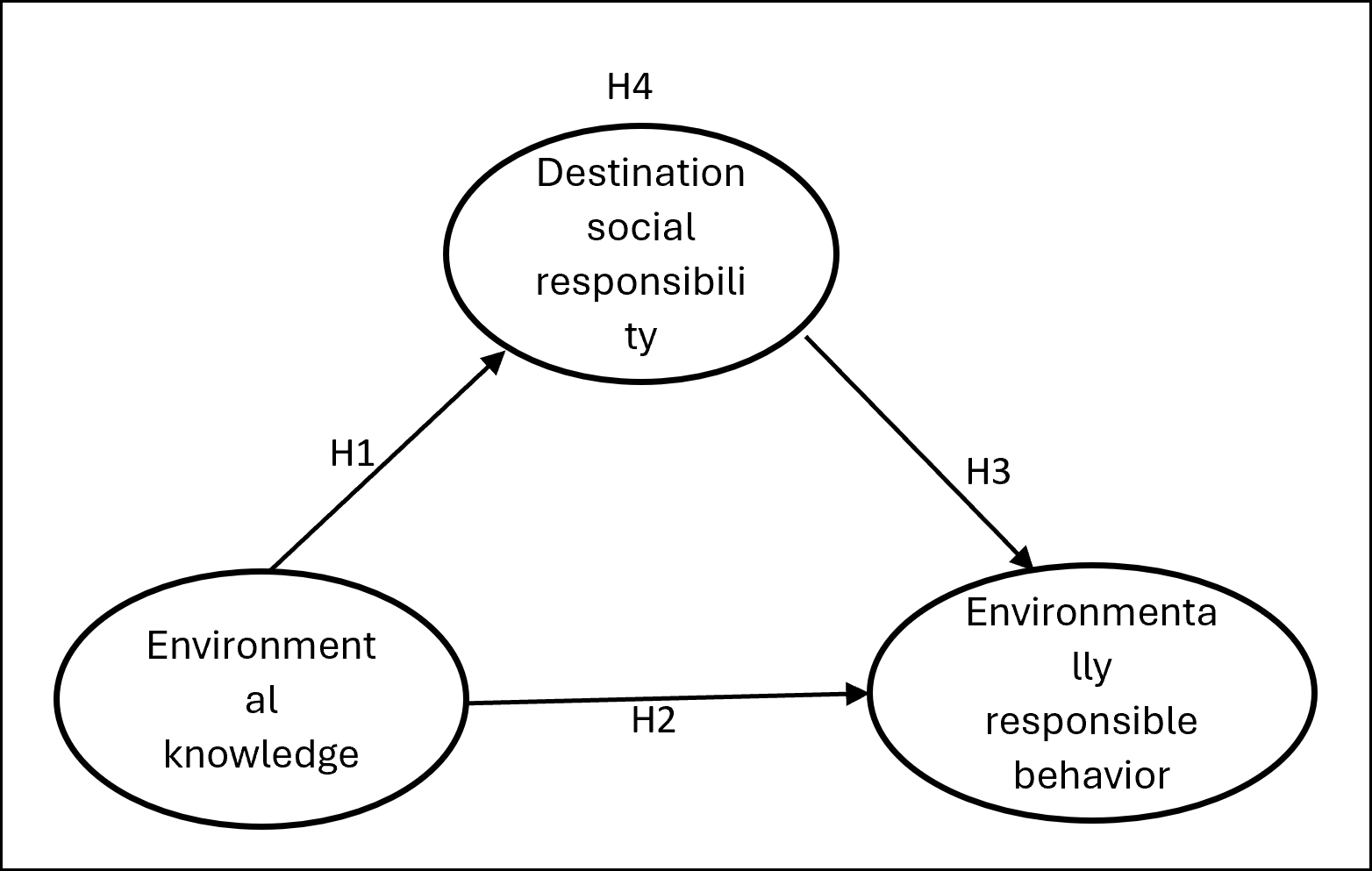
While tourists are drawn to eco-destinations for their scenic landscapes, recreational opportunities, and close interaction with nature, visitor-related environmental degradation has become increasingly unavoidable. Environmentally responsible behavior thus becomes essential for preserving these sites. This study proposes that visitors are more likely to engage in environmentally responsible behavior when they believe their actions will be positively reinforced through increased environmental knowledge or visible demonstrations of social responsibility at the destination. In this study, environmental knowledge is hypothesized to influence environmentally responsible behavior and destination social responsibility mediates this relationship. A total of 432 valid responses were collected from survey questionnaires, and SmartPLS was used to test the proposed hypothesis. The findings from this study revealed that environmental knowledge has a positive influence on destination social responsibility and environmental responsibility behavior. Destination social responsibility positively influences environmental responsibility behavior and mediates the relationship between environmental knowledge and environmental responsibility behavior. The results implied that awareness programs can cultivate a broader sense of ecological responsibility. It is expected that eco-destinations committed to sustainability initiatives encourage better visitor adherence to environmental norms while preserving the destination's ecological integrity.
Article Details

This work is licensed under a Creative Commons Attribution-NonCommercial-NoDerivatives 4.0 International License.
References
Aboelmaged, M. (2021). E-waste recycling behaviour: An integration of recycling habits into the theory of planned behaviour. Journal of Cleaner Production, 278, 124182.
Amoah, A., & Addoah, T. (2021). Does environmental knowledge drive pro-environmental behaviour in developing countries? Evidence from households in Ghana. Environment, Development and Sustainability, 23(2), 2719-2738.
Asif, M. H., Zhongfu, T., Dilanchiev, A., Irfan, M., Eyvazov, E., & Ahmad, B. (2023). Determining the influencing factors of consumers' attitude toward renewable energy adoption in developing countries: A roadmap toward environmental sustainability and green energy technologies. Environmental Science and Pollution Research, 30(16), 47861-47872.
Aziz, S., & Niazi, M. A. K. (2023). Understanding environmentally responsible behavior of tourists at coastal tourist destinations. Social Responsibility Journal, 19(10), 1952-1977.
Bamberg, S., & Moser, G. (2007). Twenty years after Hines, Hungerford, and Tomera: A new meta-analysis of psycho-social determinants of pro-environmental behaviour. Journal of Environmental Psychology, 27(1), 14-25.
Blau, P. M. (1964). Exchange and power in social life. Routledge.
Brovina, F., & Sallaku, D. (2024). Sustainable development of forest parks for active recreation: A balance between nature conservation and physical education. Ukrainian Journal of Forest & Wood Science, 15(3), 165-179.
Chen, Y. S., Lin, Y. H., & Wu, Y. J. (2020). How personality affects environmentally responsible behaviour through attitudes towards activities and environmental concern: Evidence from a national park in Taiwan. Leisure Studies, 39(6), 825-843.
Chiu, Y. T. H., Lee, W. I., & Chen, T. H. (2014). Environmentally responsible behavior in ecotourism: Antecedents and implications. Asia Pacific Journal of Tourism Research, 19(8), 876-889.
Chung, J. Y., & Lee, C.-K. (2019). The influence of destination social responsibility on tourists' pro-social and pro-environmental behaviors. Journal of Travel & Tourism Marketing, 36(5), 625-639.
Cohen, J. (2013). Statistical power analysis for the behavioral sciences. Routledge.
Fenitra, R. M., Premananto, G. C., Sedera, R. M. H., Abbas, A., & Laila, N. (2022). Environmentally responsible behavior and knowledge-belief-norm in the tourism context: The moderating role of types of destinations. International Journal of Geoheritage and Parks, 10(2), 273-288.
Fryxell, G. E., & Lo, C. W. H. (2003). The influence of environmental knowledge and values on managerial behaviours on behalf of the environment: An empirical examination of managers in China. Journal of Business Ethics, 46, 45-69.
Garcia-Maroto, I., Higueras-Castillo, E., Munoz-Leiva, F., & Liebana-Cabanillas, F. (2025). Environmentally responsible tourist behavior in socially responsible urban destinations. Tourism Review, 81(3), 1062-1080.
Hair, J. F., Howard, M. C., & Nitzl, C. (2020). Assessing measurement model quality in PLS-SEM using confirmatory composite analysis. Journal of Business Research, 109, 101-110.
Han, H., Morrison, A. M., Thong, B., & Lee, C.-K. (2019). Extending the theory of planned behavior: Visa exemptions and the traveler decision-making process. Tourism Geographies, 21(5), 825-845.
Henseler, J. (2020). Composite-based structural equation modeling: Analyzing latent and emergent variables. Guilford Publications.
Hubona, G. S., Schuberth, F., & Henseler, J. (2021). A clarification of confirmatory composite analysis (CCA). International Journal of Information Management, 61, 102399.
Kerber, H., & Kramm, J. (2021). On- and offstage: Encountering entangled waste-tourism relations on the Vietnamese Island of Phu Quoc. The Geographical Journal, 187(2), 98-109.
Khater, M., Muhammad Zeki Mahmood Al-Leheabi, S., & Faik, M. (2025). Navigating the challenges of over-tourism: Comparative insights and solutions from Petra and Karnak. Journal of Heritage Tourism, 20(2), 282-313.
Kuseni, M., Hermann, U. P., & Sifolo, P. P. S. (2025). Visitors' perspectives of ethical behaviour at the iSimangaliso Wetland Park in South Africa. Development Southern Africa, 42(1), 36-52.
Law, J. W., Lye, C. T., & Ng, T. H. (2023). Can environmental literacy and integrated behavioral factors encourage green practices at home? Evidence from Malaysia. Cleaner and Responsible Consumption, 10, 100134.
Lee, C. K., Olya, H., Ahmad, M. S., Kim, K. H., & Oh, M. J. (2021). Sustainable intelligence, destination social responsibility, and pro-environmental behaviour of visitors: Evidence from an eco-tourism site. Journal of Hospitality and Tourism Management, 47, 365-376.
Liu, P., Teng, M., & Han, C. (2020). How does environmental knowledge translate into pro-environmental behaviors? The mediating role of environmental attitudes and behavioral intentions. Science of the Total Environment, 728, 138126.
Nasr, E., Emeagwali, O. L., Aljuhmani, H. Y., & Al-Geitany, S. (2022). Destination social responsibility and residents' environmentally responsible behavior: Assessing the mediating role of community attachment and involvement. Sustainability, 14(21), 14153.
Neelis, I., Neuts, B., Nesterova, N., & Farkic, J. (2024). Sustainable mobility within nature areas: Literature review. Breda University of Applied Sciences. Available https://pure.buas.nl/ws/portalfiles/portal/35547689/MONA_D1.1.1_Sustainable_mobility_within_nature_areas_-_Literature_review.pdf
Rahman, S. A. A., Dura, N. H., Yusof, M. A., Nakamura, H., & Nong, R. A. (2020). Challenges of smart tourism in Malaysia eco-tourism destinations. Planning Malaysia, 18(4), 442-451.
Ramayah, T., Cheah, J., Chuah, F., Ting, H., & Memon, M. A. (2018). Partial least squares structural equation modeling (PLS-SEM) using SmartPLS 3.0: An updated guide and practical guide to statistical analysis (2nd edition). Pearson.
Ramkissoon, H., Smith, L. D. G., & Weiler, B. (2013). Testing the dimensionality of place attachment and its relationships with place satisfaction and pro-environmental behaviours: A structural equation modelling approach. Tourism Management, 36, 552-566.
Schroeder, H. W. (2021). Ecology of the heart: Understanding how people experience natural environments. In E. W. Ewert (Ed.), Natural resource management: The human dimension (pp. 13-27). Routledge.
Shah, S. S., & Asghar, Z. (2024). Individual attitudes toward environmentally friendly choices: A comprehensive analysis of the role of legal rules, religion, and confidence in government. Journal of Environmental Studies and Sciences, 14(4), 629-651.
Shmueli, G., Sarstedt, M., Hair, J. F., Cheah, J. H., Ting, H., Vaithilingam, S., & Ringle, C. M. (2019). Predictive model assessment in PLS-SEM: Guidelines for using PLSpredict. European Journal of Marketing, 53(11), 2322-2347.
Su, L., Huang, S. S., & Pearce, J. (2018). How does destination social responsibility contribute to environmentally responsible behaviour? A destination resident perspective. Journal of Business Research, 86, 179-189.
Su, L., & Swanson, S. R. (2017). The effect of destination social responsibility on tourist environmentally responsible behaviour: Comparative analysis of first-time and repeat tourists. Tourism Management, 60, 308-321.
Thong, J. Z., Mohamad, A. A., & Lo, M. C. (2020). Endowed and created resources towards ecotourism competitiveness: Natural protected areas in Sarawak. GeoJournal of Tourism and Geosites, 32(4), 1252-1258.
Xiao, J., Zhen, Z., Tian, L., Su, B., Chen, H., & Zhu, A. X. (2021). Green behavior toward a low-carbon society: Theory, measurement, and action. Journal of Cleaner Production, 278, 123765.