
Drivers of Islamic financial literacy: the roles of financial behavior, digital literacy, and financial socialization
Article Sidebar
Main Article Content
Abstract
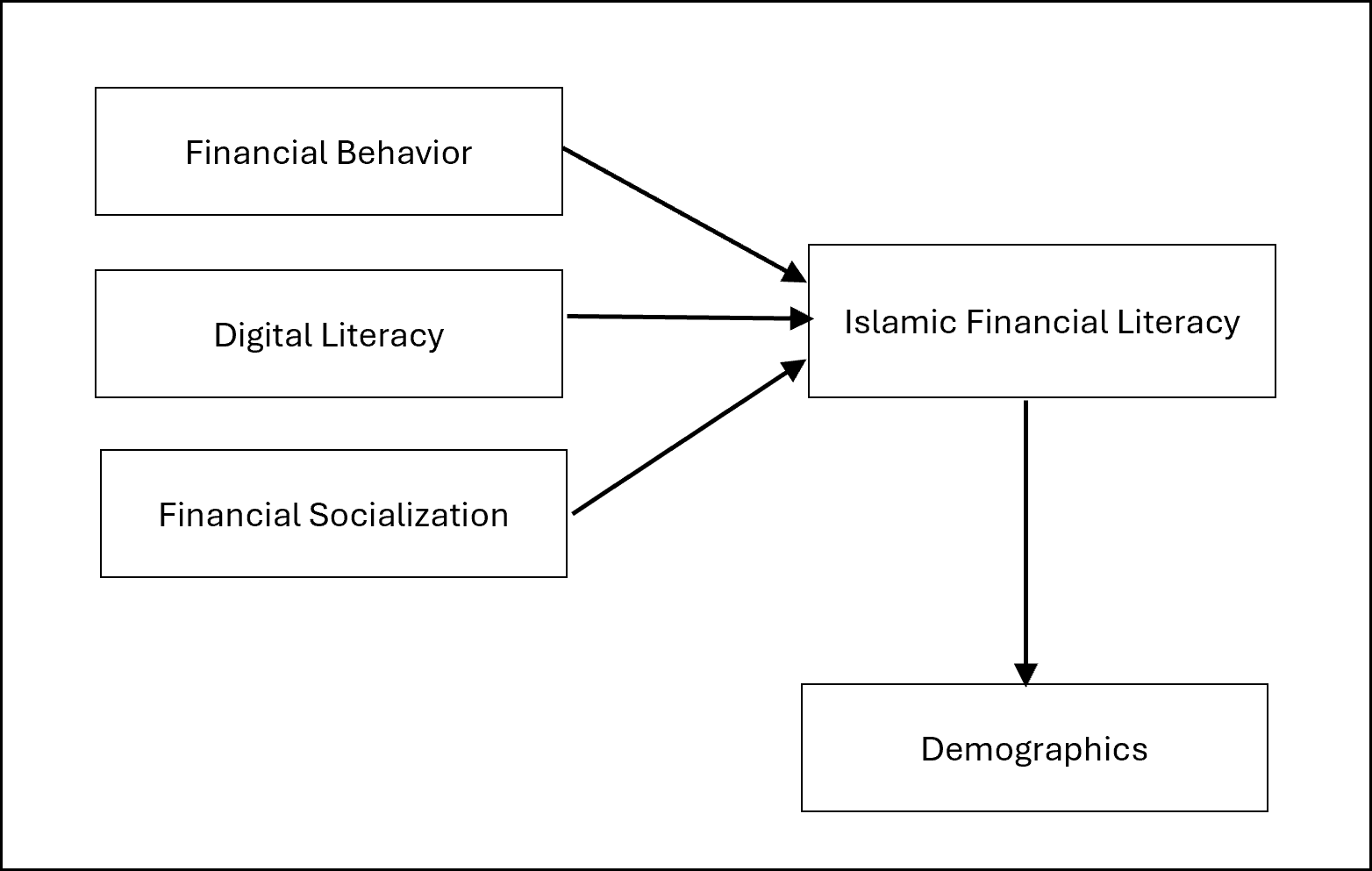
This study models the determinants of Islamic financial literacy (IFL) among university students in Malaysia, focusing on the roles of financial behavior, digital literacy, and financial socialization. Using a quantitative design, data were collected from 394 respondents using an online survey. The analysis employed ordinal logistic regression (OLR), and due to a violation of the proportional odds assumption, the generalized ordinal logistic model (GOLM) was applied to improve the model accuracy. The results indicate that financial behavior, digital literacy, and financial socialization are all statistically significant predictors of IFL at the 1% level. Among the demographic variables, age, year of study, field of study, and work experience were significantly associated with high IFL levels, whereas gender was statistically insignificant. Notably, financial socialization emerged as the strongest predictor, underscoring the influence of social and religious environments on financial knowledge acquisition. These findings suggest an urgent need for holistic educational interventions that integrate Shariah-compliant financial education with digital tools and social learning. This study’s insights offer valuable implications for universities and Islamic financial institutions seeking to improve IFL among youth.
Article Details

This work is licensed under a Creative Commons Attribution-NonCommercial-NoDerivatives 4.0 International License.
References
Ahmed, H. M. (2023, June 14). Why is Islamic financial literacy important for you & me? The Halal Times. https://www.halaltimes.com/why-is-islamic-financial-literacyimportant-for-you-me/
Ahn, T., Cunha, J. M., & Veith, P. (2024). Information transmission in groups: peer influence in high-stakes, irreversible financial decisions. Review of Economics and Statistics, 1–29. https://doi.org/10.1162/rest_a_01426
Albaity, M., & Rahman, M. (2019). The intention to use Islamic banking: an exploratory study to measure Islamic financial literacy. International Journal of Emerging Markets, 14(5), 988–1012. https://doi.org/10.1108/IJOEM-05-2018-0218
Alfarisi, M. F., Agestayani, A., & Delfiani, S. (2020). The impact of Islamic economics and finance courses on Islamic financial literacy. IQTISHADIA, 13(2), 197. https://doi.org/10.21043/iqtishadia.v13i2.7757
Ambuehl, S., Douglas, B. B., Ersoy, F., & Harris, D. (2018, September). Peer advice on financial decisions: a case of the blind leading the blind? NBER Working Paper No. w25034. https://ssrn.com/abstract=3250551
Anis Nasyietah, A. Z., & Nur Harena, R. (2023). Islamic financial literacy and living standard of women in Malaysia. International Journal of Advanced Research in Economics and Finance, 5(3), 235–247.
Anshika, S. A., & Mallik, G. (2021). Determinants of financial literacy: Empirical evidence from micro and small enterprises in India. Asia Pacific Management Review, 26(4), 248–255. https://doi.org/10.1016/j.apmrv.2021.03.001
Antara, P. M., Musa, R., & Hassan, F. (2016). Bridging Islamic financial literacy and halal literacy: the way forward in halal ecosystem. Procedia Economics and Finance, 37, 196–202. https://doi.org/10.1016/s2212-5671(16)30113-7
Asadi, K., Yousefi, Z., & Mahdad, A. (2023). The role of family in shaping financial literacy and economic behavior. Journal of Psychosociological Research in Family and Culture, 1(3), 22–29. https://doi.org/10.61838/kman.jprfc.1.3.4
Aziz, A., Giantoro Pamungkas, Alifa, N. L., Wendy Wijaya, & Layaman. (2023). The role of digital literacy and financial literacy on the use of Islamic Fintech moderated by religiosity the impact on personal financial management. International Journal of Sustainable Applied Sciences, 1(6), 759–776.
Bank of America. (2022). 8 simple ways to save money. Better Money Habits. https://bettermoneyhabits.bankofamerica.com/en/saving-budgeting/ways-to-save-money
Bai, R. (2023). Impact of financial literacy, mental budgeting and self control on financial wellbeing: Mediating impact of investment decision making. PLOS ONE, 18(11), e0294466. https://doi.org/10.1371/journal.pone.0294466
Bennett, R., & Wojno, M. (2024, April 10). 7 simple ways to build good money habits. Bankrate. https://www.bankrate.com/banking/savings/ways-to-build-good-money-habits/?tpt=a
Bhatti, M. (2019). Managing shariah non-compliance risk via Islamic dispute resolution. Journal of Risk and Financial Management, 13(1), 2. https://doi.org/10.3390/jrfm13010002
Choung, Y., Chatterjee, S., & Pak, T. Y. (2023). Digital financial literacy and financial well-being. Finance Research Letters, 58, 104438. https://doi.org/10.1016/j.frl.2023.104438
Consumer Financial Protection Bureau. (2023). Financial habits and norms. Consumer Financial Protection Bureau. https://www.consumerfinance.gov/consumer-tools/educator-tools/youth-financial-education/learn/financial-habits-norms/
Dewi, S., Febria, G., & Anggraini, R. (2022). Pengaruh teknologi keuangan terhadap preferensi konsumen memilih uang digital dalam transaksi keuangan. Jurnal Ilmiah Administrasi Bisnis Dan Inovasi, 6(1), 72–85. https://doi.org/10.25139/jiabi.v6i1.4602
Golden, W., & Cordie, L. (2022). Digital financial literacy. adult literacy education. The International Journal of Literacy, Language, and Numeracy, 4(3), 20–26. https://doi.org/10.35847/wgolden.lcordie.4.3.20
Hamzah, S.R, Mohd Fakhruddin, A., Ishak, N., & Rasedee, A. F. N. (2024a). Covid-19 financial relief scheme: an analysis of financial literacy and financial anxiety among Malaysia population. International Journal of Advanced Research in Economics and Finance, 6(3), 179–193.
Hamzah, S.R, Ahmad Tajudin, A. N., Ishak, N., & Rasedee, A. F. N. (2024b). Financial literacy and financial anxiety in Malaysia: determinants and behavioural influences. International Journal of Advanced Research in Education and Society, 6(3), 309–322.
Hamzah, S.R, Ahmad Tajudin, A. N., Ishak, N., & Rasedee, A. F. N. (2024c). The analysis of financial literacy that influences financial anxiety among Malaysians. 5th International Conference on Management, Education, Social Sciences and Innovation 2024.
Handayani, L., Ainun, B., & Fahmi, M. Y. (2021). The effect of Islamic financial literacy and financial inclusion toward financial planning among millennial: financial behaviour as an intervening variable. International Journal of Emerging Issues in Islamic Studies, 1(2), 60–67. https://doi.org/10.31098/ijeiis.v1i2.762
Harun, H., Sarman, M., & Kamaruddin, S. (2024). Determinants of Islamic financial literacy in OIC Countries: a comprehensive systematic review and analysis. Journal of Economic Cooperation and Development, 45(1), 227–248.
Hidajat, T., & Hamdani, M. (2017). Measuring Islamic financial literacy. Advanced Science Letters, 23(8), 7173–7176. https://doi.org/10.1166/asl.2017.9321
Hisan, K. (2019). Islamic financial literacy among students attending faculty of Islamic Economics and Business. Ihtiyath: Jurnal Manajemen Keuangan Syariah, 3(2), 113–122.
Hossain, B., & Abdullah, M. (2019). The importance of Islamic financial literacy for Muslims: a general review. Islam and Civilisational Renewal, 10(1), 106–117.
Huston, S. J. (2010). Measuring financial literacy. Journal of Consumer Affairs, 44(2), 296–316. https://doi.org/10.1111/j.1745-6606.2010.01170.x
InfoPro. (2023, January 16). 4 challenges faced by the Islamic banking sector in digital-age. INFOPRO. https://www.infopro.com.my/articles/challenges-faced-by-the-islamic-banking-sector-in-digital-age/
Investec. (2022). How to boost your financial confidence and manage your money. Investec. https://www.investec.com/en_gb/focus/beyond-wealth/how-to-boost-your-financial-confidence-and-manage-your-money.html
Kaur, D. (2023). A study on financial literacy among university students. Pacific Business Review, 16(2), 104–115. http://www.pbr.co.in/2023/2023_month/August/11.pdf
Khalisrani, H., Sabri, M. F., Johan, I. R., Burhan, N. A. S., & Mohd. Yusof, A. N. (2022). The influence of parental financial socialisation and financial literacy on university students' financial behaviour. International Journal of Economics and Management, 16(3), 351–364. https://doi.org/10.47836/ijeam.16.3.06
Klapper, L., Lusardi, A., & Panos, G. A. (2013). Financial literacy and its consequences: evidence from Russia during the financial crisis. Journal of Banking & Finance, 37(10), 3904–3923. https://doi.org/10.1016/j.jbankfin.2013.07.014
Kumar, P., Pillai, R., Kumar, N., & Tabash, M. I. (2022). The interplay of skills, digital financial literacy, capability, and autonomy in financial decision making and well-being. Borsa Istanbul Review, 23(1), 169–183. https://doi.org/10.1016/j.bir.2022.09.012
Md. Sapir @ Md. Shafik, A. S., & Wan Ahmad, W. M. (2020). Financial literacy among Malaysian Muslim undergraduates. Journal of Islamic Accounting and Business Research, 11(8), 1515–1529. https://doi.org/10.1108/JIABR-10-2017-0149
Mohamad Fazli Sabri, Wahab, R., Nurul Shahnaz Mahdzan, Amirah Shazana Magli, Husniyah Abd Rahim, Suhaimi, A., & Nur Shuhamin Nazuri. (2023). An enigma of Malaysia's low-income young adults: mediation of financial behaviour on financial well-being and locus of control cohesion. PLOS ONE, 18(7), e0288204. https://doi.org/10.1371/journal.pone.0288204
Moreland, K. A. (2018). Seeking financial advice and other desirable financial behaviors. Journal of Financial Counseling and Planning, 29(2), 198–207. https://doi.org/10.1891/1052-3073.29.2.198
Muhammad Zikry Hishamudin, Nur Shuhada Kamarudin, Hadi, N. A., & Ahmad, A. (2024). Intention to use digital platforms for Islamic financial education in Malaysia: structural equation model. Journal of Advanced Research in Applied Sciences and Engineering Technology, 49(1), 298–311. https://doi.org/10.37934/araset.49.1.298311
Mustafa Kevser, & Mesut Dogan. (2021). Islamic financial literacy and its determinants: a field study on Turkey. Transition Studies Review, 28(1), 91–120. https://doi.org/10.14665/1614-4007-28-1-008
Nik Azman, N. H., Abdul Hadi Zulkafli, Tajul Ariffin Masron, & Rahman, A. (2023). The interconnectivity between Islamic financial literacy and financial sustainability: evidence from Muslim micro-entrepreneurs in Malaysia. Journal of Islamic Accounting and Business Research, 16(4), 791–810. https://doi.org/10.1108/jiabr-07-2022-0191
Norzitah Abdul Karim, Zainora Ab Wahid, Suhaidi Ariffin, Syed, H., Ahmad Najib Nazlan, & Kassim, S. (2023). Financial literacy among university students and its implications towards financial scams. Information Management and Business Review, 15(3(I)), 124–128. https://doi.org/10.22610/imbr.v15i3(i).3560
Nurul, S., Mahdzan, Marhaini, W., Ahmad, W., & Zainudin, R. (2023). An exploratory study of objective Islamic financial literacy in the context of Malaysia. Turkish Journal of Islamic Economics (TUJISE), 12(1), 1–25. https://doi.org/10.26414/A4091
Nurul'ain, M., Razali, M., Yahaya, M., & Nadiyah Baharuddin, Z. (2024). The roles of Islamic financial technology (FINTECH) in fostering financial inclusion in Malaysia. Management and Accounting Review, 23(1), 329–355.
Osman, I., Syed, F., Mohsin Abdur Rehman, Ruhaini Muda, Hassan, F., Hassan, R., & Abdullah, H. (2023). The dilemma of millennial Muslims towards financial management: an Islamic financial literacy perspective. Journal of Islamic Marketing, 15(1), 59–78. https://doi.org/10.1108/jima-09-2021-0283
Pala, F., Aylin Erdogdu, Ali, M., Faisal Alnori, & Barut, A. (2023). Analyzing the linkage between Islamic financial literacy and Islamic banking services adoption: evidence from Turkey. Journal of Islamic Accounting and Business Research, 15(5), 784–817. https://doi.org/10.1108/jiabr-12-2021-0324
Saputra, A. D., & Rahmatia, A. (2021). Islamic financial literacy index of students: bridging SDGs of Islamic finance. Economics and Finance in Indonesia, 67(1), 34–50.
Servon, L. J., & Kaestner, R. (2008). Consumer financial literacy and the impact of online banking on the financial behavior of lower-income bank customers. Journal of Consumer Affairs, 42(2), 271–305. https://doi.org/10.1111/j.1745-6606.2008.00108.x
Setiawan, M., Effendi, N., Santoso, T., Dewi, V. I., & Sapulette, M. S. (2020). Digital financial literacy, current behavior of saving and spending and its future foresight. Economics of Innovation and New Technology, 31(4), 1–19. https://doi.org/10.1080/10438599.2020.1799142
Sia, G. (2024, June 12). FINCO survey highlights students' lack of financial preparedness for transition to adulthood. FINCO. https://www.finco.my/finco-survey-highlightsstudents-lack-of-financial-preparedness-for-transition-to-adulthood/
Siddharta, A. (2024). Malaysia: students in public higher education institutions by gender. Statista. https://www.statista.com/statistics/794845/students-in-public-higher-education-institutions-by-gender-malaysia/
Singh, V. (2024, November 18). Variance Inflation Factor (VIF): addressing multicollinearity in regression analysis. Datacamp. https://www.datacamp.com/tutorial/variance-inflation-factor
Tarver, E. (2023). Islamic Banking. Investopedia. https://www.investopedia.com/terms/i/islamicbanking.asp
Tavakol, M., & Dennick, R. (2011). Making sense of Cronbach's alpha. International Journal of Medical Education, 2(2), 53–55. https://doi.org/10.5116/ijme.4dfb.8dfd
Tranfaglia, A., Lloro, A., & Merry, E. (2024). Question design and the gender gap in financial literacy. Federal Reserve Board. https://www.federalreserve.gov/econres/notes/feds-notes/question-design-and-the-gender-gap-in-financial-literacy-20240102.html
Ullah, S., & Yusheng, K. (2020). Financial socialization, childhood experiences and financial well-being: the mediating role of locus of control. Frontiers in Psychology, 11, 2162. https://doi.org/10.3389/fpsyg.2020.02162
UNESCO. (2022, June 22). Digital literacy. UNESCO. https://uis.unesco.org/en/glossary-term/digital-literacy
Yanto, H., Ismail, N., Kiswanto, K., Rahim, N. M., & Baroroh, N. (2021). The roles of peers and social media in building financial literacy among the millennial generation: A case of Indonesian economics and business students. Cogent Social Sciences, 7(1), 1947579. https://doi.org/10.1080/23311886.2021.1947579
Yeni, F., Mulyani, S. R., & Susriyanti, S. (2023). Islamic financial literacy, spiritual intelligence, public perception and behaviour on public interest in Islamic banking services. Cogent Economics & Finance, 11(1), 2175470. https://doi.org/10.1080/23322039.2023.2175470
Zulfaka, A., & Kassim, S. (2023). Roles of Islamic financial literacy on financial decision making: building a conceptual framework based on theory of planned behavior and social cognitive theory. In Mansour, N., & Bujosa Vadell, L. M. (Eds.), Islamic sustainable finance, law, and innovation: opportunities and challenges (pp. 255–266). Cham: Springer Nature Switzerland.