
Turning satellite data into classroom discovery: teaching PM2.5 with NASA GIOVANNI
Article Sidebar
Main Article Content
Abstract
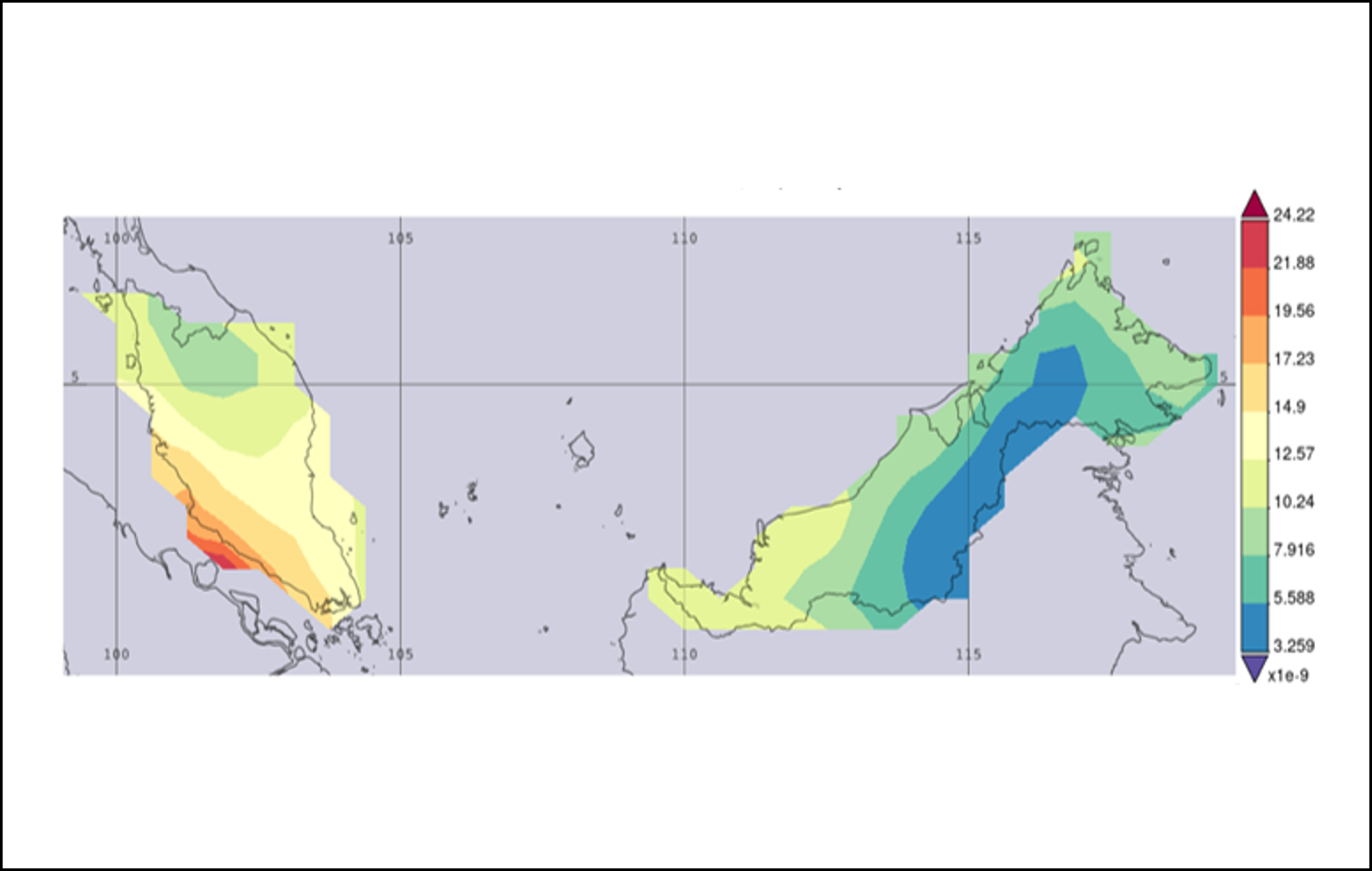
In the era of data-driven education, integrating big data into classroom instruction is becoming a powerful pedagogical tool, especially in environmental science. The aim of this study is to explore the potential of leveraging NASA’s Geospatial Interactive Online Visualisation and Analysis Infrastructure (GIOVANNI) platform in the classroom to enhance the teaching and learning of air pollution. This online platform was developed by NASA’s Goddard Earth Sciences Data and Information Services Centre (GES DISC). In this study, fine particulate matter (PM2.5) datasets acquired from MEERA-2 was used as a sample to demonstrate the capability of the platform to investigate spatial and temporal environmental phenomena over the Malaysia region. To investigate the spatial PM2.5 variation, the long-term averaged map (January 1980 to December 2024) and seasonal averaged map (DJF, MAM, JJA and SON) were constructed. Meanwhile, the temporal variation was investigated by developing area-averaged time series for the study period. In this study, monthly, annual, and seasonal time series were constructed. Sample discussions are also provided, such as haze events over the study region as in 1997 and 2015. These findings reveal how data exploration through GIOVANNI could support active and inquiry-based learning in the classroom. This study concludes with practical recommendations for incorporating GIOVANNI into the curriculum, enhancing teacher training and promoting interdisciplinary and collaborative data-based projects.
Article Details

This work is licensed under a Creative Commons Attribution-NonCommercial-NoDerivatives 4.0 International License.
References
Acker, J., Soebiyanto, R., Kiang, R., & Kempler, S. (2014). Use of the NASA GIOVANNI data system for geospatial public health research: Example of weather-influenza connection. ISPRS International Journal of Geo-Information, 3(4), 1372-1386.
Darmawan, A., Asyhari, T., Dunggio, I., Salmahaminati, & Aziz, M. (2024). Energy harvesting from tropical biomasses in Wallacea region: Scenarios, technologies, and perspectives. Biomass Conversion and Biorefinery, 14(17), 20017-20035.
Echtenbruck, M. M., Fuhles-Ubach, S., Naujoks, B., & Kaliva, E. (2025). A data literacy competence model for higher education and research (Technical report). arXiv. https://doi.org/10.48550/arXiv.2504.15690
Feng, Y., Fang, G., Ouyang, J., Guo, Y., Yang, X., Ji, W., et al. (2026). Risk of PM2.5 and its constituents for cardiovascular diseases: A cohort study of over 5.8 million participants. iScience, 29(2).
Hofner, S., & Schutze, A. (2021). Air quality measurements and education: Improving environmental awareness of high school students. Frontiers in Sensors, 2, 657920.
Jameaba, M.-S. (2024). Forest and land fire management in Indonesia: Can the past provide much needed lessons for the future? SSRN. https://doi.org/10.2139/ssrn.4898684
Kjelvik, M. K., & Schultheis, E. H. (2019). Getting messy with authentic data: Exploring the potential of using data from scientific research to support student data literacy. CBE-Life Sciences Education, 18(2), es2.
Lin, L., Zhou, D., Wang, J., & Wang, Y. (2024). A systematic review of big data driven education evaluation. SAGE Open, 14(2), 21582440241242180.
Liu, Z., & Acker, J. (2017). Giovanni: The bridge between data and science. Eos, 98, 24-30. https://doi.org/10.1029/2017EO079299
Liu, Z., Acker, J., Seiler, E., & Bryant, K. (2024, December). NASA Giovanni: Analyze, compare, and visualize more than 2000 Earth satellite and model variables without downloading data or software. Paper presented at the American Geophysical Union (AGU) Fall Meeting 2024.
Liu, Z., Shie, C. L., Li, A., & Meyer, D. (2020). NASA global satellite and model data products and services for tropical meteorology and climatology. Remote Sensing, 12(17), 2821.
Lloyd, S., Acker, J. G., Prados, A. I., & Leptoukh, G. G. (2008, December). Using NASA's Giovanni web portal to access and visualize satellite-based Earth science data in the classroom. Paper presented at the AGU Fall Meeting 2008.
Mahmud, M. M., & Wong, S. F. (2022). Digital age: The importance of 21st century skills among the undergraduates. Frontiers in Education, 7, 950553.
Montillet, J. P., Kermarrec, G., Forootan, E., Haberreiter, M., He, X., Finsterle, W., Fernandes, R., & Shum, C. K. (2024). How big data can help to monitor the environment and to mitigate risks due to climate change: A review. IEEE Geoscience and Remote Sensing Magazine, 12(2), 67-89.
O'Reilly, C. M., Josek, T., Darner, R. D., & Fortner, S. K. (2022). Pedagogy of teaching with large datasets: Designing and implementing effective data-based activities. Biochemistry and Molecular Biology Education, 50(5), 466-472.
Sabir, S., Hongsibsong, S., Chuljerm, H., Parklak, W., Ounjaijean, S., Fakfum, P., et al. (2025). Assessment of urinary oxidative stress biomarkers associated with fine particulate matter (PM2.5) exposure in Chiang Mai, Thailand. PeerJ, 13, e19047.
Shoari, N., Heydari, S., & Blangiardo, M. (2022). School neighbourhood and compliance with WHO-recommended annual NOz guideline: A case study of Greater London. Science of the Total Environment, 803, 150038.
Stojanov, A., & Daniel, B. K. (2024). A decade of research into the application of big data and analytics in higher education: A systematic review of the literature. Education and Information Technologies, 29(5), 5807-5831.
Williamson, B. (2017). Big data in education: The digital future of learning, policy and practice. SAGE Publications.
Yelistratova, L. A., Apostolov, A. A., Tomchenko, O. V., Khodorovskyi, A. Y., & Tymchyshyn, M. A. (2024). The application of remote monitoring tools in the educational process on the example of the research of the content of water vapor in the atmosphere. IOP Conference Series: Earth and Environmental Science, 1415(1), 012003. https://doi.org/10.1088/1755-1315/1415/1/012003