
Performative Inheritance through Academic Theatre: Reframing Intercultural Communication as Reflective Reasoning
Article Sidebar
Main Article Content
Abstract
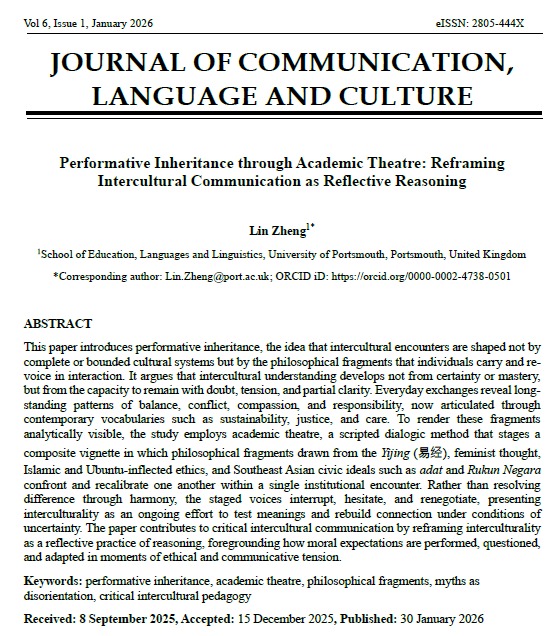
This paper introduces performative inheritance, the idea that intercultural encounters are shaped not by complete or bounded cultural systems but by the philosophical fragments that individuals carry and re-voice in interaction. It argues that intercultural understanding develops not from certainty or mastery, but from the capacity to remain with doubt, tension, and partial clarity. Everyday exchanges reveal long-standing patterns of balance, conflict, compassion, and responsibility, now articulated through contemporary vocabularies such as sustainability, justice, and care. To render these fragments analytically visible, the study employs academic theatre, a scripted dialogic method that stages a composite vignette in which philosophical fragments drawn from the Yijing, feminist thought, Islamic and Ubuntu-inflected ethics, and Southeast Asian civic ideals such as adat and Rukun Negara confront and recalibrate one another within a single institutional encounter. Rather than resolving difference through harmony, the staged voices interrupt, hesitate, and renegotiate, presenting interculturality as an ongoing effort to test meanings and rebuild connection under conditions of uncertainty. The paper contributes to critical intercultural communication by reframing interculturality as a reflective practice of reasoning, foregrounding how moral expectations are performed, questioned, and adapted in moments of ethical and communicative tension.
Article Details