
Intergenerational Cultural Transmission: A Phenomenological Inquiry into the Experiences of an Ilokano Filmmaker
Article Sidebar
Main Article Content
Abstract
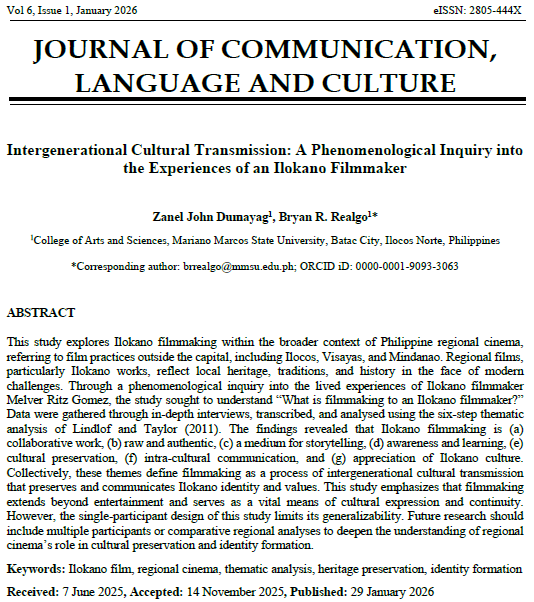
This study explores Ilokano filmmaking within the broader context of Philippine regional cinema, referring to film practices outside the capital, including Ilocos, Visayas, and Mindanao. Regional films, particularly Ilokano works, reflect local heritage, traditions, and history in the face of modern challenges. Through a phenomenological inquiry into the lived experiences of Ilokano filmmaker Melver Ritz Gomez, the study sought to understand “What is filmmaking to an Ilokano filmmaker?” Data were gathered through in-depth interviews, transcribed, and analysed using the six-step thematic analysis of Lindlof and Taylor (2011). The findings revealed that Ilokano filmmaking is (a) collaborative work, (b) raw and authentic, (c) a medium for storytelling, (d) awareness and learning, (e) cultural preservation, (f) intra-cultural communication, and (g) appreciation of Ilokano culture. Collectively, these themes define filmmaking as a process of intergenerational cultural transmission that preserves and communicates Ilokano identity and values. This study emphasizes that filmmaking extends beyond entertainment and serves as a vital means of cultural expression and continuity. However, the single-participant design of this study limits its generalizability. Future research should include multiple participants or comparative regional analyses to deepen the understanding of regional cinema’s role in cultural preservation and identity formation.
Article Details




References
Abi-Hashem, N., & Peterson, C. (2013). Intracultural communication. Online Library. https://doi.org/10.1002/9781118339893.wbeccp306
Adams, M. (2017). Mass Media and Communication. Larsen and Keller Education.
Adriano, L. (2021). Short horror film festival highlights Ilokano culture, tradition. Philippine News Agency. https://www.pna.gov.ph/articles/1157781
Antoniazzi, L. (2017). The Sustainability of Film Heritage: Cultural Policy, Digitalisation and Value. Retrieved from chrome-extension://efaidnbmnnnibpcajpcglclefindmkaj/https://etheses.whiterose.ac.uk/id/eprint/16918/1/Antoniazzi_L_Media%26Communication_PhD_2017.pdf
Batislaong, A. (2022). 7 Regional Film Festivals That Spotlight Filipino Creative Voices. https://nylonmanila.com/regional-film-festivals-that-spotlight-creative-voices-from-the-regions/
Birt, L., Scott, S., Cavers, D., Campbell, C., & Walter, F. (2016). Member checking: a tool to enhance trustworthiness or merely a nod to validation?. Qualitative health research, 26(13), 1802-1811.), 1802–1811. https://doi.org/10.1177/1049732316654870
Britannica, T. Editors of Encyclopedia. (2017, December 27). Auteur theory. Encyclopedia Britannica. https://www.britannica.com/art/auteur-theory
Buechler, C. (2020). What are the phases of film production. IPR College of Creative Arts. https://www.ipr.edu/blogs/digital-video-and-media-production/what-are-the-phases-of-film-production/
Carter, N., Bryant-Lukosius, D., DiCenso, A., Blythe, J., & Neville, A. J. (2014). The use of triangulation in qualitative research. Oncology nursing forum, 41(5), 545–547. https://doi.org/10.1188/14.ONF.545-547
Cherrier, M. H., & Rabiger, M. (2020). Directing: Film techniques and aesthetics. Routledge.
Dairo, M. (2021). The role of Indigenous films in preserving Nigerian culture: Analysis of Efunsetan Aniwura. Journal of Culture, Society and Development. https://doi.org/10.7176/jcsd/65-03
De Vera, M. J. B., & Saludadez, J. A. (2021). YouTube vlogging as access to possibilities: A phenomenological study of an OG Filipino vlogger. Plaridel, 18(2), 1–27. http://www.plarideljournal.org/article/youtubevlogging-asaccess-to-possibilities-a-phenomenological-study-of-an-og-filipino-vlogger/
Delhi, N. (2017). More 'socially relevant films' to create public awareness. Business Standard News. Retrieved from https://www.business-standard.com/article/news-ians/more-socially-relevant-films-to-create-public-awareness117083100386_1
Del Mundo, C. (2024). Disconnected Media and Other Essays. De La Salle University Publishing House.
Dickerson, A. (2012). Nothing but the truth and the whole truthiness: Examining markers of authenticity in the modern documentary. San Jose State University.
Dorsch, J. (2018). The history of Philippine cinema. Reel Run Down. https://reelrundown.com/film-industry/filipino-movies
Durian, R. (2013). Alternative cinema: A tool for creating awareness on societal issues. University of the Philippines Open University.
Ellis, J. (2021). How documentaries mark themselves out from fiction: a genre-based approach. Studies in Documentary Film, 15(2), 140–150. https://doi.org/10.1080/17503280.2021.1923144
Faulcon, E. (2012). Creating change through documentary film: An examination of select films. Valencia College. ResearchGate. https://www.researchgate.net/publication/254643669_Creating_Change_Through_Documentary_Film_An_Examination_of_Select_Films
Galeon, K. A. (2020). A documentary film for Ilokano cultural preservation. African Journal of Hospitality Tourism and Leisure. https://www.researchgate.net/publication/AdocumentaryfilmforIlocanoculturalpreservation/citation/download
Gancio, M. (2017). Philippine Contemporary Regional Cinema: A Narrative Analysis of Regional Filmmakers Accounts on the Re-emergence of Regional Films in the 21st Century. http://uruae.org/siteadmin/upload/UH0917119.pdf
Gaya, H. & Smith, E. (2016). Developing a Qualitative Single Case Study in the Strategic Management Realm: An Appropriate Research Design? International Journal of Business Management and Economic Research (IJBMER), Vol 7(2), 2016,529-538
Grant, P. D. (2020). Screening Place: Regional and Vernacular Cinemas in Cebu. Plaridel, 17(2), 23–41. http://www.plarideljournal.org/article/screening-place-regional-and-vernacular-cinemas-incebu
Groyon, V. (2014). Cinemarehiyon 2009. In J. Chua, R. Cruz-Lucero, & R. Tolentino (Eds.), A reader in Philippine film (pp. 177–196). University of the Philippines Press.
Hale, E. D., Treharne, G. J., & Kitas, G. D. (2007). Qualitative methodologies II: a brief guide to applying interpretative phenomenological analysis in musculoskeletal care. Musculoskeletal Care, 6(2), 86–96. https://doi.org/10.1002/msc.113
Hanich, J., & Fairfax, D. (2019). Introduction (to the structures of the film experience by Jean-Pierre Meunier). In J. Hanich & D. Fairfax (Eds.), The structures of the film experience by Jean-Pierre Meunier: Historical assessments and phenomenological expansions (pp. 9–13). Amsterdam University Press. https://doi.org/10.2307/j.ctvpbnq82.3
Hernandez, E. M. (2014). Digital Cinema in the Philippines 1999–2009. University of the Philippines.
Heuring, D. (2004). Preserving our heritage: Film remains the best archive material. Documentary.org. Retrieved from https://www.documentary.org/feature/preserving-our-heritage-film-remains-best-archive-material
Hjort, M., & Mackenzie, S. (2005). Cinema and nation. In Routledge eBooks. https://doi.org/10.4324/9780203977279
Jenkins, H. (2006). Confronting the challenges of participatory culture: Media education for the 21st century. John D. and Catherine T. MacArthur Foundation, Chicago, 3–7, 19–20.
Jenkins, P. (2022). 20 reasons why documentaries are important. Brilliant IO. Retrieved from https://brilliantio.com/why-documentaries-are-important/
Johansen, A. (2021). Guest column: Ways movies promote and preserve culture. https://everymoviehasalesson.com/blog/2021/12/guest-column-ways-to-promote-and-preserve-culture
Kamei, M. (2019). Film as cultural artefacts. International Journal of Advance and Innovative Research. Volume 6, Issue 1 (XXIX): Part - 3
Khatchadourian, H. (1975). Film as art. The Journal of Aesthetics and Art Criticism, 33(3), 271–284. https://doi.org/10.2307/428353
Koki, S. (1998). Storytelling: The heart & soul of education. Pacific Briefing Paper. Retrieved from https://himalaya.socanth.cam.ac.uk/collections/journals/jbs/pdf/JBS_20_07.pdf
Lim, B. C. (2018). Fragility, perseverance, and survival in state-run Philippine archives. Plaridel, 15(2), 1–40. https://doi.org/10.52518/2018.15.2-01bclim
Lindlof, T., & Taylor, B. (2011). Qualitative communication research methods. Sage Publications Inc.
Lu, Z. (2023). How do Films Reflect our Societies Today? An Analysis of Films and Film Genres. Communication Society and Media, 6 (4), 69. 10.22158/csm.v6n4p69
Luo, J. (2021). Analysis on the cultural transmission of film and TV music—Taking the film “Parasite” as an example. Atlantis Press. https://www.atlantis-press.com/proceedings/icadce-21/125960050
Mallari, M. A. (2021, September 2). The dynamics of globalization in the regional film The Chanters. Plaridel Journal. Retrieved March 21, 2023, from https://www.plarideljournal.org/article/the-dynamics-of-globalization-in-the-regional-film-the-chanters/
Martinez, L. (2022). Filmmaking as a medium to tell the stories that need to be told. https://www.ecufilmfestival.com/filmmaking-as-a-medium-to-tell-the-stories-that-need-to-be-told/
Matsumoto, D., & Hwang, H. (Eds.). (2013). Cultural influences on nonverbal behavior. SAGE Publications, Inc. https://doi.org/10.4135/9781452244037
McKim, C. (2023). Meaningful Member-Checking: A Structured Approach to Member Checking. American Journal of Qualitative Research. https://doi.org/10.29333/ajqr
Mojares, R. B. (1976). On native grounds: The significance of regional literature. In RogerR. J. Bresnahan (Ed.), Literature and society: Cross-cultural perspectives (pp. 154-158). USIS.
Mugas, J. M. (2021). Home-grown film-makers in Ilocos Norte document province’s heritage. Philippine Daily Inquirer. https://newsinfo.inquirer.net/1390616/home-grown-film-makers-in-ilocos-norte-document-provinces-heritage
Murphy, A. D., Manvell, R., Sklar, R., Andrew, D., & Stephenson, R. (2022, February 3). Film. Encyclopedia Britannica. https://www.britannica.com/art/motion-picture
Patino, B. R. A. (2018). From colonial policy to national treasure: Tracing the making of audiovisual heritage in the Philippines. Plaridel, 15(2), 41–70. https://doi.org/10.52518/2018.15.2-02patno
Perry, A. (2016). Film as an impetus for social awareness and change. Bahai Teachings Org. Retrieved from https://bahaiteachings.org/film-as-an-impetus-for-social-awareness-and-change/
Qualitative Researcher Dr Kriukow. (2022, July 5). Can a study have ONE research participant? Sampling in qualitative research [Video]. YouTube. https://www.youtube.com/watch?v=rYOOHHuLTLQ
Rapatan, M. (2017). Regional cinema: 1938–2014. In N. Tiongson (Ed.), CCP encyclopedia of Philippine art (Vol. 6: Film, pp. 82–91). Cultural Center of the Philippines.
Saludadez, J. (2021). Unit III. Methods of qualitative communication research. https://myportal.upou.edu.ph/course/view.php?id=8199
Shah, V. (2011). The role of film in society. Thought Economics. Retrieved from https://thoughteconomics.com/the-role-of-film-in-society/
Telles, J. P. (2020). Local film production in the Philippine Cordillera: Processes, motivations, and constraints. Plaridel, 17(2), 99–122. https://doi.org/10.52518/2020.17.2-05tells
Trommsdorff, G. (2008). Intergenerational relations and cultural transmission. In Cambridge University Press eBooks (pp. 126–160). https://doi.org/10.1017/cbo9780511804670.008
Van Manen, M., Higgins, I., & Van Der Riet, P. (2016). A conversation with Max van Manen on phenomenology in its original sense. Nursing and Health Sciences, 18(1), 4–7. https://doi.org/10.1111/nhs.12274