
From Morphemes to Meaning: Analysing the Names of Traditional Kelantan Kuih
Article Sidebar
Main Article Content
Abstract
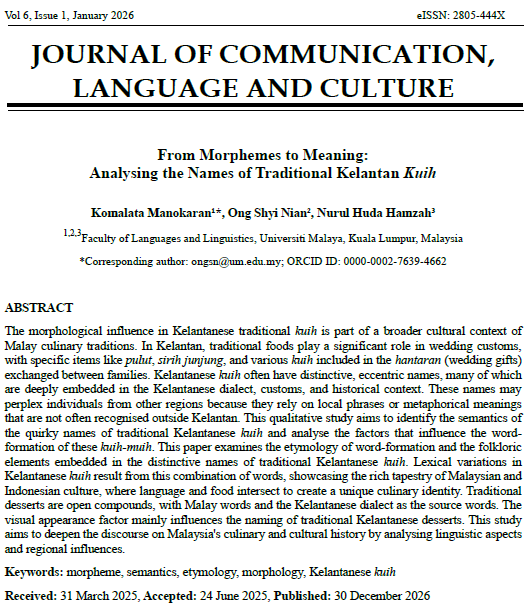
The morphological influence in Kelantanese traditional kuih is part of a broader cultural context of Malay culinary traditions. In Kelantan, traditional foods play a significant role in wedding customs, with specific items like pulut, sirih junjung, and various kuih included in the hantaran (wedding gifts) exchanged between families. Kelantanese kuih often have distinctive, eccentric names, many of which are deeply embedded in the Kelantanese dialect, customs, and historical context. These names may perplex individuals from other regions because they rely on local phrases or metaphorical meanings that are not often recognised outside Kelantan. This qualitative study aims to identify the semantics of the quirky names of traditional Kelantanese kuih and analyse the factors that influence the word-formation of these kuih-muih. This paper examines the etymology of word-formation and the folkloric elements embedded in the distinctive names of traditional Kelantanese kuih. Lexical variations in Kelantanese kuih result from this combination of words, showcasing the rich tapestry of Malaysian and Indonesian culture, where language and food intersect to create a unique culinary identity. Traditional desserts are open compounds, with Malay words and the Kelantanese dialect as the source words. The visual appearance factor mainly influences the naming of traditional Kelantanese desserts. This study aims to deepen the discourse on Malaysia's culinary and cultural history by analysing linguistic aspects and regional influences.
Article Details




References
Aleiya, N. (2019). Kuih Tradisional. https://aleiya98.weebly.com/pengenalan-mengenai-kuih-muih. html.
Anderson, C., Bjorkman, B., Denis, D., Done, J., Grant, M., Sanders, N., & Taniguchi, A. (2022). Chapter 5: Morphology. Essentials of Linguistics, 2nd edition.
Anggraeni, D. (2011). Word Formation Process in Outdoor Advertisement (A Case Study of Billboard Installed in Semarang). Semantic Scholar. https://www.semanticscholar.org/ paper/word-formation-process-in-outdoor-advertisement(a-Anggraeni/faa4a6e9cb0d7635fe46 7df3587d89207bf6dde3.
Arcodia, G. F., Grandi, N., & Montermini, F. (2009). Hierarchical NN Compounds in a Cross-Linguistic Perspective. Italian Journal of Linguistics, 21(1).
Azaman, A. M. (2020). Kisah Di Sebalik Nama Kuih Gelembung Buaya Yang Perlu Tahu. Sinar Plus. https://sinarplus.sinarharian.com.my/Lifestyle/ini-kisah-di-sebalik-nama-kuih-gelembung-bua ya-yang-perlu-tahu#google_vignette.
Aziz, Z.A., Daud, B., & Wiwin, M. (2019). Forming New Words: Compounds in Devayan. Studies in English Language and Education, 6(1), 108-116. https://www.researchgate.net/publication/3 31634639_Forming_new_words_Compounds_in_Devayan.
Bakar, S., Sahidol, J. N. M., & Harun, N. I. (2015). Uniknya Nama, Uniknya Rasa (Asal Usul Nama Kuih Tradisional Melayu). KONAKA Konferensi Akademik 2015. https://ir.uitm.edu.my/id /eprint/67942.
Benczes, R. (2015). Are Exocentric Compounds Really Exocentric? SKASE Journal of Theoretical Linguistics, 12 (3): 54–73. https://www.semanticscholar.org/paper/Are-Exocentric-Compo unds-Really-Exocen tricBenczes/f2bfbcbc64ce9edcc4ce5f4857d4cccb6d20 588c.
Bernama (2021). Tidak seganas nama, kuih gelembung buaya bangkitkan selera. Bernama. https://www.bernama.com/bm/news.php?id=1954648.
Bungsu, S.Hj., Misdih, M., & Damit, D. (2019). Identiti Budaya: Dalam Konteks Kuih Tradisional Etnik Brunei di Sabah. Journal of Borneo Social Transformation Studies (JOBSTS), 5(1). University Malaysia Sabah.
Clark, E. V., & Anglin, J. M. (1973). The Growth of Word Meaning. Language.
Cotterell, R., Kumar, A., & Schütze, H. (2021). Morphological Segmentation Inside-Out. Cornell University. https://doi.org/10.48550/arXiv.1911.04916.
Denham, K., & Lobeck, A. (2018). Why Study Linguistics (1st ed.). Routledge. https://doi.org/10.43 24/9780429444623.
Enzo, K. (2022). Morphology and Analysis in Descriptive Linguistics. University of Lancaster, Lancaster, Lancashire, UK. 10(3), pp.05–06, Prime Scholars Library. https://primescholars library.org/.
Fatimah. (2015). Iftat treat: Puteri Dua Sebilik. Patyskitchen. p. 1–15. https://patyskitchen.blogspot.c om /2015/07/iftat-treat-puteri-dua-sebilik.html.
Fitriyah, T., Amrulloh, M. A., & Nashoih, A. K. (2023). Word Formation in Arabic: A Morphological Analysis of Egyptian-Produced Snacks. An Nabighoh, 25(2), 163. https://doi.org/10.32332/an-nabighoh.v25i2.7700.
Hacken, P. T. (2017). Compounding in Morphology. Oxford Research Encyclopaedia of Linguistics. https://oxfordre.com/linguistics/view/10.1093/acrefore/9780199384655.001.0001/acrefore-9780199384655-e-251.
Hamzah, H., Karim, M.S.Ab., Othman, M., Hamzah, A. (2015). Challenges in Sustaining the Malay Traditional Kuih among Youth. International Journal of Social Science and Humanity, 5(5). pp. 472–478. https://doi.org/10.7763/IJSSH.2015.V5.502.
Hanni, I. (2022). Your Definite Guide for Kelantanese Kuih. Air Asia. https://explore.airasia.com/ assets/blte7e44c2b60698738/your-definitive-guide-to-kelantanese-kuih.
Haryati, C. (2014). A Study of Word Formation Process of Food and Beverage Product Names in Indonesia. Language Horizon, 2.
Justus, J. (2011). Carnap on Concept Determination: Methodology for Philosophy of Science. Euro Journal Philosophy Science 2, 161–179. https://doi.org/10.1007/s13194-011-0027-5.
Kamaruzaman, M. Y., Ab Karim, S., Che Ishak, F.A. & Arshad, M.M. (2020). The diversity of traditional Malay kuih in Malaysia and its potentials. Journal Ethnography Food, 7(22). https://doi.org/10.1186/s42779-020-00056-2.
Kamaruzaman, M. Y., Ab. Karim, M. S., Che Ishak, F.A. & Arshad, M.M. (2022). Exposing the nuances of traditional Malay kuih in Mersing district, Johor, Malaysia. Journal Ethnography Food, 9(23). https://doi.org/10.1186/s42779-022-00139-2.
Koh, J. (2016). Ultimate Guide to Malaysian Kuih: How Well Do You Know Your Kuih. https://www.timeout.com/kuala-lumpur/restaurants/ultimate-guide-to-malaysian-kuih.
Kosasih, H. E. (2013). Nilai-Nilai Moral Dalam Karya Sastra Melayu Klasik Islam: Kajian Terhadap Hikayat Raja Khaibar, Hikayat Saif Zulyazan, Serta Hikayat Mariam Zanariah Dan Nurdin Masri. Susurgalur Journal Kaji Sejarah Pendidik Sejarah, 1(1):11–26. http://10.2121/SUSUR GALUR.V1I1.53. G54.
Kusmana, A. (2021). Lexical Meanings the Names of Traditional Food Dishes Typical of Jambi Province. Titian: Jurnal Ilmu Humaniora. Vol. 05, No. 2, Disember 2021. https://online-journal.unja.ac.id/index.php/titian.
Lestari, O. W., Widiastuti, Y., Jazeri, M., & Busri, H. (2022). Lexicon in Tradition: Kuih Ashura Malay Society, Nakhon Si Thammarat, Thailand: An Ethnolinguistic Study. Eralingua: Jurnal Pendidikan Bahasa Asing dan Sastra, 6(2), 2022. University of Islam Malang, Indonesia. http://10.26858/eralingua.v6i2.32622.
Mohamad, S., & Hussain, H. (2017). Makanan Hantaran Dalam Perkahwinan Melayu Kelantan: Adat Dan Interpretasi. Jurnal Sains Sosial dan Kemanusiaan. http://pkukmweb. ukm.my/e-bangi/papers/2010/esah010.
Mukhibun, A., & Setyoningsih, R. U. (2024). Applied Linguistics (Gastronomic Study): Naming, Typical Characteristics, and Manufacturing Techniques on Documentation of Traditional Snacks at Purworejo District Market. Esteem Journal of English Education Study Programme. 7(2):520-535. http://10.31851/esteem.v7i2.15362.
Nordquist, R. (2025). Definition and Examples of Morphemes in English. ThoughtCo, Apr. 30, 2025. https://www.thoughtco.com/what-is-a-morpheme-1691406.
Pamungkas, K. (2015). Word-formation and Product Naming Strategy: A Study of Morphology. Jurnal Ilmiah Bina Bahasa. https://www.academia.edu/112905931/word_formation_and_pro duct_naming_strategy_a_study_of_morphology.
Punske, J. (2016). Compounding. Language and Linguistics Compass. https://doi.org/10.1111/lnc3. 12203.
Radzi, S. B. M. (2016). Pembuatan Dan Penamaan Kuih-Muih Tradisional Melayu. Universiti Teknologi MARA. https://ir.uitm.edu.my/id/eprint/16222/.
Rahman, A. Hj. Ab., Ahmad, W. I. W., Mohamad, M. Y., & Ismail, Z. (2011). Knowledge on Halal Food amongst Food Industry Entrepreneurs in Malaysia. Asian Social Science, 7(12). www.ccsenet.org/ass.
Rainer, F. (2021). Compounding: From Latin to Romance. Oxford Research Encyclopaedia of Linguistics. http://10.1093/acrefore/9780199384655.013.691.
Razali, J. R., Hassan, H., Mohamad, J. B., & Yusof, R. (2023). ‘Tahi’ dalam Otak Orang Melayu. International Journal of Humanities, Technology, and Civilisation, 8(2), 34–41. https://doi. org/10.15282/ijhtc.v8i2.9857.
Sahib, S. Z. (2018). Enaknya Kuih Primadona. Harian Metro. https://www.hmetro.com.my/WM/2018 /11/399077/enaknya-kuih-primadona.
Scalise, S., Fabregas, A., & Forza, F. (2009). Exocentricity in Compounding. Gengo Kenkyu, 135:49-83. http://10.11435/gengo.135.0_49.
Shuaib, A. A., & Enoch, O.F. (2013). The Kelantan traditional arts as indicators for sustainability: an introduction to its Genius Loci. Journal of Social Sciences, COES&RJ-JSS. https://ssrn.com /abstract=2246406.
Stukenbrock, A. (2021). Multimodal Gestalts and Their Change Over Time: Is Routinization Also Grammaticalization? Front. Commun. http://10.3389/fcomm.2021.662240.
Sun, K., & Baayen, R. H. (2021). Hyphenation as a Compounding Technique in English. Language Sciences. https://doi.org/10.1016/j.langsci.2020.101326.
Syaputri, K. D., Sari, D. P., & Zetira, Z. (2023). A Word-formation in Product Naming on Snack Brands. Jurnal Ilmiah Bina Bahasa. https://doi.org/10.33557/binabahasa.v16i1.2405.
Syaza, M. R. (2016). Pembuatan dan Penamaan Kuih-muih Tradisional Melayu. Universiti Teknologi MARA (UiTM). UiTM Institutional Repository.
Textor, M. (2007). The Use Theory of Meaning and Semantic Stipulation. Erkenntnis, 67(1), 29–45. http://www.jstor.org/stable/27667908.
Yusuf, A., & Shan, S. D. (2021). Compound Words Implementations in Novel' Flowers in the Attic' by V.C. Andrews Aprilulloh. LADU: Journal of Languages and Education, 2(1), 23–28. Universtias Bina Sarana Informatika, Jakarta, Indonesia. https://doi.org/10.56724/ladu.v2i1.76.