
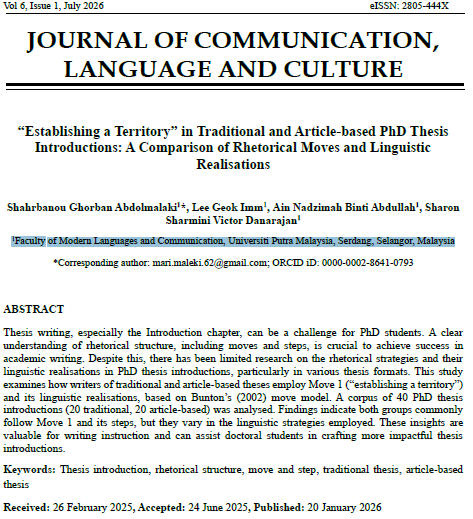
“Establishing a Territory” in Traditional and Article-based PhD Thesis Introductions: A Comparison of Rhetorical Moves and Linguistic Realisations
Article Sidebar
Main Article Content
Abstract
Thesis writing, especially the Introduction chapter, can be a challenge for PhD students. A clear understanding of rhetorical structure, including moves and steps, is crucial to achieve success in academic writing. Despite this, there has been limited research on the rhetorical strategies and their linguistic realisations in PhD thesis introductions, particularly in various thesis formats. This study examines how writers of traditional and article-based theses employ Move 1 (“establishing a territory”) and its linguistic realisations, based on Bunton’s (2002) move model. A corpus of 40 PhD thesis introductions (20 traditional, 20 article-based) was analysed. Findings indicate both groups commonly follow Move 1 and its steps, but they vary in the linguistic strategies employed. These insights are valuable for writing instruction and can assist doctoral students in crafting more impactful thesis introductions.
Article Details




References
Anderson, T., Alexander, I., & Saunders, G. (2020). An examination of education-based dissertation macrostructures. Journal of English for Academic Purposes, 45, 100845.
Anderson, T., & Okuda, T. (2019). Writing a manuscript-style dissertation in TESOL/applied linguistics. BC TEAL Journal, 4(1), 33-52.
Anderson, T., Saunders, G., & Alexander, I. (2022). Alternative dissertation formats in education-based doctorates. Higher Education Research & Development, 41(3), 593-612.
Anjum, M. T., & Masroor, F. (2023). Generic Moves in The Literature Review Section of PhD Dissertations. Pakistan Journal of Humanities and Social Sciences, 11(2), 2266-2279.
Baggs, J. G. (2011). The dissertation manuscript option, internet posting, and publication. Research in Nursing & Health, 34(2), 89-90.
Bhatia, V. K. (2014). Analysing genre: Language use in professional settings. Routledge.
Biber, D., Conrad, S., & Reppen, R. (1998). Corpus linguistics: Investigating language structure and use. Cambridge University Press.
Bitchener, J., & Basturkmen, H. (2006). Perceptions of the difficulties of postgraduate L2 thesis students writing the discussion section. Journal of English for Academic Purposes, 5(1), 4-18.
Buena, M. D. B. (2021). Moves analysis of the scientific thesis introductions of the Grade 12 STEM students of the University of the East-Caloocan Campus. Psychology and Education Journal, 58(4), 1690-1701.
Bunton, D. (2002). Generic moves in Ph.D. introductions: Chapters. Academic Discourse, 2(1), 57-75.
Carbonell-Olivares, M., Gil-Salom, L., & Soler-Monreal, C. (2009). The schematic structure of Spanish PhD thesis introductions. Spanish in Context, 6(2), 151-175.
Casal, J. E., Lu, X., Qiu, X., Wang, Y., & Zhang, G. (2021). Syntactic complexity across academic research article part-genres: A cross-disciplinary perspective. Journal of English for Academic Purposes, 52, 100996.
Cheung, Y. L. (2012). Understanding the writing of thesis introductions: An exploratory study. Procedia-Social and Behavioral Sciences, 46, 744-749.
Choe, H., & Hwang, B. H. (2014). A genre analysis of introductions in theses, dissertations and research articles based on Swales’ CARS Model. Korean Journal of Applied Linguistics, 30, 1-3.
Dong, J., & Lu, X. (2020). Promoting discipline specific genre competence with corpus based genre analysis activities. English for Specific Purposes, 58, 138–154. https://doi.org/10.1016/j.esp.2020.01.005
Dong, Y. R. (1998). Non-native graduate students’ thesis/dissertation writing in science: Self-reports by students and their advisors from two US institutions. English for Specific Purposes, 17(4), 369-390.
Dudley-Evans, T. (1986). Genre analysis: An investigation of the introduction and discussion sections of MSc dissertations. Talking about text, 14, 128.
Durling, D. (2013). Understanding the PhD by publication. Palgrave Macmillan.
Flowerdew, J., & Forest, R. W. (2009). Schematic structure and lexico-grammatical realisation in corpus-based genre analysis: The case of research in the PhD literature review. In M. Charles (Ed.), Academic Writing: At the Interface of Corpus and Discourse (pp. 15-37). London, England: Continuum International Publishing Group
Freeman, S., Jr. (2018). The manuscript dissertation: A means of increasing competitive edge for tenure-track faculty positions. International Journal of Doctoral Studies, 13, 273.
Geçíklí, M. (2013). A genre-analysis study on the rhetorical organisation of English and Turkish PhD theses in the field of English language teaching. International Journal of Business, Humanities and Technology, 3(6), 50-58.
Gross, D., Alhusen, J., & Jennings, B. M. (2012). Authorship ethics with the dissertation manuscript option. Research in Nursing & Health, 35(5), 431-434.
Gupta, R. (1995). Managing general and specific information in introductions. English for Specific Purposes, 14(1), 59-75.
Hussain, N., Hussain, M. B., & Khan, M. A. (2022). Rethinking PhD Thesis Introductions from Higher Education Perspective: Using the CARS Model. Archives of Educational Studies (ARES), 2(2), 184-204.
Hyland, K. (2024). Ken Hyland's essential bookshelf: Academic writing. Language Teaching, 57(3), 399-407.
Indrian, R. D., & Ardi, P. (2019). Rhetorical structures of English-major undergraduate thesis introduction chapters. Indonesian Journal of EFL and Linguistics, 4(2), 195-214.
Jalilifar, A., & Dabbi, R. (2012). Citation in applied linguistics: Analysis of introduction sections of Iranian master’s theses. Linguistik Online, 57(7), 91–104. https://doi.org/10.13092/lo.57.252
Kanoksilapatham, B. (2005). Rhetorical structure of biochemistry research articles. English for Specific Purposes, 24(3), 269-292.
Kawase, T. (2018). Rhetorical structure of the introductions of applied linguistics PhD theses. Journal of English for Academic Purposes, 31, 18-27.
Lee, J., Smith, A., & Chen, Y. (2023). AI-assisted textual analysis in academic research: Emerging trends and methodologies. Journal of Educational Data Science, 5(1), 45–67.
Lim, J. M. H., Loi, C. K., & Hashim, A. (2014). Postulating hypotheses in experimental doctoral dissertations on Applied Linguistics. Ibérica, (27), 121-141.
Lim, J. M. H., Loi, C. K., Hashim, A., & Liu, M. S. M. (2015). Purpose statements in experimental doctoral dissertations submitted to US universities: An inquiry into doctoral students’ communicative resources in language education. Journal of English for Academic Purposes, 20, 69-89.
Loan, N. T. T., & Pramoolsook, I. (2015). Move analysis of results-discussion chapters in TESOL master’s theses written by Vietnamese students. 3L: Southeast Asian Journal of English Language Studies, 21(2), 123-145.
Loi, C. K., Lim, J. M. H., & Wharton, S. (2016). Purpose statements in grant proposals: An interdisciplinary study. English for Specific Purposes, 42, 78–91.
Lu, X., & Ai, H. (2015). Syntactic complexity in college-level English writing: Differences among writers with diverse L1 backgrounds. Journal of second language writing, 29, 16-27.
Lu, X., Yoon, J., & Kisselev, O. (2021). Matching phrase-frames to rhetorical moves in social science research article introductions. English for Specific Purposes, 61, 63-83.
Monreal, C. S., & Salom, L. G. (2011). A cross-language study on citation practice in PhD theses. International Journal of English Studies, 11(2), 53-75.
Nguyen, L. T. T., & Pramoolsook, I. (2014). Rhetorical structure of introduction chapters written by novice Vietnamese TESOL postgraduates. 3L, Language, Linguistics, Literature, 20(1): 61-74
Nwogu, K. N. (1997). The medical research paper: Structure and functions. English for specific purposes, 16(2), 119-138.
Ono, M. (2017). Move-step structures of literature Ph. D. theses in the Japanese and UK higher education. Journal of Writing Research, 8(3), 469-491.
Paltridge, B. (2002). Thesis and dissertation writing: an examination of published advice and actual practice. English for Specific Purposes, 21(2), 125-143.
Paltridge, B., & Starfield, S. (2019). Thesis and dissertation writing in a second language: A handbook for students and their supervisors. Routledge.
Peacock, S. (2017). The PhD by publication. International Journal of Doctoral Studies, 12, 123-134.
Pho, P. (2013). Authorial Stance in Research Articles: Examples from Applied Linguistics and Educational Technology. Springer.
Pho, P. D. (2008). Research article abstracts in applied linguistics and educational technology: A study of linguistic realisations of rhetorical structure and authorial stance. Discourse studies, 10(2), 231-250.
Pojanapunya, P., & Watson Todd, R. (2011, June). Relevance of findings in results to discussion sections in applied linguistics research. In Proceedings of the International Conference Doing Research in Applied Linguistics (pp. 21-22).
Prasetyanti, D. C., & Tongpoon-Patanasorn, A. (2023). A Move Analysis of Dissertation Introductions Written by Native English Speakers and Indonesian PhD Students across Disciplines. rEFLections, 30(2), 468-487.
Pratiwi, S. N., & Kurniawan, E. (2021). Rhetorical move and genre knowledge development of English and Indonesian abstracts: A comparative analysis. Studies in English Language and Education, 8(3), 885-900.
Pujiyanti, I. A., & Arsyad, S. (2018). Rhetorical Structure Analysis on Introduction Chapters of English Master Theses by Indonesian Postgraduate Students. Online Submission, 5(2), 143-164.
Rahman, M., Darus, S., & Amir, Z. (2017). Rhetorical structure of introduction in applied linguistics research articles. EDUCARE: International Journal for Educational Studies, 9(2), 69–84.
Ruiying, Y., & Allison, D. (2003). Research articles in applied linguistics: Moving from results to conclusions. English for specific purposes, 22(4), 365-385.
Salmani Nodoushan, M. A. (2012). The role of the discussion section in academic research papers. Journal of Applied Linguistics, 14(3), 123–135.
Samraj, B. (2008). A discourse analysis of master’s theses across disciplines with a focus on introductions. Journal of English for academic purposes, 7(1), 55-67.
Setiawati, D., Nabilla, S. N., Suherdi, D., Kurniawan, E., Gunawan, W., & Lubis, A. H. (2021, April). A Move Analysis of Research Article Introduction Written by Indonesian Authors: The Case of Soft and Hard Sciences. In Thirteenth Conference on Applied Linguistics (CONAPLIN 2020) (pp. 127-132). Atlantis Press.
Shaw, P. (1991). Science research students’ composing processes. English for Specific Purposes, 10(3), 189-206.
Shehzad, W. (2006). Computer scientists’ approach to ‘establishing a research territory’. In Selected papers from the fifteenth international symposium on English teaching (Vol. 1, No. 1, pp. 127-141).
Shirani, S., & Chalak, A. (2016). A genre analysis study of Iranian EFL learners’ master theses with a focus on the introduction section. Theory and Practice in Language Studies, 6(10), 1982-1987.
Soler-Monreal, C., Carbonell-Olivares, M., & Gil-Salom, L. (2011). A contrastive study of the rhetorical organisation of English and Spanish PhD thesis introductions. English for Specific Purposes, 30(1), 4-17.
Sujiyani, E. (2022). The Rhetorical Moves in Indonesian EFL Graduate Students’ Thesis Abstracts. EBONY: Journal of English Language Teaching, Linguistics, and Literature, 2(1), 55-71.
Swales, J. M. (1990). Genre analysis: English in academic and research settings. Cambridge University Press.
Swales, J. M. (2004). Research genres: Explorations and applications. Cambridge University Press.
Thomas, R. A., West, R. E., & Rich, P. (2016). Benefits, challenges, and perceptions of the multiple article dissertation format in instructional technology. Australasian Journal of Educational Technology, 32(2), 82–99.
Thomas, S., & Hawes, T. P. (1994). Reporting verbs in medical journal articles. English for Specific Purposes, 13(2), 129–148. https://doi.org/10.1016/0889-4906(94)90012-4
Thompson, G., & Ye, Y. (1991). Evaluation in the reporting verbs used in academic papers. Applied Linguistics, 12(4), 365–382. https://doi.org/10.1093/applin/12.4.365
Wang, W., & Yang, C. (2015). Claiming centrality as promotion in applied linguistics research article introductions. Journal of English for Academic Purposes, 20, 162–175. https://doi.org/10.1016/j.jeap.2015.05.002
Wu, B., & Paltridge, B. (2021). Stance expressions in academic writing: A corpus-based comparison of Chinese students’ MA dissertations and PhD theses. Lingua, 253, 103071. https://doi.org/10.1016/j.lingua.2021.103071
Ye, Y. (2019). Macrostructures and rhetorical moves in energy engineering research articles written by Chinese expert writers. Journal of English for Academic Purposes, 38, 48-61.
Zainuddin, S. Z., & Shaari, A. H. (2017). Contextual Layers in the Establishment of Research Niche in Doctoral Thesis Introductions by Malaysian Writers. GEMA Online Journal of Language Studies, 17(2).