Dialogic feedback among a selected group of pre-university business students: expanding the feedback literacy model
Article Sidebar
Main Article Content
Abstract
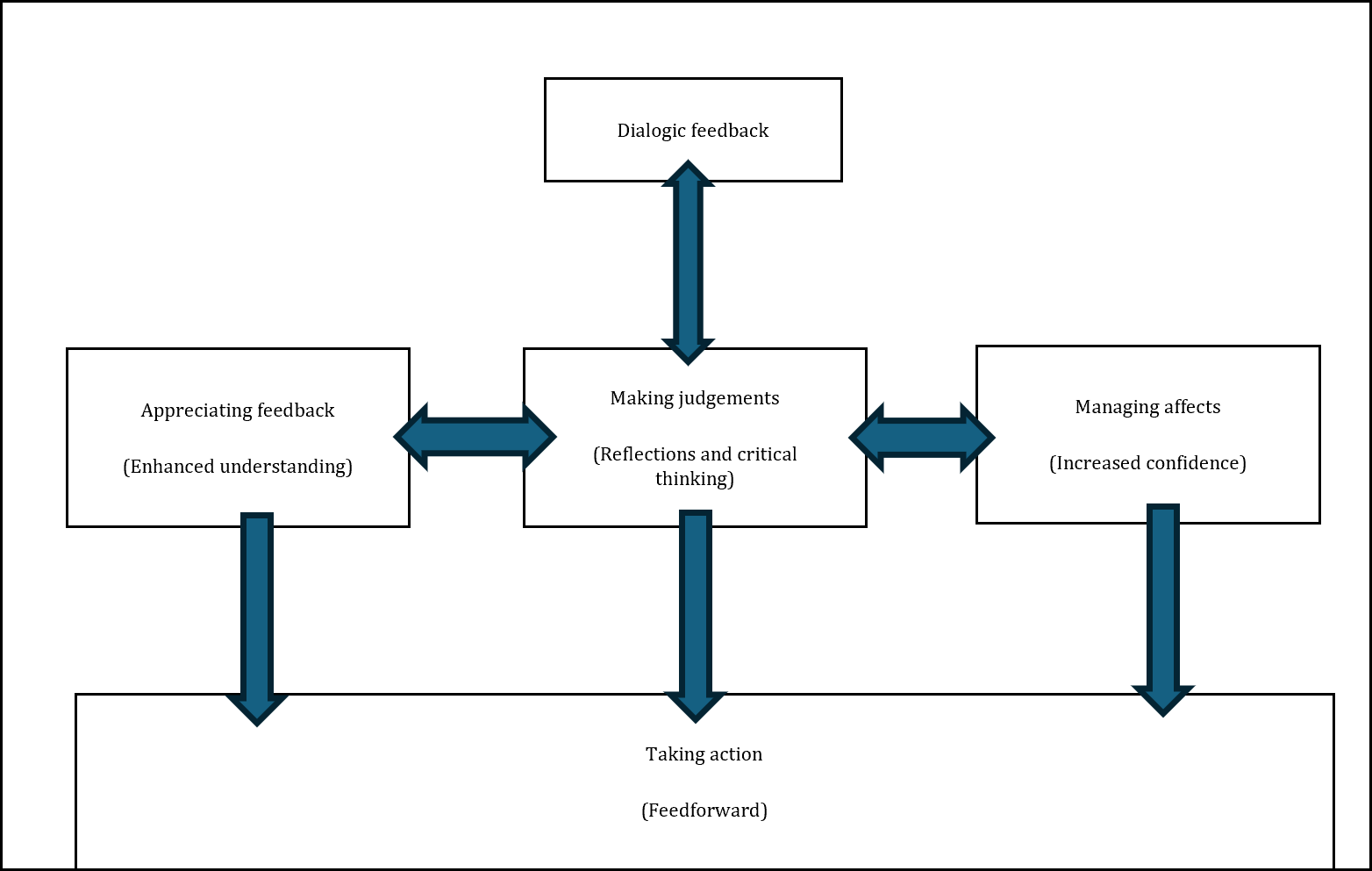
This research examines the effectiveness of dialogic feedback on pre-university business students’ learning experience. In a year-long 3-semester pre-university Business Management course, students’ experience and engagement in dialogic feedback with their lecturer were studied. Dialogic feedback was incorporated in the course from the beginning of the first semester until the students’ final semester. This feedback approach enables students to engage in a meaningful dialogue with their lecturers regarding a particular assessment and in turn acts as a feedforward. Undoubtedly dialogic feedback can clear all misunderstandings or misconceptions prior to and while working on an assignment. Besides written feedback, dialogic feedback provides tremendous opportunity for both students and the lecturers. Students could clarify a comment or the awarded grade, and the lecturer could better understand from the students’ perspective and vice versa. The views of six Foundation in Business students at a pre-university programme at a private higher learning institution regarding this feedback approach were sought through a qualitative study. Analysis of the focus group interview transcripts uncovered four major themes namely dialogic feedback enhances students’ understanding, increases their confidence, as a feedforward approach and promotes reflection and critical thinking. This paper expands Carless and Boud’s (2018) feedback literacy model by incorporating dialogic feedback as its core and demonstrates that the themes align with the features in the model.
Article Details

This work is licensed under a Creative Commons Attribution-NonCommercial-NoDerivatives 4.0 International License.
References
Agricola, B. T., Prins, F. J., & Sluijsmans, D. M. A. (2020). Impact of feedback request forms and verbal feedback on higher education students' feedback perception, self-efficacy, and motivation. Assessment in Education: Principles, Policy & Practice, 27(1), 6-25. https://doi.org/10.1080/0969594X.2019.1688764
Bloxham, S., & Campbell, L. (2010). Generating Dialogue in Assessment Feedback: Exploring the Use of Interactive Cover Sheets. Assessment & Evaluation in Higher Education, 35(3), 291-300. https://doi.org/10.1080/02602931003650045
Braun, V., & Clarke, V. (2006). Using thematic analysis in psychology. Qualitative Research in Psychology, 3(2), 77-101. https://doi.org/10.1191/1478088706qp063oa
Carless, D. (2013). Trust and its role in facilitating dialogic feedback. In D. Boud & E. Molloy (Eds.), Feedback in higher and professional education: understanding it and doing it well (pp. 90-103). London: Routledge.
Carless, D. (2020). Longitudinal Perspectives on Students' Experiences of Feedback: A Need for Teacher-student Partnerships. Higher Education Research & Development, 39, 425-438. https://doi.org/10.1080/07294360.2019.1684455
Carless, D., & Boud, D. (2018). The development of student feedback literacy: enabling uptake of feedback. Assessment & Evaluation in Higher Education, 43(8), 1315-1325. https://doi.org/10.1080/02602938.2018.1463354
Chalmers, C., Mowat, E., & Chapman, M. (2018). Marking and Providing Feedback Face-toFace: Staff and Student Perspectives. Active Learning in Higher Education, 19, 35-45. https://doi.org/10.1177/1469787417721363
Chi, M.T.H., Siler, S.A., Jeong, H., Yamauch, T., & Hausmann, R.G. (2001). Learning from human tutoring. Cognitive Science, 25, 471-533. https://psycnet.apa.org/doi/10.1016/S0364-0213(01)00044-1
Chinpakdee, M. (2025). Talking feedback: Fostering student feedback literacy through a dialogic approach. RELC Journal, 57(1), 1-14. https://doi.org/10.1177/00336882251346206
Crimmins, G., Nash, G., Oprescu, F., Liebergreen, M., Turley, J., Bond, R., & Dayton, J. (2016). A written, reflective and dialogic strategy for assessment feedback that can enhance student/teacher relationships. Assessment & Evaluation in Higher Education, 41(1), 141-153. https://doi.org/10.1080/02602938.2014.986644
Fong, C. J., Patall, E. A., Vasquez, A. C., & Stautberg, S. (2019). A meta-analysis of negative feedback on intrinsic motivation. Educational Psychology Review, 31(1), 121-162. https://doi.org/10.1007/s10648-018-9446-6
Gibbs, G. (2014). Dialogue by design: Creating a dialogic feedback cycle using assessment rubrics. In Transformative, innovative and engaging. Proceedings of the 23rd Annual Teaching Learning Forum, 30-31 January 2014. Perth: The University of Western Australia. http://ctl.curtin.edu.au/professional_development/conferences/tlf/tlf2014/refereed/gibbs.pdf
Guest, G., Bunce, A., & Johnson, L. (2006). How many interviews are enough? An experiment with data saturation and variability. Field Methods, 18(1), 59-82. https://doi.org/10.1177/1525822X05279903
Guskey, T. R. (2019). Grades versus comments: Research on student feedback. Phi Delta Kappan, 101(3), 42-47. https://www.kappanonline.org/grades-versuscomments-research-student-feedback-guskey/
Henderson, M., Ryan, T., & Phillips, M. (2019). The challenges of feedback in higher education. Assessment & Evaluation in Higher Education, 44(8), 1237-1252. https://doi.org/10.1080/02602938.2019.1599815
Hill, J., & West, H. (2020). Improving the student learning experience through dialogic feed-forward assessment. Assessment & Evaluation in Higher Education, 45(1), 82-97. https://doi.org/10.1080/02602938.2019.1608908
Hill, J., & West, H. (2022). Dialogic Feed-Forward in Assessment: Pivotal to Learning but not Unproblematic. Teaching & Learning Inquiry, 10. https://doi.org/10.20343/teachlearninqu.10.20
Jwa, S. (2025), Written Feedback Dialogue: A Cyclical Model for Student Engagement with Feedback. TESOL Quarterly, 59(2), 1024-1035. https://doi-org.hwu-ezproxy.idm.oclc.org/10.1002/tesq.3365
Laurillard, D. (2002). Rethinking university teaching: A framework for the effective use of learning technologies. (2nd ed.). London: Routledge Falmer.
Loh, C. Y. R., & Teo, T. C. (2017). Understanding Asian students learning styles, cultural influence and learning strategies. Journal of Education & Social Policy, 7(1), 194-210. https://jesp.thebrpi.org/journals/Vol_4_No_1_March_2017/23.pdf
Merriam, S. B. (2009). Qualitative research: A guide to design and implementation. Jossey Bass.
Myers, T., & Buchanan, J. (2025). Dialogism in feedback literacies: a critical review. Assessment & Evaluation in Higher Education, 50(6), 846-860. https://doi.org/10.1080/02602938.2025.2478159
Nedrehagen, E., Vee, T.S., Stokstad, J.M., & Orm, S. (2025). A scoping review of dialogic formative feedback practices in higher education. Front. Educ, 10. https://doi.org/10.3389/feduc.2025.1696703
Nicol, D. (2010). From monologue to dialogue: improving written feedback processes in mass higher education. Assessment & Evaluation in Higher Education, 35(5), 501-517. https://doi.org/10.1080/02602931003786559
Nicol, D.J., & Macfarlane-Dick. D. (2006). Formative assessment and self-regulated learning: A model and seven principles of good feedback practice. Studies in Higher Education, 31(2), 199-218. https://doi.org/10.1080/03075070600572090
Oranga, J., & Matere, A. (2023) Qualitative Research: Essence, Types and Advantages. Open Access Library Journal, 10: e11001. https://doi.org/10.4236/oalib.1111001
Orsmond, P., Maw, S. J., Park, J.R., Gomez, S., & Crook, A. C. (2013). Moving feedback forward: theory to practice. Assessment & Evaluation in Higher Education, 38(2), 240-252. https://doi.org/10.1080/02602938.2011.625472
Sadler, D. R. (2010). Beyond feedback: Developing student capability in complex appraisal. Assessment & Evaluation in Higher Education, 35(5), 535-550. https://doi.org/10.1080/02602930903541015
Sadler, I., Reimann, N., & Sambell, K. (2023). Feedforward practices: a systematic review of the literature. Assessment & Evaluation in Higher Education, 48(3), 305-320. https://doi.org/10.1080/02602938.2022.2073434
Schillings, M., Roebertsen, H., Savelberg, H., & Dolmans, D. (2023). A review of educational dialogue strategies to improve academic writing skills. Active Learning in Higher Education, 24(2), 95-108. https://doi.org/10.1177/1469787418810663
Susanti, A., Tengku Sharif, T. I. S., & Masardo, A. (2025). Dialogic feedback in English Language Teaching: Modalities, outcomes, and research trends. Journal of English Language Teaching, 8(1), 37-53. https://doi.org/10.12928/eltej.v8i1.14057
Sutton, P. (2012). Conceptualizing feedback literacy: knowing, being, and acting. Innovations in Education and Teaching International, 49 (1), 31-40. https://doi.org/10.1080/14703297.2012.647781
Tam, A.C.F. (2021). Undergraduate students' perceptions of and responses to exemplar-based dialogic feedback. Assessment & Evaluation in Higher Education, 46(2), 269-285. https://doi.org/10.1080/02602938.2020.1772957
To, J., Aluquin, D., & Tan, K.H.K. (2025). Making student voice heard in dialogic feedback: feedback design matters. Front. Educ, 10. https://doi.org/10.3389/feduc.2025.1550328
Troy, A., Moua, H., & Van Boekel, M. (2024). Wise Feedback and Trust in Higher Education: A Quantitative and Qualitative Exploration of Undergraduate Students' Experiences with Critical Feedback. Psychology in the Schools, 61, 2424-2447. https://doi.org/10.1002/pits.23164 https://doi.org/10.1002/pits.2316
Tseng, S., & Er, E. (2024). Maximizing the impact of dialogic peer feedback on student engagement: The role of regulation support. Educational Technology & Society, 27(2), 133-148. https://doi.org/10.30191/ETS.202404_27(2).RP04
Van der Schaaf, M., Baartman, L., Prins, F., Oosterbaan, A. & Schaap, H. (2013). Feedback dialogues that stimulate students' reflective thinking. Scandinavian Journal of Educational Research, 57(3), 227-245. https://doi.org/10.1080/00313831.2011.628693
Winstone, N., & Carless, D. (2019). Designing effective feedback processes in higher education: A learning-focused approach. Abingdon: Routledge. https://doi.org/10.4324/9781351115940
Wittek, A.L., & Steen-Utheim, A. (2017). Dialogic feedback and potentialities for student learning. Learning, Culture and Social Interaction, 15, 18-30. https://doi.org/10.1016/j.lcsi.2017.06.002
Wylie, E.C. (2023). Closing the feedback loop: reflections on practical educational implications and future research. Learning and Instruction, 87. https://doi.org/10.1016/j.learninstruc.2023.101801
Zhang, J. (2023). A study on the effectiveness of dialogic feedback in English writing. Journal of Linguistics and Communication Studies, 2(3), 81-92. https://www.pioneerpublisher.com/JLCS/article/view/467