
Beyond identification: ranking stable COz emission drivers in Malaysia via ML-Enhanced SDA for SDG 13
Article Sidebar
Main Article Content
Abstract
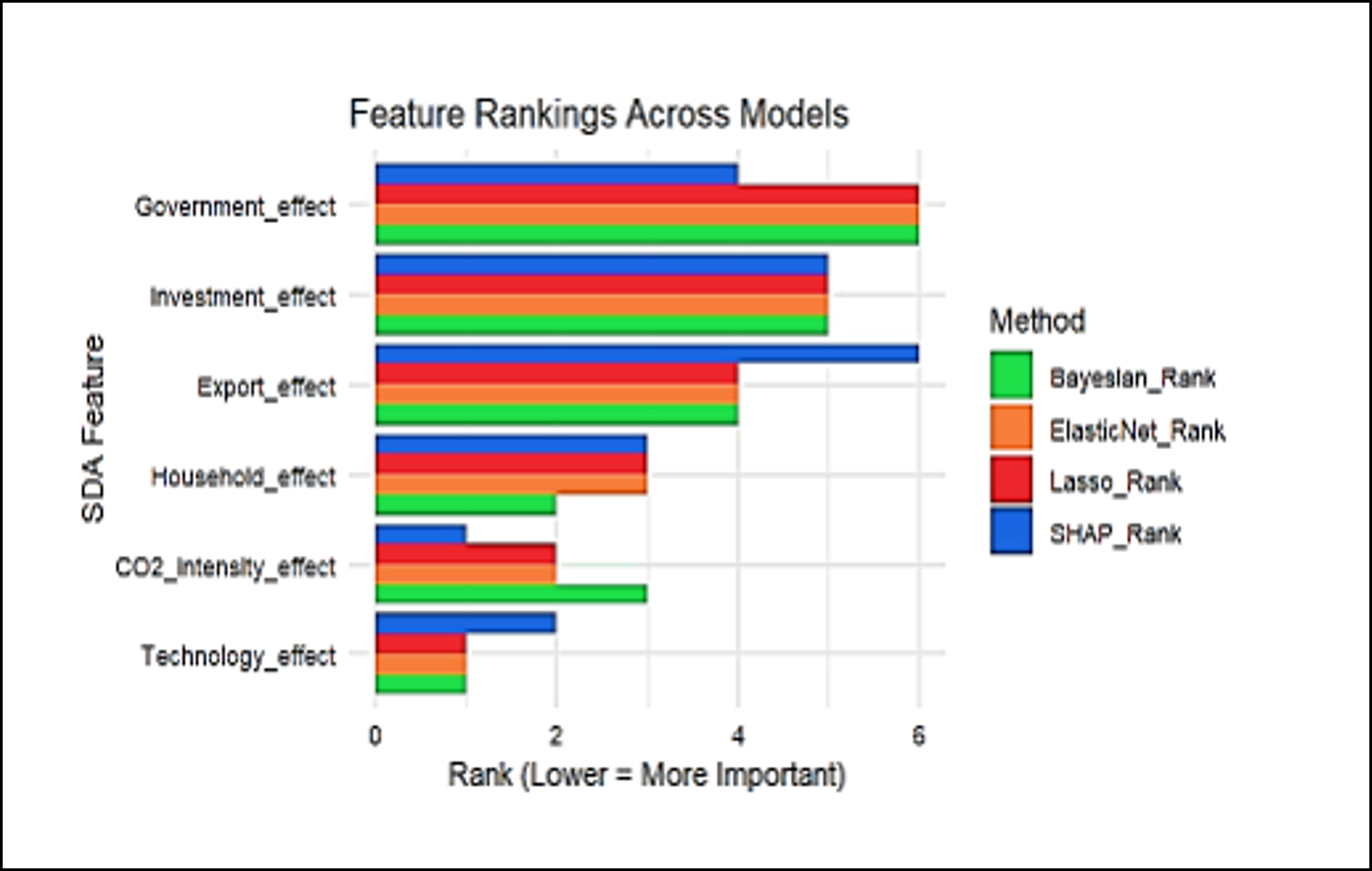
This study advances understanding of COz emission dynamics in Malaysia by integrating Structural Decomposition Analysis (SDA) with Machine Learning (ML) techniques to identify key emission drivers and evaluate their stability and predictability during 2010-2020. Using multi-year input-output tables and emissions data, an additive SDA framework decomposes changes in COz emissions into six effects: COz intensity, technology (production structure), household expenditure, investment, government expenditure, and exports. Four ML methods, namely Neural Networks with SHapley Additive exPlanations (SHAP), Lasso Regression, Elastic Net Regression, and Bayesian Regression, are applied to rank driver importance at aggregate and sectoral levels. Results show consistent findings across methods, with COz intensity emerging as the most influential and variable driver, followed by technology and household consumption. In contrast, government expenditure, investment, and exports contribute relatively little to emission changes. Sectoral analysis indicates that emissions fluctuations are primarily driven by electricity, gas and water supply, manufacturing, wholesale and retail trade, and transportation. SHAP results further confirm the significance of intensity improvements in the early decade, demand-driven growth in the middle years, and pandemic-related declines in 2019-2020. The findings provide evidence-based insights for climate policy, highlighting the importance of renewable energy adoption, technological upgrading, carbon taxation, and sustainable consumption in supporting Malaysia's net-zero ambitions and Sustainable Development Goal 13.
Article Details

This work is licensed under a Creative Commons Attribution-NonCommercial-NoDerivatives 4.0 International License.
References
Albrecht, J., Francois, D., & Schoors, K. (2002). A Shapley decomposition of carbon emissions without residuals. Energy Policy, 30(9), 727-736. https://doi.org/10.1016/S0301-4215(01)00131-8
Asian Development Bank. (2020). Global Input-Output Database: Constant price I-O tables [Dataset]. https://kidb.adb.org/globalization/constant
Chen, H., Latiff, A. R. A., & Chua, S. Y. (2025). Carbon emissions embodied in exports from regional comprehensive economic partnership member countries: Perspectives on internal and external dynamics. Asia-Pacific Journal of Regional Science, 9(4), 931-953. https://doi.org/10.1007/s41685-025-00391-9
Cotterlaz, P., & Gouel, C. (2026). Outsourcing decarbonization? How trade shaped France's carbon footprint (2000-14). Ecological Economics, 240, Article 108814. https://doi.org/10.1016/j.ecolecon.2025.108814
Dall'Erba, S., Riemer, N., Xu, Y., Xu, R., & Yao, Y. (2024). Identifying the key atmospheric and economic drivers of global carbon monoxide emission transfers. Economic Systems Research, 36(3), 404-421. https://doi.org/10.1080/09535314.2023.2300787
de Boer, P., & Rodrigues, J. F. D. (2020). Decomposition analysis: When to use which method? Economic Systems Research, 32(1), 1-28. https://doi.org/10.1080/09535314.2019.1652571
Di Berardino, C., Doganieri, I., & Onesti, G. (2024). The drivers of employment manufacturing growth. Eastern European Economics, 62(5), 650-677. https://doi.org/10.1080/00128775.2023.2167723
Economic Planning Unit, Prime Minister's Department, Malaysia. (2021). Twelfth Malaysia Plan, 2021-2025: A prosperous, inclusive, sustainable Malaysia., https://rmke12.ekonomi.gov.my/en
Economic Planning Unit, Prime Minister's Department, Malaysia. (2025). Thirteen Malaysia Plan, 2026-2030: Reshaping Development, https://rmk13.ekonomi.gov.my/
Efron, B., & Tibshirani, R. J. (1994). An introduction to the bootstrap (1st ed.). Chapman and Hall/CRC. https://doi.org/10.1201/9780429246593
Gelman, A., Carlin, J. B., Stern, H. S., Dunson, D. B., Vehtari, A., & Rubin, D. B. (2013). Bayesian data analysis (3rd ed.). CRC Press.
Guan, D., Meng, J., Reiner, D. M., Zhang, N., Shan, Y., Mi, Z., Shao, S., Liu, Z., Zhang, Q., & Davis, S. J. (2018). Structural decline in China's COz emissions through transitions in industry and energy systems. Nature Geoscience, 11(8), 551-555. https://doi.org/10.1038/s41561-018-0161-1
Huang, Y.-R., Lee, L.-C., Lee, C.-H., & Yadav, N. P. (2025). The carbon emissions of waste paper tableware recycling from the impact of COVID-19 on escalated eating out demand in Taiwan: A global supply chain perspective. Environment, Development and Sustainability. Advance online publication. https://doi.org/10.1007/s10668-025-06528-2
Intergovernmental Panel on Climate Change. (2022). Climate change 2022: Mitigation of climate change. Contribution of Working Group III to the Sixth Assessment Report of the Intergovernmental Panel on Climate Change (P. R. Shukla, J. Skea, R. Slade, et al., Eds.). Cambridge University Press.
Intergovernmental Panel on Climate Change. (2023). Summary for policymakers. In Climate change 2023: Synthesis report. Contribution of Working Groups I, II and III to the Sixth Assessment Report of the Intergovernmental Panel on Climate Change (Core Writing Team, H. Lee, & J. Romero, Eds.; pp. 1-34). IPCC. https://doi.org/10.59327/IPCC/AR6-9789291691647.001
Jiang, M., & Kim, E. (2024). Decomposing structural changes of production network for electronics industry in Northeast Asia regions in the 2010s. Applied Economics Letters, 31(17), 1666-1674. https://doi.org/10.1080/13504851.2023.2205094
Le Quere, C., Jackson, R. B., Jones, M. W., Smith, A. J. P., Abernethy, S., Andrew, R. M., De-Gol, A. J., Willis, D. R., Shan, Y., Canadell, J. G., Friedlingstein, P., Creutzig, F., & Peters, G. P. (2020). Temporary reduction in daily global COz emissions during the COVID-19 forced confinement. Nature Climate Change, 10(7), 647-653. https://doi.org/10.1038/s41558-020-0797-x
Liang, Y., Niu, D., Zhou, W., & Fan, Y. (2018). Decomposition analysis of carbon emissions from energy consumption in Beijing-Tianjin-Hebei, China: A weighted-combination model based on logarithmic mean Divisia index and Shapley value. Sustainability, 10(7), Article 2535. https://doi.org/10.3390/su10072535
Liu, Z., Ciais, P., Deng, Z., Lei, R., Davis, S. J., Feng, S., Zheng, B., Cui, D., Dou, X., Zhu, B., Guo, R., Ke, P., Sun, T., Lu, C., He, P., Wang, Y., Yue, X., Wang, Y., Lei, Y., Zhou, H., ... Schellnhuber, H. J. (2020). Near-real-time monitoring of global COz emissions reveals the effects of the COVID-19 pandemic. Nature Communications, 11(1), Article 5172. https://doi.org/10.1038/s41467-020-18922-7
Lundberg, S. M., & Lee, S.-I. (2017). A unified approach to interpreting model predictions. In I. Guyon, U. V. Luxburg, S. Bengio, H. Wallach, R. Fergus, S. V. N. Vishwanathan, & R. Garnett (Eds.), Advances in neural information processing systems (Vol. 30, pp. 4765-4774). Curran Associates.
Ma, S., Hua, X., & Liu, J. (2025). Decarbonizing Mongolia: An integrated structural path and decomposition analysis of carbon emissions (2015-2021). Resources, Conservation and Recycling, 222, Article 108422. https://doi.org/10.1016/j.resconrec.2025.108422
Mi, Z., Zhang, Y., Guan, D., Shan, Y., Liu, Z., Cong, R., Yuan, X.-C., & Wei, Y.-M. (2016). Consumption-based emission accounting for Chinese cities. Applied Energy, 184, 1073-1081. https://doi.org/10.1016/j.apenergy.2016.06.094
Ministry of Economy, Malaysia. (2023). National Energy Transition Roadmap (NETR). https://www.ekonomi.gov.my/sites/default/files/202308/National%20Energy%20Transition%20Roadmap.pdf
Ministry of Economy, Malaysia. (2025). Malaysia's third Voluntary National Review 2025. United Nations High-Level Political Forum on Sustainable Development, https://ekonomi.gov.my/sites/default/files/2025-12/Malaysia_VNR_2025_251106.pdf
Ministry of Investment, Trade and Industry, Malaysia. (2023). New Industrial Master Plan 2030 (NIMP 2030). https://www.nimp2030.gov.my/
Ministry of Natural Resources and Environmental Sustainability, Malaysia. (2024). National Policy on Climate Change 2.0, https://www.nres.gov.my/ms-my/pustakamedia/Penerbitan/National%20Policy%20on%20Climate%20Change%202.0.pdf
Nagashima, F., Tokito, S., & Hanaka, T. (2025). Identifying the driving forces of embodied emissions from intermediate goods export. Energy Economics, 143, Article 108283. https://doi.org/10.1016/j.eneco.2025.108283
Organisation for Economic Co-operation and Development. (2025). Production-based COz emissions by sector [Dataset]. https://data-explorer.oecd.org/vis?lc=en&df[ds]=StiDisseminateFinalDMZ&df[id]=DSD_ICIO_GHG_MAIN%40DF_ICIO_GHG_MAIN_2023&df[ag]=OECD.STI.PIE&dq=A..._T.T_CO2E&pd=2020%2C&to[TIME_PERIOD]=false
Roman-Collado, R., Ordonez, M., & Mundaca, L. (2018). Has electricity turned green or black in Chile? A structural decomposition analysis of energy consumption. Energy, 162, 282-298. https://doi.org/10.1016/j.energy.2018.07.206
Sahel, W., & El Abbassi, I. (2025). Structural change in Morocco: Rethinking industrial policies. Structural Change and Economic Dynamics, 72, 412-426. https://doi.org/10.1016/j.strueco.2024.12.008
Sandu, S., Yang, M., Mahlia, T. M. I., Wongsapai, W., Ong, H. C., Putra, N., & Rahman, S. M. A. (2019). Energy-related COz emissions growth in ASEAN countries: Trends, drivers and policy implications. Energies, 12(24), Article 4650. https://doi.org/10.3390/en12244650
Shimotsuura, T. (2025). A comprehensive structural decomposition analysis of COz emissions from vessels: A case study of Japan. Energy Economics, 148, Article 108674. https://doi.org/10.1016/j.eneco.2025.108674
Su, B., & Ang, B. W. (2012). Structural decomposition analysis applied to energy and emissions: Some methodological developments. Energy Economics, 34(1), 177-188. https://doi.org/10.1016/j.eneco.2011.10.009
Su, B., & Ang, B. W. (2015). Multiplicative decomposition of aggregate carbon intensity change using input-output analysis. Applied Energy, 154, 13-20. https://doi.org/10.1016/j.apenergy.2015.04.077
Su, B., & Ang, B. W. (2017). Multiplicative structural decomposition analysis of aggregate embodied energy and emission intensities. Energy Economics, 65, 137-147. https://doi.org/10.1016/j.eneco.2017.05.002
Su, B., & Ang, B. W. (2025). Semi-closed input-output and structural decomposition analysis of embodied emissions and intensities. Energy Economics, 149, 108720. https://doi.org/10.1016/j.eneco.2025.108720
Sun, X., & Mi, Z. (2023). Factors driving China's carbon emissions after the COVID-19 outbreak. Environmental Science & Technology, 57(48), 19125-19136. https://doi.org/10.1021/acs.est.3c03802
Sun, Y., Wu, S., & Li, S. (2024). Inequity of value-added gains and embodied carbon emissions in North-South trade during the restructuring of global value chains. Environment, Development and Sustainability. Advance online publication. https://doi.org/10.1007/s10668-024-05538-w
Tausch, L., & Althouse, J. (2025). Ecologically unequal exchange (EUE) as a multi-tiered hierarchy: Investigating the interdependence of global and domestic environmental inequalities to explain China's rise. Ecological Economics, 235, Article 108644. https://doi.org/10.1016/j.ecolecon.2025.108644
Tibshirani, R. (1996). Regression shrinkage and selection via the lasso. Journal of the Royal Statistical Society: Series B (Methodological), 58(1), 267-288. https://doi.org/10.1111/j.2517-6161.1996.tb02080.x
Ueda, T. (2022). Structural decomposition analysis of Japan's energy transitions and related COz emissions in 2005-2015 using a hybrid input-output table. Environmental and Resource Economics, 81(4), 763-786. https://doi.org/10.1007/s10640-022-00650-9
United Nations. (2015). Transforming our world: The 2030 Agenda for Sustainable Development. https://sdgs.un.org/2030agenda
Wang, H., & Yang, Y. F. (2023). Decomposition analysis applied to energy and emissions: A literature review. Frontiers of Engineering Management, 10(4), 625-639. https://doi.org/10.1007/s42524-023-0270-4
Wang, H., Ang, B. W., & Su, B. (2017). Multiplicative structural decomposition analysis of energy and emission intensities: Some methodological issues. Energy, 123, 47-63. https://doi.org/10.1016/j.energy.2017.01.141
Xu, C., Zhu, Q., Li, X., Wu, L., & Deng, P. (2024). Determinants of global carbon emission and aggregate carbon intensity: A multi-region input-output approach. Economic Analysis and Policy, 81, 418-435. https://doi.org/10.1016/j.eap.2023.12.002
Yang, Y., Wang, H., & Zhou, P. (2025). The COz emission effects of global supply chain geographic restructuring on emerging economies. Energy Economics, 143, Article 108255. https://doi.org/10.1016/j.eneco.2025.108255
Yuan, Q., Wang, Q., & Zhang, M. (2024). Tracing changes in manufacturing-related carbon emissions: A structural decomposition analysis from the perspective of China. Structural Change and Economic Dynamics, 71, 568-581. https://doi.org/10.1016/j.strueco.2024.09.003
Zhang, H., Hua, Y., Xu, Y., & Lahr, M. L. (2025). Tracking China's household carbon footprint (1997-2017): Insights from drives and supply chain analyses. Economic Systems Research, 37(4), 528-548. https://doi.org/10.1080/09535314.2025.2520310
Zhang, J., Tian, K., Zhu, L., & Yang, C. (2024). Are SME exporters dirtier? A novel input-output analysis distinguishing firm size heterogeneity. Structural Change and Economic Dynamics, 71, 145-156. https://doi.org/10.1016/j.strueco.2024.07.003
Zhao, G., Xie, R., Su, B., & Wang, Q. (2025). COz terms of trade and its determinants based on input-output models with technical differences. Economic Systems Research, 37(1), 1-29. https://doi.org/10.1080/09535314.2023.2279898
Zheng, X., Lu, Y., Yuan, J., Baninla, Y., Zhang, S., Stenseth, N. C., Hessen, D. O., Tian, H., Obersteiner, M., & Chen, D. (2020). Drivers of change in China's energy-related COz emissions. Proceedings of the National Academy of Sciences of the United States of America, 117(1), 29-36. https://doi.org/10.1073/pnas.1908513117
Zhu, Q., Xu, C., & Lee, C.-C. (2024). Trade-induced carbon-economic inequality within China: Measurement, sources, and determinants. Energy Economics, 136, Article 107731. https://doi.org/10.1016/j.eneco.2024.107731
Zou, H., & Hastie, T. (2005). Regularization and variable selection via the elastic net. Journal of the Royal Statistical Society: Series B (Statistical Methodology), 67(2), 301-320. https://doi.org/10.1111/j.1467-9868.2005.00503.x