
The rise of alternative brands during the boycott movement: evidence from Malaysia
Article Sidebar
Main Article Content
Abstract
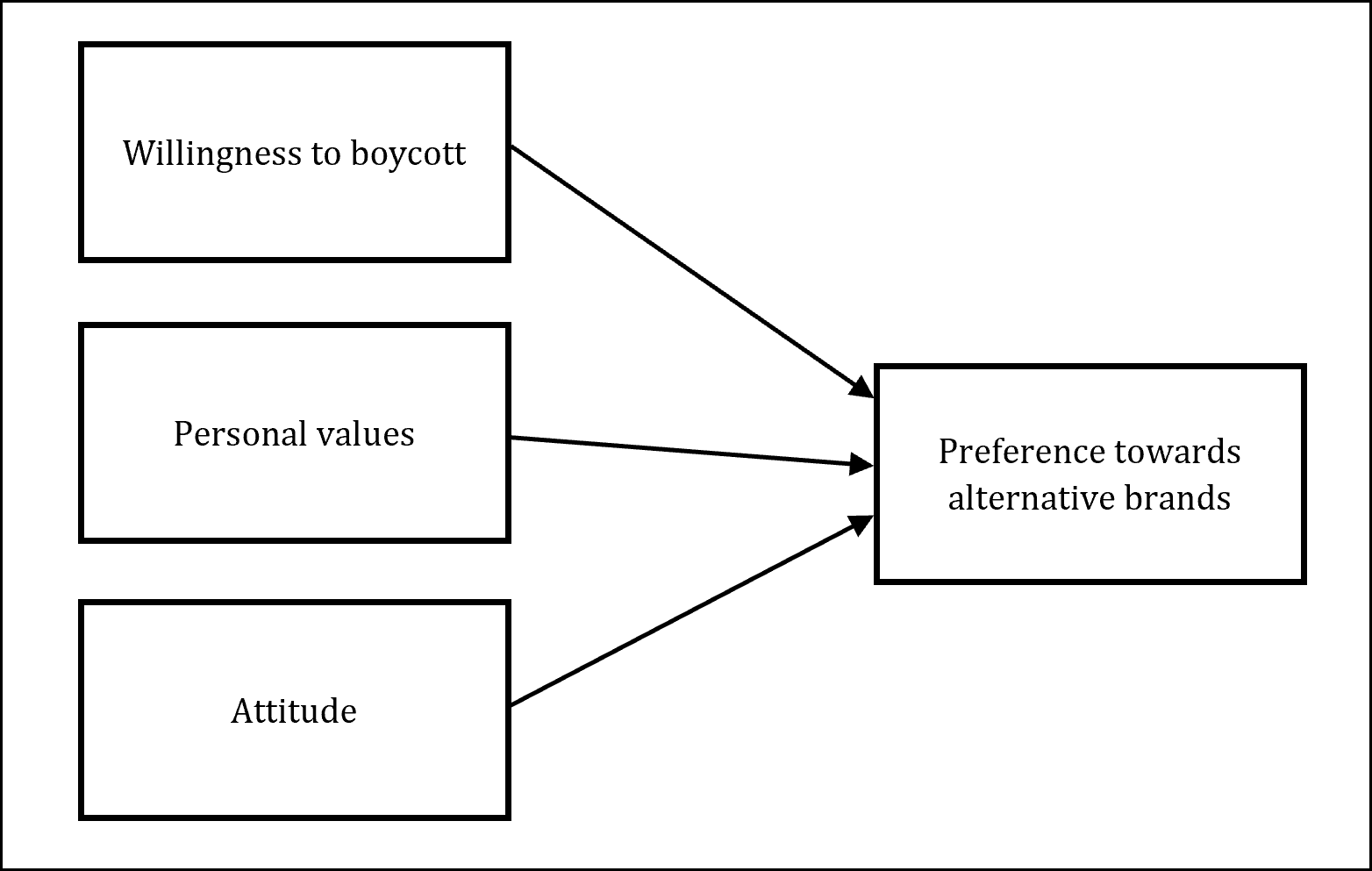
The ongoing Palestinian-Israeli conflict has driven significant boycott movements among Malaysian consumers, resulting in shifts toward alternative brands. However, there remains a knowledge gap regarding the factors influencing consumer preference for these brands during boycotts. This research investigates the relationship between consumers’ willingness to boycott, consumers’ attitudes, and consumers’ personal values and their preference for alternative brands. A quantitative method using Pearson Correlation and Ordered Probit Regression was employed. Data were collected through a convenience sampling method involving 289 respondents from Negeri Sembilan, Malaysia, aged 18 and above, who were aware of the boycott movement. The findings revealed a strong positive correlation between consumers’ willingness to boycott, personal values, and consumer preference for alternative brands, while consumers’ attitudes showed a moderate positive correlation. Ordered Probit Regression further confirmed that consumers’ willingness to boycott and consumers’ personal values significantly influence consumer preference for alternative brands. However, consumers’ attitudes had a weaker yet positive relationship. The findings conclude that consumers with strong personal and ethical values and who are more willing to boycott are more likely to shift preferences towards alternative brands. This highlights the importance of ethical branding strategies in addressing consumer expectations during boycott movements.
Article Details

This work is licensed under a Creative Commons Attribution-NonCommercial-NoDerivatives 4.0 International License.
References
Abdullah, Z., Anuar, M. M., & Yaacob, M. R. (2021). The effects of religiosity and attitude on consumer boycotts. International Journal of Academic Research in Business and Social Sciences, 11(18), 133–150. https://doi.org/10.6007/IJARBSS/v11-i18/11432
Abdul-Talib, A.-N., & Adnan, M. M. M. (2017). Determinants of consumer’s willingness to boycott surrogate products. Journal of Islamic Marketing, 8(3), 345–360. https://doi.org/10.1108/JIMA-08-2015-0065
Ajzen, I. (1991). The theory of planned behavior. Organizational Behavior and Human Decision Processes, 50(2), 179–211. https://doi.org/10.1016/0749-5978(91)90020-T
Alias, S. N. A., Mohamed, N. H., & Mohamad, M. (2024). Riding the Gaza boycott wave: A strategic guide for Malaysian franchises. Global Business and Management Research: An International Journal, 16(3), 138–149. http://gbmrjournal.com/pdf/v16n3s/V16N3s-11.pdf
Department of Statistics Malaysia. (2023). Data portal. https://www.dosm.gov.my/portal-main/release-content/current-population-estimates-malaysia----2023
Elsayed, K. G., Lestari, A. A., & Brougham, F. A. (2023). Role of religion in shaping ethical and moral values among the youths in Athens, Greece. Journal of Sociology, Psychology and Religious Studies, 5(1), 11–20. https://doi.org/10.53819/81018102t5153
Friedman, M. (1999). Consumer boycotts: Effecting change through the marketplace and the media. Routledge.
Golzar, J., Noor, S., & Tajik, O. (2022). Convenience sampling. International Journal of Education & Language Studies, 1(2), 72–77. https://doi.org/10.22034/ijels.2022.162981
Hamzah, H., & Mustafa, H. (2019). Exploring consumer boycott intelligence towards Israel-related companies in Malaysia: An integration of the Theory of Planned Behaviour with Transtheoretical Stages of Change. Journal of Islamic Marketing, 10(1), 209–226. https://doi.org/10.1108/JIMA-06-2017-0070
Joshi, A., Kale, S., Chandel, S., & Pal, D. (2015). Likert scale: Explored and explained. British Journal of Applied Science & Technology, 7(4), 396–403. https://doi.org/10.9734/BJAST/2015/14975
Kutaula, S., Gillani, A., Gregory-Smith, D., & Bartikowski, B. (2024). Ethical consumerism in emerging markets: Opportunities and challenges. Journal of Business Ethics, 191(4), 651–673. https://doi.org/10.1007/s10551-024-05657-4
Lasarov, W., Hoffmann, S., & Orth, U. (2023). Vanishing boycott impetus: Why and how consumer participation in a boycott decreases over time. Journal of Business Ethics, 182(4), 1129–1154. https://doi.org/10.1007/s10551-021-04997-9
MalaysiaNow. (2024, October 29). Over 100 Starbucks outlets in Malaysia closed as boycott of US brands takes bite. Malaysia Now. https://www.malaysianow.com/news/2024/10/29/over-100-starbucks-outlets-in-malaysia-closed-as-boycott-of-us-brands-takes-bite
Mekonnen, W. (2020). Review on correlation research. International Journal of English Literature and Culture, 8(4), 99–106. https://doi.org/10.14662/IJELC2020.085
Mirza, F., Ashraf, S., & Jahangir, H. B. (2020). The impact of religiously motivated consumer boycotts on product judgment, brand image and loyalty. International Journal of Academic Research in Business and Social Sciences, 10(11), 384–402. https://doi.org/10.6007/IJARBSS/v10-i11/7902
Neilson, L. A. (2010). Boycott or buycott? Understanding political consumerism. Journal of Consumer Behaviour, 9(3), 214–227. https://doi.org/10.1002/cb.313
Pandey, S. P., Ahmad, Y., & Gautam, A. (2021). Consumer motivations for boycott. Pacific Business Review International, 14(6), 51–63.
Rafiki, A., Hidayat, S. E., & Nasution, M. D. T. P. (2024). An extensive effect of religiosity on the purchasing decisions of halal products. PSU Research Review, 8(3), 898–919. https://doi.org/10.1108/PRR-07-2022-0093
Safeer, A. A., Zhou, Y., Abrar, M., & Luo, F. (2022). Consumer perceptions of brand localness and globalness in emerging markets: A cross-cultural context. Frontiers in Psychology, 13, 919020. https://doi.org/10.3389/fpsyg.2022.919020
Shanbhogue, A. V., & Ranjith, A. K. (2024). Effects of consumer dispositional attitude on purchase intention in an emerging market. F1000Research, 12, 384. https://doi.org/10.12688/f1000research.131103.3
StataCorp. (2024). Roprobit [Manual]. https://www.stata.com/manuals/roprobit.pdf
Tariki, H. E., & Abdul Shukor, S. (2019). The factors influencing consumers’ willingness to boycott among Malaysian Muslim youth. In M. I. Qureshi (Ed.), European Proceedings of Social and Behavioural Sciences (pp. 319–330). Future Academy. https://doi.org/10.15405/epsbs.2019.05.02.31
Tavakol, M., & Dennick, R. (2011). Making sense of Cronbach’s alpha. International Journal of Medical Education, 2, 53–55. https://doi.org/10.5116/ijme.4dfb.8dfd
Utama, A. P., Simon, J. C., Nurlaela, F., Iskandar, & Arsyad, A. A. J. (2023). The impact of the boycott movement on Israeli products on brand perception among Muslim consumers: An analysis of brand image and customer loyalty. Branding: Jurnal Ilmiah Manajemen dan Bisnis, 2(2), 56–69.