
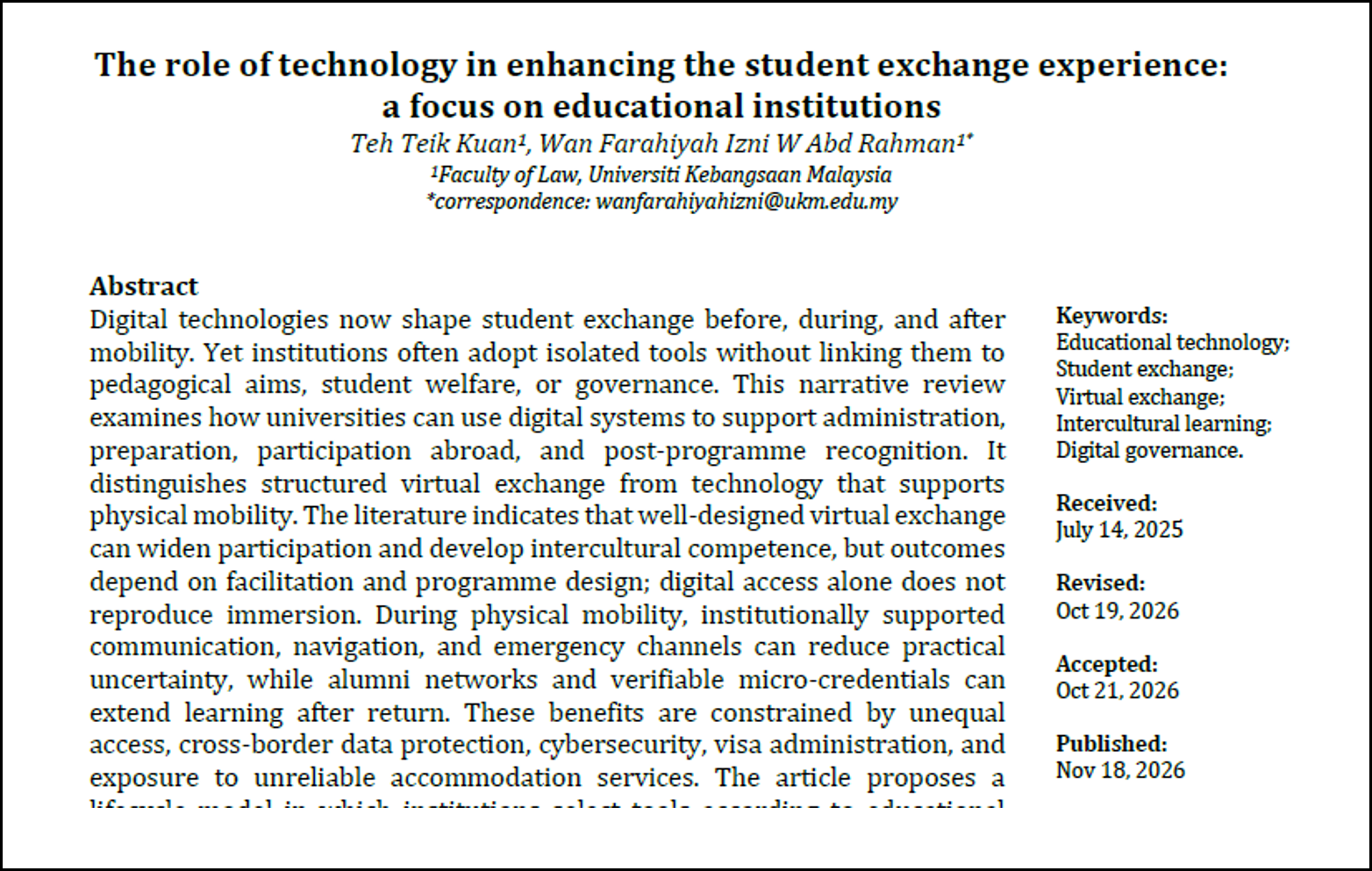
The role of technology in enhancing the student exchange experience: a focus on educational institutions
Article Sidebar
Main Article Content
Abstract
Digital technologies now shape student exchange before, during, and after mobility. Yet institutions often adopt isolated tools without linking them to pedagogical aims, student welfare, or governance. This narrative review examines how universities can use digital systems to support administration, preparation, participation abroad, and post-programme recognition. It distinguishes structured virtual exchange from technology that supports physical mobility. The literature indicates that well-designed virtual exchange can widen participation and develop intercultural competence, but outcomes depend on facilitation and programme design; digital access alone does not reproduce immersion. During physical mobility, institutionally supported communication, navigation, and emergency channels can reduce practical uncertainty, while alumni networks and verifiable micro-credentials can extend learning after return. These benefits are constrained by unequal access, cross-border data protection, cybersecurity, visa administration, and exposure to unreliable accommodation services. The article proposes a lifecycle model in which institutions select tools according to educational purpose, provide accessible alternatives, minimise data collection, define security responsibilities, and preserve face-to-face cultural engagement. Future research should test integrated models across different institutional and socioeconomic contexts.
Article Details

This work is licensed under a Creative Commons Attribution-NonCommercial-NoDerivatives 4.0 International License.
References
Appiah-Kubi, P., & Annan, E. (2020). A review of a collaborative online international learning. International Journal of Engineering Pedagogy, 10(1), 109–124. https://doi.org/10.3991/ijep.v10i1.11678
Beelen, J., & Jones, E. (2015). Redefining internationalization at home. In A. Curaj, L. Matei, R. Pricopie, J. Salmi, & P. Scott (Eds.), The European Higher Education Area: Between critical reflections and future policies (pp. 59–72). Springer. https://doi.org/10.1007/978-3-319-20877-0_5
Cheng, Y. E., Yeoh, B. S. A., & Yang, P. (2023). Virtual student mobility on Zoom: Digital platforms and differentiated experiences of international education and (im)mobilities in a time of pandemic. Mobilities, 18(5), 839–854. https://doi.org/10.1080/17450101.2023.2209824
Council of the European Union. (2022). Council Recommendation of 16 June 2022 on a European approach to micro-credentials for lifelong learning and employability (2022/C 243/02). Official Journal of the European Union, C 243, 10–25. https://eur-lex.europa.eu/legal-content/EN/TXT/?uri=CELEX:32022H0627(02)
Deardorff, D. K. (2006). Identification and assessment of intercultural competence as a student outcome of internationalization. Journal of Studies in International Education, 10(3), 241–266. https://doi.org/10.1177/1028315306287002
Devisakti, A., Muftahu, M., & Xiaoling, H. (2024). Digital divide among B40 students in Malaysian higher education institutions. Education and Information Technologies, 29(2), 1857–1883. https://doi.org/10.1007/s10639-023-11847-w
European Parliament & Council of the European Union. (2016). Regulation (EU) 2016/679 of 27 April 2016 on the protection of natural persons with regard to the processing of personal data and on the free movement of such data. Official Journal of the European Union, L 119, 1–88. https://eur-lex.europa.eu/eli/reg/2016/679/oj
European Union Agency for Cybersecurity. (2024). ENISA threat landscape 2024. https://www.enisa.europa.eu/publications/enisa-threat-landscape-2024
Fang, C., & van Liempt, I. (2021). ‘We prefer our Dutch’: International students’ housing experiences in the Netherlands. Housing Studies, 36(6), 822–842. https://doi.org/10.1080/02673037.2020.1720618
Fukkink, R. G., Helms, R., Spee, O., Mongelos, A., Bratland, K., & Pedersen, R. (2024). Pedagogical dimensions and intercultural learning outcomes of COIL: A review of studies published between 2013–2022. Journal of Studies in International Education, 28(5), 761–779. https://doi.org/10.1177/10283153241262462
Furnell, S., & Clarke, N. (2012). Power to the people? The evolving recognition of human aspects of security. Computers & Security, 31(8), 983–988. https://doi.org/10.1016/j.cose.2012.08.004
Gibson, D., Ostashewski, N., Flintoff, K., Grant, S., & Knight, E. (2015). Digital badges in education. Education and Information Technologies, 20(2), 403–410. https://doi.org/10.1007/s10639-013-9291-7
Gumus, S., Gok, E., & Esen, M. (2020). A review of research on international student mobility: Science mapping the existing knowledge base. Journal of Studies in International Education, 24(5), 495–517. https://doi.org/10.1177/1028315319893651
Hackett, S., Janssen, J., Beach, P., Perreault, M., Beelen, J., & van Tartwijk, J. (2023). The effectiveness of Collaborative Online International Learning (COIL) on intercultural competence development in higher education. International Journal of Educational Technology in Higher Education, 20, Article 5. https://doi.org/10.1186/s41239-022-00373-3
Helm, F. (2015). The practices and challenges of telecollaboration in higher education in Europe. Language Learning & Technology, 19(2), 197–217. http://hdl.handle.net/10125/44424
Hofhuis, J., van Egmond, M. C., Lutz, F. E., von Reventlow, K., & Rohmann, A. (2023). The effect of social network sites on international students’ acculturation, adaptation, and wellbeing. Frontiers in Communication, 8, Article 1186527. https://doi.org/10.3389/fcomm.2023.1186527
Knight, J. (2004). Internationalization remodeled: Definition, approaches, and rationales. Journal of Studies in International Education, 8(1), 5–31. https://doi.org/10.1177/1028315303260832
Leask, B. (2009). Using formal and informal curricula to improve interactions between home and international students. Journal of Studies in International Education, 13(2), 205–221. https://doi.org/10.1177/1028315308329786
Lee, J., Leibowitz, J., & Rezek, J. (2022). The impact of international virtual exchange on participation in education abroad. Journal of Studies in International Education, 26(2), 202–221. https://doi.org/10.1177/10283153211052777
Lopez-Nores, M., Pazos-Arias, J. J., Golcu, A., & Kavrar, O. (2022). Digital technology in managing Erasmus+ mobilities: Efficiency gains and impact analysis from Spanish, Italian, and Turkish universities. Applied Sciences, 12(19), Article 9804. https://doi.org/10.3390/app12199804
Marks, A., Al-Ali, M., Atassi, R., Abualkishik, A. Z., & Rezgui, Y. (2020). Digital transformation in higher education: A framework for maturity assessment. International Journal of Advanced Computer Science and Applications, 11(12), 504–513. https://doi.org/10.14569/IJACSA.2020.0111261
Mittelmeier, J., Rienties, B., Gunter, A., & Raghuram, P. (2021). Conceptualizing internationalization at a distance: A ‘third category’ of university internationalization. Journal of Studies in International Education, 25(3), 266–282. https://doi.org/10.1177/1028315320906176
Netz, N. (2021). Who benefits most from studying abroad? A conceptual and empirical overview. Higher Education, 82(6), 1049–1069. https://doi.org/10.1007/s10734-021-00760-1
Oduwaye, O., Kiraz, A., & Sorakin, Y. (2023). A trend analysis of the challenges of international students over 21 years. SAGE Open, 13(4), Article 21582440231210387. https://doi.org/10.1177/21582440231210387
O’Dowd, R. (2018). From telecollaboration to virtual exchange: State-of-the-art and the role of UNICollaboration in moving forward. Journal of Virtual Exchange, 1, 1–23. https://doi.org/10.14705/rpnet.2018.jve.1
Pascoe, C., Quinn, S., & Scarfone, K. (2024). The NIST Cybersecurity Framework (CSF) 2.0 (NIST CSWP 29). National Institute of Standards and Technology. https://doi.org/10.6028/NIST.CSWP.29
Radianti, J., Majchrzak, T. A., Fromm, J., & Wohlgenannt, I. (2020). A systematic review of immersive virtual reality applications for higher education: Design elements, lessons learned, and research agenda. Computers & Education, 147, Article 103778. https://doi.org/10.1016/j.compedu.2019.103778
Raes, A., Detienne, L., Windey, I., & Depaepe, F. (2020). A systematic literature review on synchronous hybrid learning: Gaps identified. Learning Environments Research, 23(3), 269–290. https://doi.org/10.1007/s10984-019-09303-z
Salisbury, M. H., Umbach, P. D., Paulsen, M. B., & Pascarella, E. T. (2009). Going global: Understanding the choice process of the intent to study abroad. Research in Higher Education, 50(2), 119–143. https://doi.org/10.1007/s11162-008-9111-x
Smith, R. A., & Khawaja, N. G. (2011). A review of the acculturation experiences of international students. International Journal of Intercultural Relations, 35(6), 699–713. https://doi.org/10.1016/j.ijintrel.2011.08.004
Soria, K. M., & Troisi, J. (2014). Internationalization at home alternatives to study abroad: Implications for students’ development of global, international, and intercultural competencies. Journal of Studies in International Education, 18(3), 261–280. https://doi.org/10.1177/1028315313496572
Sussman, N. M. (2000). The dynamic nature of cultural identity throughout cultural transitions: Why home is not so sweet. Personality and Social Psychology Review, 4(4), 355–373. https://doi.org/10.1207/S15327957PSPR0404_5
UNESCO. (2023). Global education monitoring report 2023: Technology in education—A tool on whose terms? UNESCO. https://unesdoc.unesco.org/ark:/48223/pf0000385723
Ward, C., Bochner, S., & Furnham, A. (2001). The psychology of culture shock (2nd ed.). Routledge.
World Wide Web Consortium. (2024). Web Content Accessibility Guidelines (WCAG) 2.2 (W3C Recommendation). https://www.w3.org/TR/WCAG22/
Yu, B., Bodycott, P., & Mak, A. S. (2019). Language and interpersonal resource predictors of psychological and sociocultural adaptation: International students in Hong Kong. Journal of Studies in International Education, 23(5), 572–588. https://doi.org/10.1177/1028315318825336
Zheng, L., Westerhaus-Renfrow, C., Lin, S. Z., & Yang, Y. (2022). Assessing intercultural competence in the digital world: Evidence from virtual exchange experience in a study abroad program. Frontiers: The Interdisciplinary Journal of Study Abroad, 34(4), 418–441. https://doi.org/10.36366/frontiers.v34i4.614