
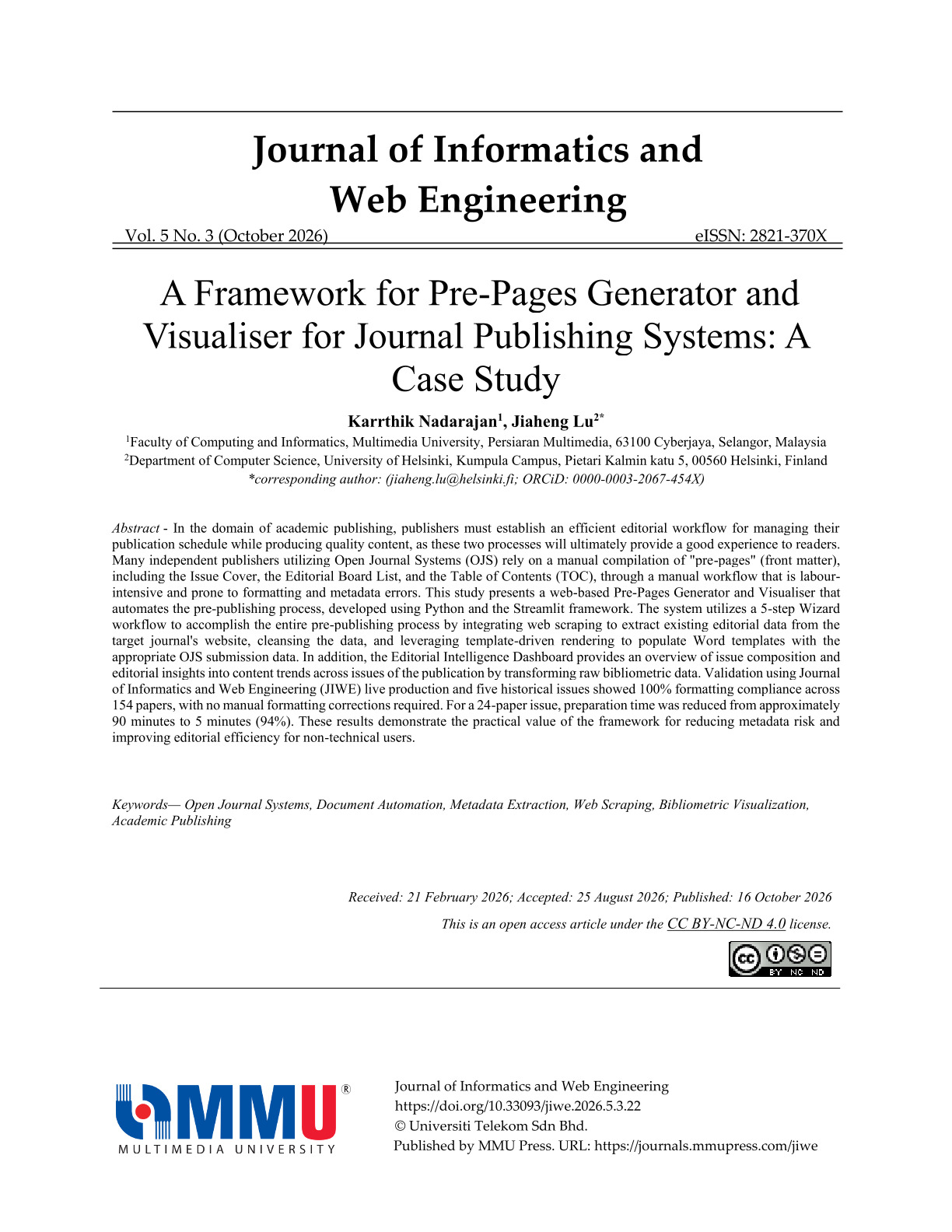
A Framework for Pre-Pages Generator and Visualiser for Journal Publishing Systems: A Case Study
Article Sidebar
Main Article Content
Abstract
In the domain of academic publishing, publishers must establish an efficient editorial workflow for managing their publication schedule while producing quality content, as these two processes will ultimately provide a good experience to readers. Many independent publishers utilizing Open Journal Systems (OJS) rely on a manual compilation of "pre-pages" (front matter), including the Issue Cover, the Editorial Board List, and the Table of Contents, through a manual workflow that is labor-intensive and highly prone to human error, resulting in a product that is inconsistently formatted. Through this project, we have developed a web-based Pre-Pages Generator and Visualiser that automates the pre-publishing process, developed using Python and the Streamlit framework. The application utilizes a 5-step Wizard workflow to accomplish the entire pre-publishing process by integrating web scraping to extract existing editorial data from the target journal's website, cleansing the data, and leveraging template-driven rendering to populate Word templates with the appropriate OJS submission data. In addition, the Editorial Intelligence Dashboard provides an overview of issue composition and editorial insights into content trends across issues of the publication by transforming raw bibliometric data. A prototype of this system was developed in Python and was evaluated using the metadata of the Journal of Informatics and Web Engineering (JIWE) as a validation case study. Empirical output shows an estimated 80% time reduction in document preparation (reducing hours of manual labor to minutes) and a decrease in formatting inconsistencies. The findings suggest that this prototype could help to increase operational efficiency, reduce metadata risk, and improve decision support for non-technical editorial teams.
Article Details

This work is licensed under a Creative Commons Attribution-NonCommercial-NoDerivatives 4.0 International License.
All articles published in JIWE are licensed under a Creative Commons Attribution-NonCommercial-NoDerivatives 4.0 International (CC BY-NC-ND 4.0) License. Readers are allowed to
- Share — copy and redistribute the material in any medium or format under the following conditions:
- Attribution — You must give appropriate credit, provide a link to the license, and indicate if changes were made. You may do so in any reasonable manner, but not in any way that suggests the licensor endorses you or your use;
- NonCommercial — You may not use the material for commercial purposes;
- NoDerivatives — If you remix, transform, or build upon the material, you may not distribute the modified material.




References
[1] P. M. Saugmann, “The precariousness of academic publishing in a digital world,” European Review, vol. 32, no. S1, pp. S75–S91, 2024, doi: 10.1017/s1062798723000613.
[2] L. Cespedes et al., “Evaluating the linguistic coverage of OpenAlex : An assessment of metadata accuracy and completeness,” Journal of the Association for Information Science and Technology, vol. 76, no. 6, pp. 884-895, 2025, doi: 10.1002/asi.24979.
[3] D. Auclair, J. Carmichael, and J. Thibodeau, “Challenges and roadblocks to robust metadata in the scholarly communications industry,” Insights: the UKSG Journal, vol. 37, 2024, doi: 10.1629/uksg.642.
[4] S. Serpa et al., “Future of scholarly publishing: A perspective,” Science Insights, vol. 39, no. 3, 2021, doi: 10.15354/si.21.re239.
[5] S. Baker, “Assessing open source journal management software,” Journal of Electronic Publishing, vol. 23, no. 1, 2020, doi: 10.3998/3336451.0023.101.
[6] R. Kannan and J.-J. Chin, “Backup automation using power automate for Malaysian vaccination centres,” Journal of Informatics and Web Engineering, vol. 1, no. 1, 2022, doi: 10.33093/jiwe.2022.1.1.3.
[7] B. D. Edgar and J. Willinsky, “A survey of the scholarly journals using Open Journal Systems,” OJS pa dansk, vol. 1, no. 1, 2010, doi: 10.7146/ojssb.v1i1.2707.
[8] B. Tabatadze, “Technological aspects of Open Journal Systems (OJS),” Journal of Technical Science and Technologies, vol. 8, no. 1, 2024, doi: 10.31578/jtst.v8i1.151.
[9] M. Farmanbar and P. Kolstrup, “Publishing with Open Journal Systems (OJS): The engaged university and library support at the University of Stavanger,” Septentrio Conference Series, no. 4, 2020, doi: 10.7557/5.5604.
[10] W. A. M. Gregg, C. Erdmann, L. Paglione, J. Schneider, and C. Dean, “A literature review of scholarly communications metadata,” Research Ideas and Outcomes, vol. 5, 2019, doi: 10.3897/rio.5.e38698.
[11] M. Waqas, N. Anjum, and M. T. Afzal, “A hybrid strategy to extract metadata from scholarly articles by utilizing support vector machine and heuristics,” Scientometrics, vol. 128, no. 8, 2023, doi: 10.1007/s11192-023-04774-7.
[12] J. Choi, H. Kong, H. Yoon, H. Oh, and Y. Jung, “LAME: Layout-Aware Metadata Extraction approach for research articles,” Computers, Materials and Continua, vol. 72, no. 2, 2022, doi: 10.32604/cmc.2022.025711.
[13] H. Kim, J. Choi, S. Park, and Y. Jung, “Layout aware semantic element extraction for sustainable science & technology decision support,” Sustainability (Switzerland), vol. 14, no. 5, 2022, doi: 10.3390/su14052802.
[14] F. Ridzuan and W. M. N. Wan Zainon, “A review on data cleansing methods for big data,” in Procedia Computer Science, 2019, doi: 10.1016/j.procs.2019.11.177.
[15] J. Zhu, X. Zhao, Y. Sun, S. Song, and X. Yuan, “Relational data cleaning meets Artificial Intelligence: A survey,” Data Science and Engineering, vol. 10, no. 2, pp. 147–174, 2024, doi: 10.1007/s41019-024-00266-7.
[16] N. Meuschke, A. Jagdale, T. Spinde, J. Mitrovic, and B. Gipp, “A benchmark of PDF information extraction tools using a multi-task and multi-domain evaluation framework for academic documents," in Lecture Notes in Computer Science (including subseries Lecture Notes in Artificial Intelligence and Lecture Notes in Bioinformatics), 2023, doi: 10.1007/978-3-031-28032-0_31.
[17] Z. Boukhers and C. Yang, “MESD: Metadata Extraction from Scholarly Documents- A shared task overview,” 2025. [Online]. Available: https://zeyd.boukhers.com
[18] M. Ahmadi Achachlouei, O. Patil, T. Joshi, and V. N. Nair, “Document automation architectures and technologies: A survey.”
[19] A. Krewinkel and R. Winkler, “Formatting open science: Agilely creating multiple document formats for academic manuscripts with pandoc scholar,” PeerJ Computer Science, vol. 2017, no. 5, 2017, doi: 10.7717/peerj-cs.112.
[20] C. Borchert, R. Cozatl, F. Eichler, A. Hoffmann, and M. Putnings, “Automatic XML extraction from word and formatting of E-Book formats: Insight into the Open Source Academic Publishing Suite (OS-APS),” Publications, vol. 11, no. 1, 2023, doi: 10.3390/publications11010001.
[21] C.-X. Ling, K.-W. Ng, and H. A. Santoso, “Mapping relational database to Full-text XML for Open Journal System cross-platform article distribution,” Journal of Informatics and Web Engineering, vol. 4, no. 3, 2025.
[22] W. M. Lim, S. Kumar, and N. Donthu, “How to combine and clean bibliometric data and use bibliometric tools synergistically: Guidelines using metaverse research,” Journal of Business Research, vol. 182, p. 114760, 2024, doi: 10.1016/j.jbusres.2024.114760.
[23] I. Boschen, "Evaluation of JATSdecoder as an automated text extraction tool for statistical results in scientific reports," Scientific Reports, vol. 11, no. 1, 2021, doi: 10.1038/s41598-021-98782-3.
[24] OJS-Services, “DOCX to JATS XML Converter Plugin,” OJS Services. Accessed: Dec. 05, 2025. [Online]. Available: https://ojs-services.com/ojs-plugins/docx-to-jats-xml-converter-plugin/
[25] Z. Shen, K. Lo, L. L. Wang, B. Kuehl, D. S. Weld, and D. Downey, “VILA: Improving structured content extraction from scientific PDFs using visual layout groups,” Transactions of the Association for Computational Linguistics, vol. 10, pp. 376–392, 2022, doi: 10.1162/tacl_a_00466.
[26] L. Jertec Musap, “Enhancing scientific publishing: automatic conversion to JATS XML,” European Science Editing, vol. 2023, no. 49, 2023, doi: 10.3897/ese.2023.e114977.
[27] Ljiljana Jertec Musap, Drazenko Celjak, Petra Cacic, and Ivan Jelenic, “Enhancing machine-readability in scientific publishing: introducing the JATS XML Converter Service,” OPERAS Innovation Lab. Accessed: Dec. 05, 2025. [Online]. Available: https://lab.operas-eu.org/2024/11/21/enhancing-machine-readability-in-scientific-publishing-introducing-the-jats-xml-converter-service/
[28] V. Pereira, M. P. Basilio, C. Henrique, and T. Santos, “pyBibX: A Python library for bibliometric and scientometric analysis powered with Artificial Intelligence tools," arXiv preprint arXiv:2304.14516, Apr. 2023, doi: 10.48550/arXiv.2304.14516.
[29] M. I. Rizqi, M. Z. Abdullah, and M. A. Hendrawan, "The Development of Meta data Extractor Plugin for Open Journal System," in Proceedings of the International Conference on Applied Science and Technology on Engineering Science 2023 (iCAST-ES 2023), pp. 985–991, 2024, doi: 10.2991/978-94-6463-364-1_90.