
Resonance and Alienation in GenAI-Mediated Learning: A New Media Teacher Education Course Case Study
Article Sidebar
Main Article Content
Abstract
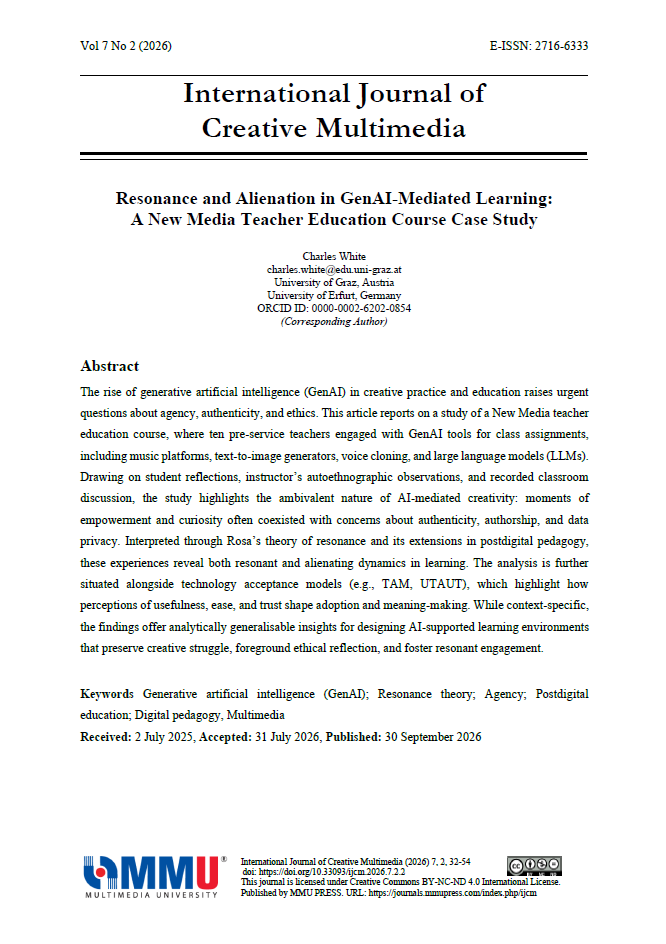
The rise of generative artificial intelligence (GenAI) in creative practice and education raises urgent questions about agency, authenticity, and ethics. This article reports on a study of a New Media teacher education course, where ten pre-service teachers engaged with GenAI tools for class assignments, including music platforms, text-to-image generators, voice cloning, and large language models (LLMs). Drawing on student reflections, instructor’s autoethnographic observations, and recorded classroom discussion, the study highlights the ambivalent nature of AI-mediated creativity: moments of empowerment and curiosity often coexisted with concerns about authenticity, authorship, and data privacy. Interpreted through Rosa’s theory of resonance and its extensions in postdigital pedagogy, these experiences reveal both resonant and alienating dynamics in learning. The analysis is further situated alongside technology acceptance models (e.g., TAM, UTAUT), which highlight how perceptions of usefulness, ease, and trust shape adoption and meaning-making. While context-specific, the findings offer analytically generalisable insights for designing AI-supported learning environments that preserve creative struggle, foreground ethical reflection, and foster resonant engagement.
Article Details

This work is licensed under a Creative Commons Attribution-NonCommercial-NoDerivatives 4.0 International License.



