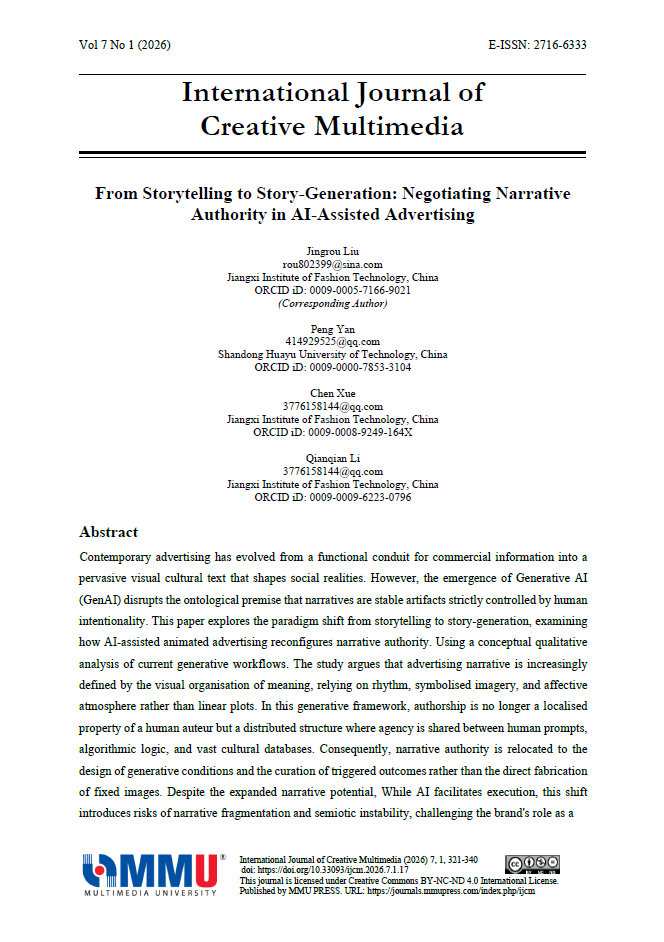
From Storytelling to Story-Generation: Negotiating Narrative Authority in AI-Assisted Advertising
Article Sidebar
Main Article Content
Abstract
Contemporary advertising has evolved from a functional conduit for commercial information into a pervasive visual cultural text that shapes social realities. However, the emergence of Generative AI (GenAI) disrupts the ontological premise that narratives are stable artifacts strictly controlled by human intentionality. This paper explores the paradigm shift from storytelling to story-generation, examining how AI-assisted animated advertising reconfigures narrative authority. Using a conceptual qualitative analysis of current generative workflows. The study argues that advertising narrative is increasingly defined by the visual organisation of meaning, relying on rhythm, symbolised imagery, and affective atmosphere rather than linear plots. In this generative framework, authorship is no longer a localised property of a human auteur but a distributed structure where agency is shared between human prompts, algorithmic logic, and vast cultural databases. Consequently, narrative authority is relocated to the design of generative conditions and the curation of triggered outcomes rather than the direct fabrication of fixed images. Despite the expanded narrative potential, While AI facilitates execution, this shift introduces risks of narrative fragmentation and semiotic instability, challenging the brand's role as a consistent gatekeeper of meaning. The paper concludes that advertising has become a generative visual cultural practice, suggesting that the brand of the future will function as a curator of algorithmic systems. Ultimately, this research provides a framework for understanding how "algorithmic vision" redefines the social imaginary through emergent and variable visual texts.
Article Details

This work is licensed under a Creative Commons Attribution-NonCommercial-NoDerivatives 4.0 International License.