
Leveraging Moodle for Personalised E-Learning: A Framework-Based Analysis of Tools, Resources and Plugins
Article Sidebar
Main Article Content
Abstract
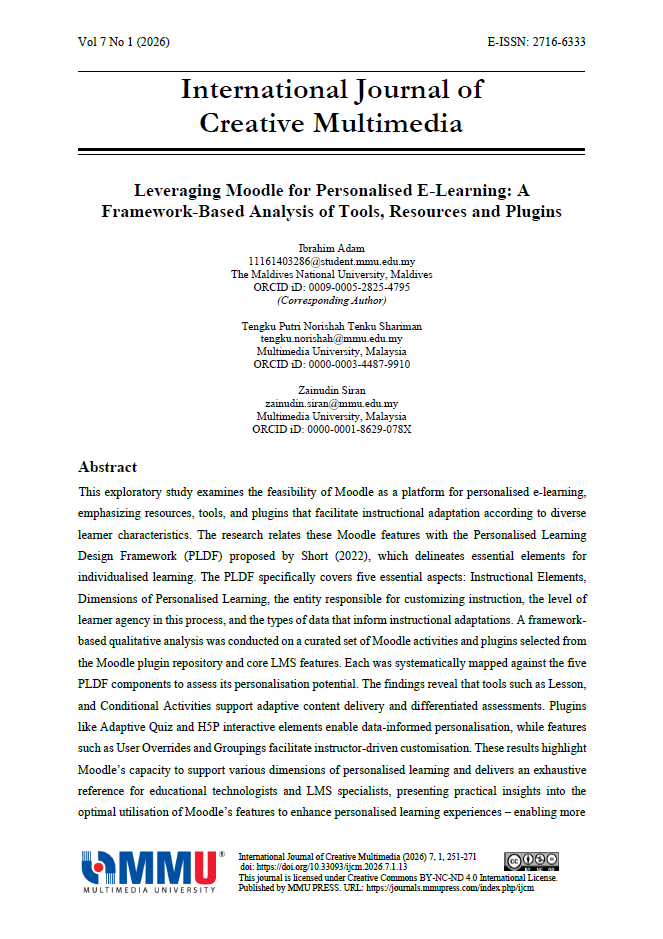
This exploratory study examines the feasibility of Moodle as a platform for personalised e-learning, emphasizing resources, tools, and plugins that facilitate instructional adaptation according to diverse learner characteristics. The research relates these Moodle features with the Personalised Learning Design Framework (PLDF) proposed by Short (2022), which delineates essential elements for individualised learning. The PLDF specifically covers five essential aspects: Instructional Elements, Dimensions of Personalised Learning, the entity responsible for customizing instruction, the level of learner agency in this process, and the types of data that inform instructional adaptations. A framework-based qualitative analysis was conducted on a curated set of Moodle activities and plugins selected from the Moodle plugin repository and core LMS features. Each was systematically mapped against the five PLDF components to assess its personalisation potential. The findings reveal that tools such as Lesson, and Conditional Activities support adaptive content delivery and differentiated assessments. Plugins like Adaptive Quiz and H5P interactive elements enable data-informed personalisation, while features such as User Overrides and Groupings facilitate instructor-driven customisation. These results highlight Moodle’s capacity to support various dimensions of personalised learning and delivers an exhaustive reference for educational technologists and LMS specialists, presenting practical insights into the optimal utilisation of Moodle’s features to enhance personalised learning experiences – enabling more inclusive and learner-centreed educational environments. This paper establishes a basis for the actual execution of personalised learning activities, assisting instructors in customizing instruction to enhance engagement and outcomes for all students.
Article Details

This work is licensed under a Creative Commons Attribution-NonCommercial-NoDerivatives 4.0 International License.