
Virtual Avatars in Digital Heritage: A Systematic Review of Design Evolution and User Experience
Article Sidebar
Main Article Content
Abstract
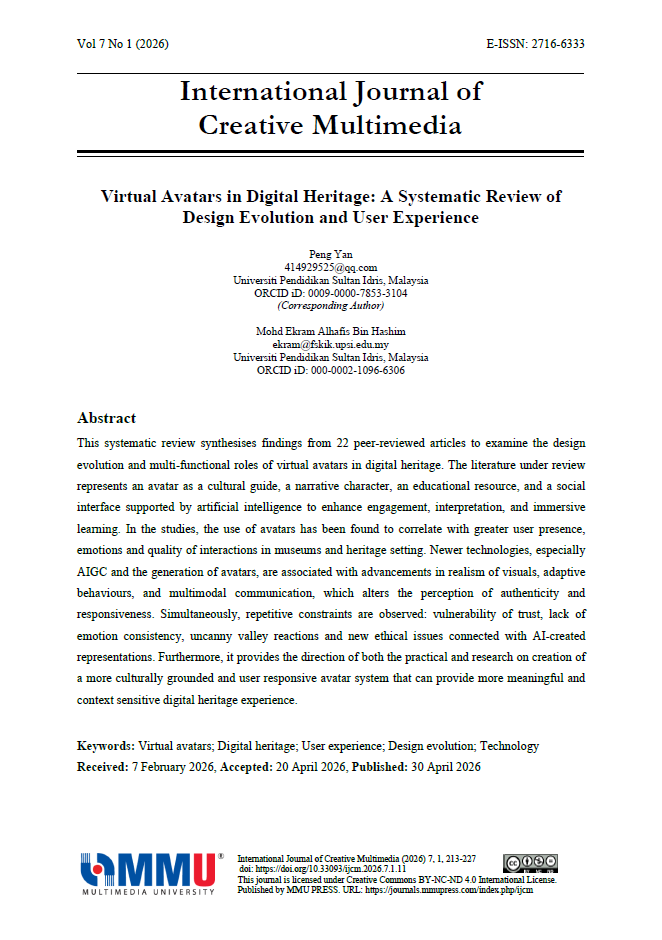
This systematic review synthesises findings from 22 peer-reviewed articles to examine the design evolution and multi-functional roles of virtual avatars in digital heritage. The literature under review represents an avatar as a cultural guide, a narrative character, an educational resource, and a social interface supported by artificial intelligence to enhance engagement, interpretation, and immersive learning. In the studies, the use of avatars has been found to correlate with greater user presence, emotions and quality of interactions in museums and heritage setting. Newer technologies, especially AIGC and the generation of avatars, are associated with advancements in realism of visuals, adaptive behaviours, and multimodal communication, which alters the perception of authenticity and responsiveness. Simultaneously, repetitive constraints are observed: vulnerability of trust, lack of emotion consistency, uncanny valley reactions and new ethical issues connected with AI-created representations. Furthermore, it provides the direction of both the practical and research on creation of a more culturally grounded and user responsive avatar system that can provide more meaningful and context sensitive digital heritage experience.
Article Details

This work is licensed under a Creative Commons Attribution-NonCommercial-NoDerivatives 4.0 International License.